Junte-se a nós em uma viagem ao mundo dos livros!
Adicionar este livro à prateleira
Grey
Deixe um novo comentário Default profile 50px
Grey
Assine para ler o livro completo ou leia as primeiras páginas de graça!
All characters reduced
Awe (with Study Questions) - Why It Matters for Everything We Think Say and Do - cover
LER

Awe (with Study Questions) - Why It Matters for Everything We Think Say and Do

Paul David Tripp

Editora: Crossway

  • 0
  • 0
  • 0

Sinopse

Rediscovering Awe for God and Passion to Lead a Christian Life
Humans are hardwired for awe. Whether it's the Grand Canyon, a beautiful work of art, or the birth of a baby, we love to be amazed. But there's something—or someone, rather—who surpasses all others: God himself. 
Helping us kindle an ever-growing passion for God's glory, this book by popular author Paul David Tripp reminds us of the importance of awe for shaping everything we choose, decide, think, desire, say, and do. Reflecting on how awe for God impacts our approach to spiritual warfare, ministry, material things, and more, Tripp will energize readers' love for God by opening their eyes afresh to the glory of his love, grace, and power. This edition includes a section of engaging study questions for every chapter, helping individuals and groups reflect on each topic in greater depth. 

- Inspiring: Helps readers kindle a passion for living the Christian life and rediscover their awe for God
- Written by Paul David Tripp: Bestselling author of New Morning Mercies; Reactivity; and Lead
- Engaging Study Questions: Reflect on each chapter alone or as part of a small group 
- Replacing ISBN 978-1-4335-4707-2
Disponível desde: 11/02/2025.
Comprimento de impressão: 208 páginas.
Outros livros que poderiam interessá-lo

  • Treasures from the Book of Mormon - Vol 4 - Third Nephi 8 - Moroni 10 - cover

    Treasures from the Book of...

    W. Cleon Skousen

    • 0
    • 0
    • 0
    This four-volume work entitled Treasures from the Book of Mormon, was originally prepared as a university course, but each volume is easy and comfortable to listen to and has therefore proven highly popular with seminary students and those preparing for missions. It is also used extensively as a "Come Follow Me" course of study for adults. This audiobook is a narration of the Book of Mormon along with historical commentary by W. Cleon Skousen, who taught the Book of Mormon at Brigham Young University for many years. The narration of the scriptural verses is by the spiritually compelling voice of Wendell Noble. The four-volume audio commentary covers the entire text of the Book of Mormon and this fourth and final volume covers Third Nephi chapter 8 through Moroni chapter 10. As you listen to these recordings, one or two verses of the Book of Mormon are first narrated by Brother Noble, after which Brother Skousen interjects highlights and doctrine from those verses. By using this Book of Mormon narration with insightful commentary, you can make the Book of Mormon your daily, personal resource.
    Ver livro
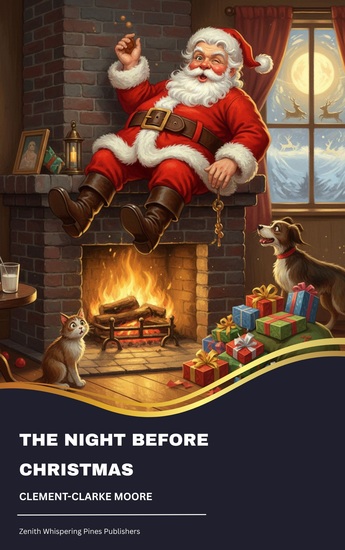
  • The Night Before Christmas - cover

    The Night Before Christmas

    Clement Clarke Moore

    • 0
    • 0
    • 0
    'Twas the night before Christmas—when wonder filled every corner of the home.
    This timeless poem captures the magic of Christmas Eve as St. Nicholas arrives with his sleigh, reindeer, and boundless cheer. With its rhythmic verse, vivid imagery, and warm spirit, the poem brings to life a moment of pure childhood wonder that has shaped Christmas celebrations for generations.
    
    Cherished as "the poem that defined the modern image of Santa Claus," this classic continues to delight readers young and old. Its joyful cadence, cozy charm, and festive heart make it a treasured part of the holiday season.
    
    If you love Christmas traditions, poetic storytelling, and stories that glow with warmth and nostalgia, this beloved poem is a holiday essential.
    
    Open the book—and relive the magic of Christmas Eve, one perfect line at a time.
    Ver livro
  • Hume’s Dialogues Concerning Natural Religion - cover

    Hume’s Dialogues Concerning...

    David Hume

    • 0
    • 0
    • 0
    David Hume’s Dialogues Concerning Natural Religion had not yet been published when he died in 1776. Even though the manuscript was mostly written during the 1750s, it did not appear until 1779. The subject itself was too delicate and controversial, and Hume’s dialectical examination of religious knowledge was especially provocative. What should we teach young people about religion?
     
    The characters Demea, Cleanthes, and Philo passionately present and defend three sharply different answers to that question. Demea opens the dialogue with a position derived from Rene; Descartes and Father Malebranche—God’s nature is a mystery, but God’s existence can be proved logically. Cleanthes attacks that view, both because it leads to mysticism and because it attempts the impossible task of trying to establish existence on the basis pure reason, without appeal to sense experience.
     
    As an alternative, he offers a proof of both God’s existence and God’s nature based on the same kind of scientific reasoning established by Copernicus, Galileo, and Newton. Taking a skeptical approach, Philo presents a series of arguments that question any attempt to use reason as a basis for religious faith. He suggests that human beings might be better off without religion.
     
    The dialogue ends without agreement among the characters, justifying Hume’s choice of dialogue as the literary style for this topic.
    Ver livro
  • Holy Roman Empire’s Conflicts with the Vatican The: The History of the Medieval Wars that Fractured Germany and Italy - cover

    Holy Roman Empire’s Conflicts...

    Charles River Editors

    • 0
    • 0
    • 0
    It has been famously pointed out that the Holy Roman Empire was neither holy, nor Roman, but it was also not an empire in the sense people expect when hearing the term. In theory, the emperor was the highest prince in Christendom, and his dominion extended the length and breadth of Western Europe. The empire had been created by the papacy in 801 when Pope Leo the Third famously crowned the supposedly unwitting Charlemagne in Saint Peter’s Basilica, intending to recreate the Western Roman Empire. In truth, the imperial power did not extend beyond central Europe, which by the beginning of the 16th century included Germany, northern Italy, and the Netherlands. Even in these lands, however, the emperor struggled to command obedience. His dominion over northern Italy was theoretical only, the cities of the Netherlands were deeply conscious of their ancient rights and privileges, and Germany had long ceased to be compliant. The latter had become a collection of principalities, dukedoms and bishoprics which vied with each other and pursued their own agendas. They were, however, united in only one sense: denying the emperor power and resisting attempts to centralize the government.  
    	At the same time, the secular sovereigns frequently butted heads with religious authorities back in Rome, and arguably none of the conflicts were as crucial as the War of the Keys and the Investiture Controversy. The tensions between the Holy Roman Empire and Church over the power to invest bishops with authority led to decades of civil war in Germany on the way to establishing the relationship between Church and state, elevating the status of the papacy and weakening the Holy Roman Empire. What is crucial in understanding the conflicts is to not view them with the benefit of hindsight. Most importantly, no nation as people recognize it today yet existed, as England, France, Germany, and Italy were largely geographical expressions, not national identities.
    Ver livro
  • The Dog Who Wanted to Play - cover

    The Dog Who Wanted to Play

    Fred Ash

    • 0
    • 0
    • 0
    Dog had big teeth and sharp claws. His bark was like thunder. 
    Tommy was afraid and ran away. Dog ran faster. 
    A story for everyone who has ever been afraid of the unknown. 
    Ver livro
  • The Founding - cover

    The Founding

    Michael L. Ross

    • 0
    • 0
    • 0
    Two men, two dreams, two new towns on the plains, and a railroad that will determine whether the towns—one black, one white—live or die.  
     Will Crump has survived the Civil War, Red Cloud’s War, and the loss of his love, but the search for peace still eludes him. From Colorado, famed Texas Ranger Charlie Goodnight lures Will to Texas, where he finds new love, but can love between a sharpshooter and a Quaker survive? Will has a chance to join in founding a new town, and risks everything—his savings, his family, and his life—but it will all be for nothing if the new railroad passes them by. 
     Luther has escaped slavery in Kentucky through Albinia, Will’s sister, only to find prejudice rearing its ugly head in Indiana. When the Black Codes are passed, he’s forced to leave and begin a new odyssey. Where can he and his family go to be truly free? Can they start a town owned by blacks, run by blacks, with no one to answer to? Their success depends on the almighty railroad and overcoming bigotry to prove their town deserves the chance to thrive. 
     Will’s eldest sister, Julia, and her husband, Hiram, are watching the demise of their steamboat business and jump into railroads, but there’s a long black shadow in the form of Jay Gould, the robber baron who ruthlessly swallows any business he considers competition. Can Julia fight the rules against women in business, dodge Gould, and hold her marriage together? 
     The Founding tells the little-known story of the Exodusters and Nicodemus, the black town on the plains of Kansas, and the parallel story of Will’s founding of Lubbock, Texas, against the background of railroad expansion in America. A family reunited, new love discovered, the quest for freedom, the rise of two towns. In the end, can they reach Across the Great Divide? The Founding is the exciting conclusion to the series.
    Ver livro