¡Acompáñanos a viajar por el mundo de los libros!
Añadir este libro a la estantería
Grey
Escribe un nuevo comentario Default profile 50px
Grey
Suscríbete para leer el libro completo o lee las primeras páginas gratis.
All characters reduced
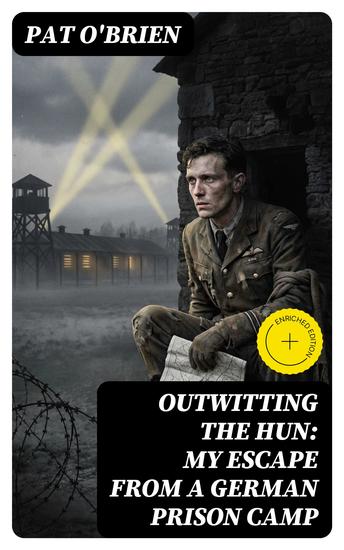
Outwitting the Hun: My Escape from a German Prison Camp - Enriched edition - cover

Outwitting the Hun: My Escape from a German Prison Camp - Enriched edition

Pat O'Brien

Editorial: DigiCat

  • 0
  • 0
  • 0

Sinopsis

In "Outwitting the Hun: My Escape from a German Prison Camp," Pat O'Brien presents a riveting first-hand account of his harrowing experiences as a prisoner during World War I. This memoir is characterized by its vivid prose and gripping narrative style, capturing the emotional and psychological toll of captivity. O'Brien's storytelling weaves together themes of resilience, camaraderie, and the indomitable human spirit, highlighting not only the brutality of war but also the ingenuity of those who seek to reclaim their freedom. Situated within the broader context of wartime memoirs, O'Brien's account stands out for its detailed observations and a palpable sense of urgency as he recounts the odyssey of his escape from the clutches of the German military. Pat O'Brien, a decorated veteran of World War I, draws from his own life experiences as a soldier and prisoner, lending authenticity and authority to his narrative. His background as a commissioned officer deeply informs his perspectives on honor, sacrifice, and the psychological battles fought both during and after the war. Through this memoir, he not only sheds light on his personal journey but also pays homage to the countless individuals who endured similar fates. This evocative memoir is highly recommended for readers interested in military history, personal resilience, and the intricacies of human relationships under duress. O'Brien's eloquent prose and compelling storytelling will resonate with anyone drawn to tales of survival and ingenuity in the face of overwhelming odds.

In this enriched edition, we have carefully created added value for your reading experience:
- Hand‐picked Memorable Quotes shine a spotlight on moments of literary brilliance.
- Interactive footnotes clarify unusual references, historical allusions, and archaic phrases for an effortless, more informed read.
Disponible desde: 28/05/2022.
Longitud de impresión: 133 páginas.

Otros libros que te pueden interesar

  • The Power of Your Subconscious Mind - cover

    The Power of Your Subconscious Mind

    Joseph Murphy

    • 0
    • 0
    • 0
    In The Power of Your Subconscious Mind, Dr. Joseph Murphy gives you the tools you will need to unlock the awesome powers of your subconscious mind. You can improve your relationships, your finances, your physical well-being. Once you learn how to use this unbelievably powerful force there is nothing you will not be able to accomplish. Join the millions of people who have already unlocked the power of their subconscious minds. I urge you to study this book and apply the techniques outlined therein; and as you do, I feel absolutely convinced that you will lay hold of a miracle-working power that will lift you up from confusion, misery, melancholy, and failure, and guide you to your true place, solve your difficulties, sever you from emotional and physical bondage, and place you on the royal road to freedom, happiness, and peace of mind.- Dr. Joseph Murphy
    Ver libro
  • Assassinated Presidents The: The Lives and Deaths of Abraham Lincoln James Garfield William McKinley and John F Kennedy - cover

    Assassinated Presidents The: The...

    Editors Charles River

    • 0
    • 0
    • 0
    Until April 14, 1865, John Wilkes Booth was one of the most famous actors of his time, and President Abraham Lincoln had even watched him perform. But his most significant performance at a theater did not take place on the stage. That night, Booth became one of history’s most infamous assassins when he assassinated President Lincoln at Ford's Theatre in Washington, D.C. 
    	In 1880, Garfield ran as a Republican for president, and one of his supporters was a man named Charles Guiteau, who wrote and circulated a speech called “Garfield vs. Hancock” that aimed to rally support for the Republican candidate. Though few knew it, Guiteau’s family had already deemed him insane and attempted to keep him committed in an asylum, only to have him manage an escape from confinement. Garfield went on to narrowly edge Winfield Scott Hancock in the election, and Guiteau, harboring delusions of grandeur, believed he had helped tip the scales in Garfield’s favor.  
    President James Garfield had been assassinated just 20 years earlier, but McKinley didn’t worry about presidential security or his own safety, and that was the case in Buffalo. McKinley’s insistence on greeting the public and shaking hands allowed Czolgosz to walk up to him on September 6, 1901 at a public reception in the Temple of Music on the expo grounds and shoot him point blank, with one bullet grazing the president and another lodging in his abdomen.  
    In many ways, John Fitzgerald Kennedy and his young family were the perfect embodiment of the ‘60s. The decade began with a sense of idealism, personified by the attractive Kennedy, his beautiful and fashionable wife Jackie, and his young children. Months into his presidency, Kennedy exhorted the country to reach for the stars, calling upon the nation to send a man to the Moon and back by the end of the decade. But the idealism and optimism of the decade was quickly shattered, starting with Kennedy’s assassination in 1963. 
    Ver libro
  • Still Pictures - On Photography and Memory - cover

    Still Pictures - On Photography...

    Janet Malcolm, Anne Malcom, Ian...

    • 0
    • 0
    • 0
    For decades, Janet Malcolm's books and dispatches for the New Yorker and the New York Review of Books poked and prodded at reportorial and biographical convention, gesturing toward the artifice that underpins both public and private selves. In Still Pictures, she turns her gimlet eye on her own life—a task demanding a writer just as peerlessly skillful as she was widely known to be. 


    Still Pictures, then, is not the story of a life but an event on its own terms, an encounter with identity and family photographs as poignant and original as anything since Roland Barthes's Camera Lucida. Malcolm looks beyond the content of the image and the easy seductions of self-recognition, constructing a memoir from memories that pose questions of their own. 


    Still Pictures begins with the image of a morose young girl on a train, leaving Prague for New York at the age of five in 1939. From her fitful early loves, to evenings at the old Metropolitan Opera House, to her fascination with what it might mean to be a "bad girl," Malcolm assembles a composite portrait of a New York childhood, one that never escapes the tug of Europe and the mysteries of fate and family. Later, Still Pictures delves into her marriage to Gardner Botsford, the world of William Shawn's New Yorker, and the libel trial that led Malcolm to become a character in her own drama.
    Ver libro
  • Smugglers' Times: - Smuggling In The Days Of Marijuana Prohibition - cover

    Smugglers' Times: - Smuggling In...

    M. Dennis Taylor

    • 0
    • 0
    • 0
    Life, With A History Of Smuggling. 
    ISLAMORADA, Florida, With Keys Don -- "Marijuana is a people business," explained Don, a long-retired pioneer of the marijuana smuggling industry, who flew single-engine planes back and forth to Colombia, carrying up to a million dollars-worth of pot per load, in today's money. 
    He brought marijuana through the Florida Keys, an area with thousands of places to hide, that's been a haven for smugglers since the times of the Spanish Main up until sometime late last night. Later he and his friends used boats and vehicles and expanded connections throughout the states, Mexico and the Philippines, even working with Federal Agents. 
    "I'll tell you about the life of a smuggler," said Don. "When marijuana is legal, we will be like the rum runners during prohibition and people might be interested in how it was in Smugglers' Times.
    Ver libro
  • The Matryoshka Memoirs - A Story of Ukrainian Forced Labour the Leica Camera Factory and Nazi Resistance - cover

    The Matryoshka Memoirs - A Story...

    Sasha Colby

    • 0
    • 0
    • 0
    Irina Nikifortchuk was nineteen years old and a Ukrainian schoolteacher when she was abducted to be a forced laborer in the Leica camera factory in Nazi Germany. Eventually pulled from the camp hospital to work as a domestic in the Leica owners' household, Irina survived the war and eventually found her way to Canada. 


    Decades later Sasha Colby, Irina's granddaughter, seeks out her grandmother's story over a series of summer visits and gradually begins to interweave the as-told-to story with historical research. As she delves deeper into the history of the Leica factory and World War II forced labor, she discovers the parallel story of Elsie Kühn-Leitz, Irina's rescuer and the factory heiress, later imprisoned and interrogated by the Gestapo on charges of "excessive humanity." 


    This is creative nonfiction at its best as the mystery of Irina's life unspools skillfully and arrestingly. Despite the horrors that the story must tell, it is full of life, humor, food, and the joy of ordinary safety in Canada. The Matryoshka Memoirs takes us into a forgotten corner of history, weaving a rich and satisfying tapestry of survival and family ties and asking what we owe those who aid us.
    Ver libro
  • The Secret History - cover

    The Secret History

    Procopius

    • 0
    • 0
    • 0
    A scandalous and vengeful cult favorite of the Byzantine Empire.
     
    Procopius held a position of esteem in Justinian’s empire as an advisor to the military commander Belisarius. He even wrote the official histories of Justinian’s military conquests, lauding both the emperor and his commander. But secretly… Procopius hated them both, so he wrote Anecdota, later known as Secret History, in private.
     
    Published a thousand years after it was written, Secret History labels Justinian as a demonic figure and a despot and takes huge shots at him, Belisarius, and both of their wives, Theodora and Antonina. This book was suppressed and hidden for hundreds of years because of its capacity to throw the whole empire into disarray, but it was eventually found in its full form in the Vatican Library and then published in 1623.
     
    Filled with explosive revelations and the smart and sardonic voice of Procopius, Secret History will appeal equally to armchair historians and those just looking for a Byzantine way to throw an insult.
    Ver libro