¡Acompáñanos a viajar por el mundo de los libros!
Añadir este libro a la estantería
Grey
Escribe un nuevo comentario Default profile 50px
Grey
Suscríbete para leer el libro completo o lee las primeras páginas gratis.
All characters reduced
The Transformational Bureaucracy - cover

The Transformational Bureaucracy

Pasquale De Marco

Editorial: Publishdrive

  • 0
  • 0
  • 0

Sinopsis

In a world facing unprecedented challenges, from climate change to economic inequality, the need for effective and efficient government has never been greater. Yet, many bureaucracies are struggling to keep up with the demands of the 21st century. They are often seen as slow, unresponsive, and inefficient. They are also often unable to adapt to changing circumstances or to implement new ideas.

But there is a better way. Transformational bureaucracies are a new type of bureaucracy that is designed to be flexible, adaptive, and innovative. They are able to respond quickly to changing needs, and they are constantly looking for new and better ways to serve the public.

This book provides a comprehensive overview of transformational bureaucracies. It explores the key elements of these bureaucracies and shows how they are able to overcome the challenges that traditional bureaucracies face. It also provides real-world examples of transformational bureaucracies that are making a difference in the lives of their citizens.

Readers will learn about the role of leadership in transformational bureaucracies, the importance of engaging stakeholders, and the need for process improvement and innovation. They will also learn about the importance of performance measurement and accountability.

By the end of this book, readers will have a clear understanding of what transformational bureaucracies are and how they can be used to improve the performance of government. They will also be inspired by the stories of real-world bureaucracies that are making a difference in the lives of their citizens.

This book is essential reading for anyone who wants to understand the future of government. It is also a valuable resource for practitioners who are working to improve the performance of bureaucracies.


If you like this book, write a review!
Disponible desde: 02/06/2025.
Longitud de impresión: 165 páginas.


Otros libros que te pueden interesar

  • A Rare Recording of Elie Wiesel’s Nobel Peace Prize Acceptance Speech - cover

    A Rare Recording of Elie...

    Elie Wiesel

    • 0
    • 0
    • 0
    Eliezer "Elie" Wiesel (September 30, 1928 to July 2, 2016) was a Romanian-born American writer, professor, political activist, Nobel laureate, and Holocaust survivor. He authored 57 books, written mostly in French and English, including Night, a work based on his experiences as a Jewish prisoner in the Auschwitz and Buchenwald concentration camps. In 1986, Wiesel was awarded the Nobel Peace Prize for being a messenger to mankind: his message is one of peace, atonement and dignity.
    Ver libro
  • Tales From Tipperary - cover

    Tales From Tipperary

    Edward Forde Hickey

    • 0
    • 0
    • 0
    Full of amusement, this series of fictional tales starts with a Galwayman’s arrival in Tipperary’s post-famine days and portrays the daily lives of a hillside community.  
    Written in the colloquial and lyrical language of some of our ancestors, it tells – amongst others – such diverse stories as the reliance of families on children rabbit-poaching, on the pre-dawn cattle-droving days of a young school-leaver, the re-appearance of a dead girl to her newly-born sister… along with a number of love-hate incidents, like the townie scorn for a mountainy man at the show-fair, before he walks off with the big trophy!
    Ver libro
  • The Creatures Time Forgot - cover

    The Creatures Time Forgot

    Ray Bradbury

    • 0
    • 0
    • 0
    In "The Creatures Time Forgot," Ray Bradbury weaves a poignant and imaginative tale that explores the themes of nostalgia, memory, and the inexorable passage of time. The story follows the protagonist, who embarks on a journey back to a forgotten world, where ancient creatures and lost wonders linger in the recesses of his mind.
    As the narrative unfolds, the protagonist reflects on his childhood and the vivid, fantastical memories that shaped his perception of reality. Through a series of rich and evocative descriptions, Bradbury captures the essence of a bygone era, invoking a sense of longing for the innocence and wonder of youth. The creatures of the past symbolize not only the innocence lost but also the enduring power of imagination and the impact of memories that remain etched in our hearts.
    Bradbury's lyrical prose draws readers into a world where the boundaries between reality and dreams blur, and where the creatures of our past serve as reminders of the beauty and fragility of life. The story invites readers to confront their own memories and consider how they shape our present and future.
    "The Creatures Time Forgot" is a testament to Bradbury's mastery of storytelling, revealing his ability to evoke deep emotions and provoke thoughtful reflections on the nature of existence. This tale resonates with anyone who has ever looked back at their past with a sense of wonder and nostalgia, making it a memorable and impactful reading experience.
    Ver libro
  • Prussia - History of the Prominent German State - cover

    Prussia - History of the...

    Kelly Mass

    • 0
    • 0
    • 0
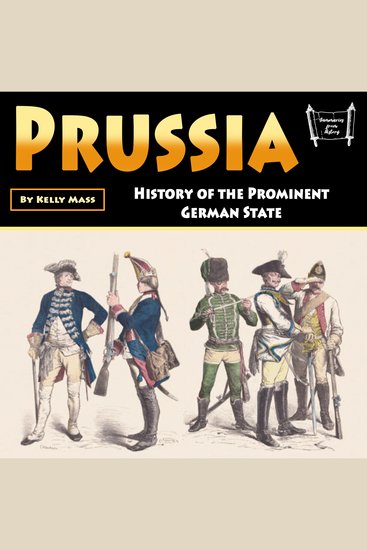
    Prussia, once a powerful and influential German state, traces its origins back to 1525, when it began as a duchy focused on the region near the southeast coast of the Baltic Sea. Over the centuries, it would grow to play a pivotal role in European history, especially through its military and political influence. Prussia was formally dissolved in 1947 by a decision from the Allies, though its disbandment began much earlier in 1932 when German Chancellor Franz von Papen issued an emergency order transferring the powers of the Prussian government to the central state. The state had been slowly losing its autonomy for years before that, following the turbulent events of the early 20th century. 
    At the height of its power, Prussia was ruled by the House of Hohenzollern, a royal family that presided over its expansive territories and built a military machine renowned for its discipline and effectiveness. Prussia's capital was initially Königsberg, but in 1701, it became Berlin when Prussia elevated itself to the status of a kingdom. Over the years, the Kingdom of Prussia became a major player in European affairs, with its well-organized army enabling it to extend its borders and influence across the continent.
    Ver libro
  • The Right to Oblivion - Privacy and the Good Life - cover

    The Right to Oblivion - Privacy...

    Lowry Pressly

    • 0
    • 0
    • 0
    We are able to configure privacy settings on our devices and social media platforms, but we know our efforts pale in comparison to the scale of surveillance capitalism and algorithmic manipulation. In our hyperconnected era, many have begun to wonder whether it is still possible to live a private life, or whether it is no longer worth fighting for. 


    The Right to Oblivion argues incisively and persuasively that we still can and should strive for privacy, though for different reasons than we might think. Recent years have seen heated debate in the realm of law and technology about why privacy matters, often focusing on how personal data breaches amount to violations of individual freedom. In a novel philosophical account, Pressly insists that privacy isn't simply a right to be protected but a tool for making life meaningful. 


    Privacy deepens our relationships with others as well as ourselves, reinforcing our capacities for agency, trust, play, self-discovery, and growth. Without privacy, the world would grow shallow, lonely, and inhospitable. Drawing inspiration from the likes of Hannah Arendt, Jorge Luis Borges, and a range of contemporary artists, Pressly shows why we all need a refuge from the world: not a place to hide, but a psychic space beyond the confines of a digital world in which the individual is treated as mere data.
    Ver libro
  • Air Raids Over Japan during World War II The: The History of the Allies’ Bombing Campaigns on the Japanese Mainland - cover

    Air Raids Over Japan during...

    Editors Charles River

    • 0
    • 0
    • 0
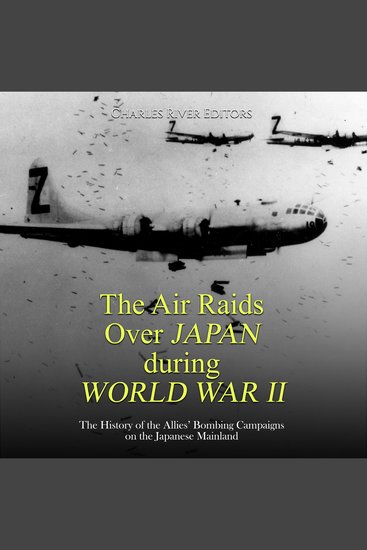
    The Americans would turn the war in the Pacific around in the middle of 1942, but in the wake of Pearl Harbor and the Japanese invasion of the Philippines, the country was in desperate need of a morale boost, and it would come in the form of the Doolittle Raid. In part to show that the Japanese were not invincible, and in part to reassure the American public that the nation would not lose the war, the Doolittle Raid included both Army and Navy units that launched 16 land-based medium bombers from an aircraft carrier, a feat that was the first of its kind but also one involving a great deal of risk. Getting the bombers and carriers in place to execute the mission involved much strategic planning and cooperation within the American military, and had it failed, it could have dealt a serious blow to the Americans’ Pacific presence due to the nation’s limited resources in that theater. 
    The first serious air raids over Japan came in November 1944, after the Americans had captured the Marianas Islands, and through February 1945, American bombers concentrated on military targets at the fringes of the city, particularly air defenses. However, the air raids of March 1945, and particularly on the night of March 9, were a different story altogether. In what is generally referred to as strategic or area bombing, waves of bombers flew low over Tokyo for over two and a half hours, dropping incendiary bombs with the intention of producing a massive firestorm. The American raids intended to produce fires that would kill soldiers and civilians, as well as the munitions factories and apartment buildings of those who worked in them. 325 B-29s headed toward Tokyo, and nearly 300 of them dropped bombs on it. Additional raids, this time largely on the north and west, came in April, and in May, raids hit Ginza and the south. Altogether, American bombers flew more than 4,000 missions over Tokyo before surrender.
    Ver libro