Rejoignez-nous pour un voyage dans le monde des livres!
Ajouter ce livre à l'électronique
Grey
Ecrivez un nouveau commentaire Default profile 50px
Grey
Abonnez-vous pour lire le livre complet ou lisez les premières pages gratuitement!
All characters reduced
The French Crowns - cover

The French Crowns

Pasquale De Marco

Maison d'édition: Publishdrive

  • 0
  • 0
  • 0

Synopsis

The Bourbon dynasty is one of the most fascinating and enduring in European history. For over two centuries, the Bourbons ruled France, leaving an indelible mark on the country's culture, politics, and society. From the dashing Henri IV to the ill-fated Louis XVI, the Bourbon kings presided over a period of both glory and turmoil, shaping the course of French history.

This book tells the captivating story of the Bourbon dynasty, from its humble origins to its eventual fall. Meet the colorful characters who inhabited the royal court, from ambitious queens to scheming cardinals. Witness the rise and fall of empires, the clash of armies, and the birth of new ideas.

The Bourbons were a family of contradictions. They were both pious and libertine, both powerful and vulnerable. They were capable of great cruelty and great kindness. They were beloved by their subjects and despised by their enemies. Through it all, they remained steadfast in their belief in their divine right to rule.

The Bourbon dynasty came to an end in 1830, but its legacy continues to this day. The Bourbons left behind a rich cultural heritage that can still be seen in the palaces, gardens, and museums of France. They also left behind a political legacy that is still debated today. Were the Bourbons enlightened despots or tyrannical oppressors? Were they the saviors of France or its destroyers?

This book explores the many sides of the Bourbon dynasty, providing a deeper understanding of this fascinating chapter in French history. It is a story of ambition, intrigue, love, and betrayal that will captivate and inspire readers for generations to come.

Discover the Bourbon dynasty's lasting impact on France and Europe, and gain insights into the strengths and weaknesses of absolute monarchy. This book is a must-read for anyone interested in French history, European history, or the history of monarchy.


If you like this book, write a review!
Disponible depuis: 02/06/2025.
Longueur d'impression: 162 pages.

D'autres livres qui pourraient vous intéresser

  • Surviving Three Shermans - With the 3rd Armored Division into the Battle of the Bulge: What I Didn’t Tell Mother About My War - cover

    Surviving Three Shermans - With...

    Walter Boston Stitt Jr.

    • 0
    • 0
    • 0
    In 1943, eighteen-year-old Walter Stitt enlisted in the US Army, ready to serve his country. From his time in basic training at Fort Polk in Louisiana, throughout his time as a tank gunner in the 33rd Armored Regiment, to his post-injury service in England, he wrote home to the family he had left at home. 


    Unbeknown to him, his mother carefully numbered and saved the letters, treasuring them until her death. This book brings together the very different two versions of Walter's war: the version that a teenage soldier could reveal to his parents and younger siblings without scaring them or invoking the censor's pen, and the full and often terrifying details of serving as a tank loader and gunner in France, Belgium, and Germany, remembered so clearly eighty years later. Walter explains the forced omissions and partial truths his teenage self offered to comfort his family while he survived the destruction of three Sherman tanks, the death of three crew members, and two wounds. 


    Coming from West Virginia, Walter's Appalachian roots and values are apparent through the memories he held dear as a soldier and the values he clung to while fighting in one of the darkest periods of human history. His memoir recounts his experiences of serving during World War II while honoring those who served and made the ultimate sacrifice.
    Voir livre
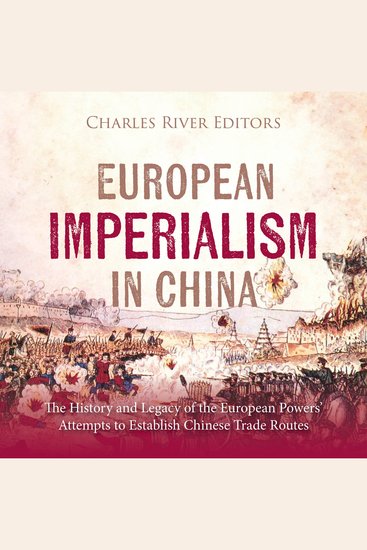
  • European Imperialism in China: The History and Legacy of the European Powers’ Attempts to Establish Chinese Trade Routes - cover

    European Imperialism in China:...

    Editors Charles River

    • 0
    • 0
    • 0
    During the 15th century, China had become economically and technologically advanced compared to civilizations in Europe at the time, and its fleet, which had reached a total of 3,500 ships, was unmatched by any other world power. Nevertheless, after conducting several trade expeditions with the massive fleet, the Chinese ships were either burned in the docks or left to rot. With that, China began to revert to the xenophobic policies of its past and reduce its presence in other lands. By 1525, the largest naval fleet in the world had essentially been destroyed or dismantled by China itself.  
    While China was in the process of isolating itself from the rest of the world, the European explorers were beginning to discover new lands, such as North America and South America. Among the countries doing the most exploring during this time were the Portuguese. The Portuguese had reached India in 1498, and by 1509 they had established part of their empire in India. This allowed the Portuguese to have a base of operations to further expand east into Asia. In 1511, the Portuguese captured the large spice trading center of Malacca in Malaysia, and like their base in India, Malacca allowed the Portuguese to have a foothold, thereby providing access to China and Southeast Asia. 
    The location of Macau was beneficial and strategically chosen by the Portuguese, as it was in close communication with Guangzhou and connected via a river system. In contrast to their earlier dealings with the Chinese, the Portuguese attempted to appear more humble and comply with the wishes of the Chinese rather than with force. As it turned out, the policy, in conjunction with increased European activities in the region, would help the Portuguese Empire hold on to Macau even as its fortunes dwindled everywhere else across the world.
    Voir livre
  • Philosophia Ultima - The Upanishadic Universal Vision of Totality - cover

    Philosophia Ultima - The...

    Osho

    • 0
    • 0
    • 0
    These talks contain what Osho describes as the most significant statements ever made, which point to the whole secret of the mystic approach toward life. And the sutra that begins this series of discourses, he says, contains the very essence of the entire Upanishadic vision - that the universe is an indivisible totality, an organic whole.
    Osho illuminates these ancient texts with such clarity that their significance seems stunningly obvious. A wealth of jokes and amusing anecdotes are magically interwoven through his commentaries.
    1. The Alternative to the Family
    2. Truth Has to Be Assertive
    3. The Pure Self Alone
    4. You Transcend Duality
    5. Make the World as Rich as Possible
    6. Aloneness Comes Out of Awareness
    7. Silently Blissful, Blissfully Silent
    8. A Challenge to My Love
    9. Ego Is Just a Habit
    10. Money is a Beautiful Means
    11. This is the Ultimate Philosophy
    12. Wholeness: A Single Word Contains the Upanishad
    13. Truth as It Is – Naked
    14. Totally Immersed in This Moment
    © & ℗ 1980 OSHO International Foundation
    Voir livre
  • Making of Modern China The: The History of the World’s Most Populous Country from the Qing Dynasty to Today - cover

    Making of Modern China The: The...

    Charles River Editors

    • 0
    • 0
    • 0
    During the 15th century, China had become economically and technologically advanced compared to civilizations in Europe at the time, and its fleet, which had reached a total of 3,500 ships, was unmatched by any other world power. Nevertheless, after conducting several trade expeditions with the massive fleet, the Chinese ships were either burned in the docks or left to rot. With that, China began to revert to the xenophobic policies of its past and reduce its presence in other lands. By 1525, the largest naval fleet in the world had essentially been destroyed or dismantled by China itself.  
    	Meanwhile, the 19th century saw the rise of one of the largest, most powerful empires of the modern era. The sun never set on the British Empire, whose holdings spanned the globe, in one form or another. Its naval supremacy linked the Commonwealth of Canada with the colonies in South Africa and India, and through them trade flowed east and west. An integral but underutilized part of this vast trade network included China, a reclusive Asian kingdom closed off from the Western world that desired none of its goods. 
    	Unfortunately for China, the British had the might of an empire and economic force, not to mention modern arms, on their side. Breaking into China’s lucrative trade markets nearly destroyed the nation, severely discredited the Chinese dynasty, wreaked havoc on its people, and further propelled Britain’s empire into a dominant economic and military position. 
    	The collision of these two empires took many years and caused much bloodshed. In fact, the troubles started well before the eventual hostilities, festering as frustration mounted until finally boiling over. Such was the state of relations between the British Empire and Qing Dynasty for the better part of the century, its footing upended from the very start of relations.
    Voir livre
  • The Holy Trinity - cover

    The Holy Trinity

    Prana Govinda Das

    • 0
    • 0
    • 0
    Noted internationally known Self-help advocate and teacher of devotional yoga Prana Govinda Das was born in Liverpool, England in 1968 admittedly a pretty good year for all things bright and beautiful. He says, "From as early as I can remember I had a unquenchable thirst for knowledge, and a desire to understand the true nature of man and this world we live in. I was also always seeking out people who could answer all the questions I had about life, the universe and everything." After studying film production in the early nineties Prana was able to fulfill his lifelong desire to travel to India. admittedly his first trip changed his life completely and forever. "At that point," He recalls, "my thirst for material knowledge turned to desire to understand the spiritual side of life. For the next six years I returned frequently to, where I studied many different paths of Hinduism, Buddhism and other forms of yoga and meditation. However, even after learning and experiencing so much I was still left incomplete." in 2001 during the young man's sixth trip to India, he travelled to Vrindavan, a holy town associated with Lord Krishna south of Delhi. It was there he met his spiritual guide, and mentor Srila Bhaktivedanta Naryana Goswami. Some twenty years on, Prana has been resident in his teacher's temples all over the world, particularly India, Australia, America, and Europe. Welcome then to the inspirational, engrossing, all-inclusive teachings of Prana Govinda Das.
    Voir livre
  • On the Cannibals - cover

    On the Cannibals

    Michel de Montagrie

    • 0
    • 0
    • 0
    'I am not sorry we note the barbarous horror of cannibalism, but grieved that, prying so narrowly into their faults, we are so blinded in ours.'
    
    First translated into English in 1603, 'On the Cannibals' is an essay reflecting on a remarkable trip to Brazil which Michel de Montaigne undertook at the end of the sixteenth century.
    
    A study into the customs and practices of indigenous peoples in the Americas, Montaigne delves into the concept of 'civilisation', contrasting the behaviour of so-called 'barbarians' with Western society. He challenges the idea that European values are superior, understanding the practices of the Tupinambá people and arguing that the horrors inflicted by the soldiers of Portugal on their enemies at the time are – in many ways – far worse. It remains a persuasive and compelling argument for cultural relativism. This audiobook edition is expertly narrated by Malk Williams.
    Michael de Montaigne (1533 – 1592) was a French philosopher and writer, and a significant figure in the French Renaissance. He is widely known for popularising the essay, amalgamating anecdotes with memoir and intellect. He has been a huge influence on several Western writers, including William Shakespeare.
    Voir livre