¡Acompáñanos a viajar por el mundo de los libros!
Añadir este libro a la estantería
Grey
Escribe un nuevo comentario Default profile 50px
Grey
Suscríbete para leer el libro completo o lee las primeras páginas gratis.
All characters reduced
The Fragile Civic Identity - cover

The Fragile Civic Identity

Pasquale De Marco

Editorial: Publishdrive

  • 0
  • 0
  • 0

Sinopsis

In an era of increasing division and polarization, it is more important than ever to understand and strengthen our civic identity. Civic identity is the sense of belonging and connection that individuals feel to their community and nation. It is shaped by a variety of factors, including shared history, culture, values, and institutions.

A strong civic identity is essential for a healthy and vibrant democracy. It is the foundation of social cohesion and trust, and it is a bulwark against the forces of division and polarization. When individuals feel connected to their community and nation, they are more likely to be engaged in civic life, to vote, and to hold their leaders accountable.

However, civic identity is under threat in many parts of the world. The rise of populism and nationalism has led to a resurgence of divisive rhetoric and policies. This has contributed to a decline in trust in government and other institutions, and it has made it more difficult for people to come together and work towards common goals.

This book offers a comprehensive and accessible exploration of civic identity. It examines the historical and philosophical foundations of civic identity, the challenges facing civic identity in the 21st century, and the importance of civic identity for a healthy democracy. The book also provides a number of concrete recommendations for how to strengthen civic identity and build more cohesive and inclusive communities.

This book is essential reading for anyone who is interested in understanding the challenges facing our democracy and who wants to work towards building a more just and equitable society. It is a call to action for all of us to embrace our civic identity and to work together to create a better future for our communities and our nation.


If you like this book, write a review!
Disponible desde: 02/06/2025.
Longitud de impresión: 164 páginas.
Otros libros que te pueden interesar

  • Who Really Owns Ireland - How we became tenants in our own land - and what we can do about it - cover

    Who Really Owns Ireland - How we...

    Matt Cooper

    • 0
    • 0
    • 0
    Through centuries of oppression, we were tenants in our own land.
    Today, despite our independence and new-found affluence, we are in the midst of a crisis.
    The question of who owns Ireland is once again taking on a sense of urgency. Is the land of Ireland still for the people of Ireland?
    In a deep and far-reaching investigation, journalist, broadcaster and No. 1 bestselling author Matt Cooper examines the power wielded by those who control the land where we live, work and play. Who are they, how did they acquire so much and what does it mean for ordinary citizens when the ownership of key resources like shopping centres, wind farms, forestry and data centres comes from outside?
    This is a story about how power and money influence and control the present and the future of Ireland … sometimes for good and sometimes for bad. Filled with riveting detail, this compelling story of who really owns Ireland is an essential account of the issues that affect every single one of us living on this island.
    Ver libro
  • Phocion - Good Citizen in a Divided Democracy - cover

    Phocion - Good Citizen in a...

    Thomas R. Martin

    • 0
    • 0
    • 0
    "Elegant and enlightening." —Dominic Green, Wall Street Journal 


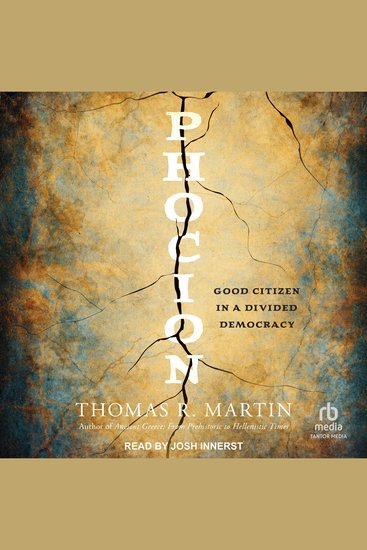
    Phocion (402–318 BCE) won Athens's highest public office by direct democratic election an unmatched forty-five times and was officially honored as a "Useful Citizen." A student at Plato's Academy, Phocion gained influence and power during a time when Athens faced multiple crises stemming from Macedonia's emergence as an international power under Philip II and his son Alexander the Great. Following Athens's defeat by Macedonia, Phocion unsuccessfully sought mild terms of surrender. Oligarchy was imposed on democratic Athens, and more than twelve thousand "undesirable" Athenians were exiled. When the oligarchic regime was overthrown and the exiles returned, dispossessed Athenians took out their volcanic anger on Phocion, who throughout his career had often been a harsh critic of the citizens' political decisions. His inflammatory rhetoric contributed to the popular conclusion that he lacked a genuine sense of belonging to the community he wished so desperately to preserve. When he was eighty-four, the Athenians convicted him of treason and condemned him to die by hemlock. In this fresh biography, Thomas R. Martin explores how and why Phocion ultimately failed as a citizen and as a leader. His story offers unsettling lessons for citizens in democracies today.
    Ver libro
  • Improvised Explosive Device - cover

    Improvised Explosive Device

    Arji Manuelpillai

    • 0
    • 0
    • 0
    Improvised Explosive Device is a startlingly innovative exploration of extremism, hate crime and violence by poet Arji Manuelpillai. In this powerful and unsettling first collection, Manuelpillai presents a vision of the contemporary haunted by Melville's image of the whale – the terror beneath the surface of the sea. His uncompromising focus on violence is laced with gallows humour and the surreal, framed against the mundane detritus of modern life: two boys playing Mortal Kombat; a field of old trainers; the lonely glare of laptop light; a suspicious looking package in the back seat of a van.
    The poems in Improvised Explosive Device emerged through research and interviews with academics, sociologists, and former members of extremist groups and their families – from the English Defence League and the National Front to ISIS and the Tamil Tigers. These complex, unnerving texts ask a series of important questions. What drives a person to commit a radical act of violence? How is that violence mediated through screens and social media? And how does the British government police marginalised groups? Improvised Explosive Device is a brave, surprising and risk-taking book; it will change the way you look at the world.
    "Refusing glib analysis and easy answers, Improvised Explosive Device is a work of radical empathy, fuelled by honesty and compassion, both for those stirred to violence against minorities, and those who suffer from it." Rishi Dastidar
    "The project of Arji Manuelpillai's Improvised Explosive Device leans into the mighty disciplines of poetry, sociology, and reportage to formulate an arresting debut which contests the ways we're conditioned to internalise notions of terrorism, nationalism and belonging...a bold and startling new work." Anthony Anaxagorou
    Ver libro
  • Beyond States - Powers Peoples and Global Order - cover

    Beyond States - Powers Peoples...

    Anthony Pagden

    • 0
    • 0
    • 0
    Today, the majority of the peoples of the planet live in nation-states, based upon the idea, if never the reality, of a single people, a single culture, a single rule of law, and a single source of sovereign authority. But will they continue to do so in the future? 


    None of the major challenges that confront humanity today—from climate change to disease, from terrorism to mass migration—can be handled effectively by single nation-states, no matter how powerful. The world is no longer made up only of states but also of an ever-increasing multitude of interstate networks and organizations which recognize no borders. We are beginning to be able to imagine the very real possibility of a new global civil society. But what political form should this take? 


    By examining the history of the evolution of human society from the world's first empires to today's world of interstate networks, this book argues that there now exists the possibility of the emergence of a new political form, a global 'federation of federations', that will bring the species closer to the possibility of a more harmonious, equitable, and secure future.
    Ver libro
  • Populism and Democracy - Examining the Intersection of Populism and Democratic Systems (3 in 1) - cover

    Populism and Democracy -...

    Arlo Holders

    • 0
    • 0
    • 0
    This is a combo of three titles, which are: 
      - Populism vs. Liberalism: Political ideologies form the foundation of how societies organize governance, economics, and social structures. They are systems of ideas and beliefs that provide a framework for political thought and action, influencing policies, institutions, and the behavior of individuals and groups. Among the diverse range of ideologies, populism and liberalism have emerged as two of the most significant and often opposing forces in modern political discourse. This chapter introduces the concepts of populism and liberalism, highlights their importance, and sets the stage for the comparative analysis that follows. 
      - The Populist Playbook: Populism, as a political ideology and movement, is rooted in the idea of a fundamental divide between "the people" and "the elite." It asserts that the common people, often portrayed as hardworking and morally upright, are being oppressed or ignored by an elite class of politicians, businessmen, and intellectuals who are perceived as self-serving and out of touch with the needs of the general public. The term "populism" has evolved over time and can be used to describe a range of political movements and leaders who claim to represent the interests of the ordinary person against established powers. 
      - The Impact of Populism: The roots of populism stretch back to the 19th century, with early movements advocating for the empowerment of ordinary citizens, particularly in agricultural societies. However, the modern manifestation of populism began to take shape in the mid-20th century and accelerated in the 21st century, fueled by growing disillusionment with traditional political elites. The rise of social media, economic inequality, and a globalized world have all contributed to populism's recent resurgence, particularly in Western democracies.
    Ver libro
  • A Supreme Court Unlike Any Other - The Deepening Divide Between the Justices and the People - cover

    A Supreme Court Unlike Any Other...

    Kevin J. McMahon

    • 0
    • 0
    • 0
    A data-rich examination of the US Supreme Court’s unprecedented detachment from the democratic processes that buttress its legitimacy. 
    Today’s Supreme Court is unlike any other in American history. This is not just because of its jurisprudence but also because the current Court has a tenuous relationship with the democratic processes that help establish its authority. Historically, this “democracy gap” was not nearly as severe as it is today. Simply put, past Supreme Courts were constructed in a fashion far more in line with the promise of democracy—that the people decide and the majority rules. 
    Drawing on historical and contemporary data alongside a deep knowledge of court battles during presidencies ranging from FDR to Donald Trump, Kevin J. McMahon charts the developments that brought us here. McMahon offers insight into the altered politics of nominating and confirming justices, the shifting pool of Supreme Court hopefuls, and the increased salience of the Court in elections. A Supreme Court Unlike Any Other is an eye-opening account of today’s Court within the context of US history and the broader structure of contemporary politics.
    Ver libro