
¡Acompáñanos a viajar por el mundo de los libros!
Añadir este libro a la estantería
Grey
Escribe un nuevo comentario Default profile 50px
Grey
Suscríbete para leer el libro completo o lee las primeras páginas gratis.
All characters reduced
The Age of Empire - Tales from the Byzantine Realm - cover

The Age of Empire - Tales from the Byzantine Realm

Pasquale De Marco

Editorial: Publishdrive

  • 0
  • 0
  • 0

Sinopsis

From the ashes of the Western Roman Empire rose a beacon of civilization in the East—the Byzantine Empire. This enduring realm, often referred to as the Eastern Roman Empire, flourished for over a millennium, leaving an indelible mark on the course of history.

Journey through the captivating narrative of the Byzantine Empire, from its humble beginnings in the 5th century to its eventual decline in the 15th century. Witness the empire's rise to power under emperors like Justinian and Basil II, and its resilience in the face of adversity during the Iconoclast Controversy and the Crusades.

Explore the vibrant tapestry of Byzantine culture, where Christianity intertwined with classical learning, art, and architecture. Discover the empire's contributions to law, philosophy, and theology, and its enduring influence on Western civilization.

Unravel the complex political and military strategies that allowed the Byzantines to maintain their empire for centuries. Delve into the economic and social structures that supported the empire's prosperity, and examine the intricate relationship between Byzantium and the Islamic world.

Through a comprehensive examination of primary sources and the insights of leading scholars, this book provides a comprehensive understanding of the Byzantine Empire's triumphs and tribulations. It sheds light on a civilization that was both resilient and innovative, leaving a legacy that continues to shape the world today.

Immerse yourself in the grandeur and complexity of the Byzantine Empire, and gain a deeper appreciation for its enduring impact on art, architecture, literature, and religion. This book is an invitation to explore a fascinating chapter in human history and to discover the enduring legacy of a civilization that stood at the crossroads of East and West.


If you like this book, write a review!
Disponible desde: 02/06/2025.
Longitud de impresión: 161 páginas.

Otros libros que te pueden interesar

  • Shadows of Salem - Witch Hunts Hysteria and the Making of American Fear - cover

    Shadows of Salem - Witch Hunts...

    Davis Truman

    • 0
    • 0
    • 0
    In 1692, a small Puritan community in Massachusetts became the stage for one of the darkest episodes in American history. The Salem Witch Trials, fueled by superstition, religious zeal, and the fear of the unknown, led to over 150 accusations, countless shattered lives, and the executions of innocent men and women. But beyond the gallows and confessions lies a deeper story, one of resistance, power, and the origins of collective fear in America. 
    In Shadows of Salem, readers are taken inside the trials to witness how hysteria spread, how law was bent to justify injustice, and how individuals, like Giles Corey, chose silence and suffering over submission. Drawing on historical records, legal precedents, and cultural analysis, this book uncovers how Salem’s legacy shaped America’s enduring relationship with fear, authority, and social control. 
    From the use of spectral evidence to the crushing weight of peine forte et dure, Shadows of Salem explores not just what happened in 1692, but why it continues to haunt the American imagination. It is a story of mass panic and manipulation, but also of defiance and resilience, an essential lens for understanding both the past and the patterns of fear that still echo in modern society. 
    Perfect for readers of history, law, and cultural studies, Shadows of Salem offers a compelling examination of how hysteria becomes power, and how silence can be the most powerful act of resistance.
    Ver libro
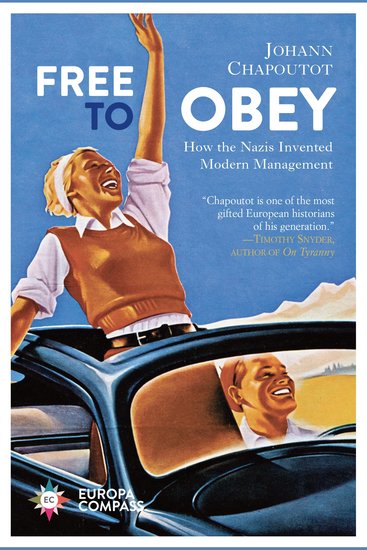
  • Free to Obey - How the Nazis Invented Modern Management - cover

    Free to Obey - How the Nazis...

    Johann Chapoutot

    • 0
    • 0
    • 0
    What if the rules of modern capitalism were written during the Third Reich?
     
    Reinhard Höhn (1904-2000) was a commander of the SS, one of Nazi Germany’s most brilliant legal minds, and an archetype of the fervid technocrats and intellectuals that built the Third Reich. Following Germany’s defeat, after a few years in hiding, he emerged in the early 1950s as the founder and director of a renowned management school in Lower Saxony.
     
    Höhn’s story wouldn’t be very different from that of many other prominent Nazis if not for the fact that a vast number of Germany’s postwar business leaders—more than 600,000 executives—were educated at his management school.
     
    In this fascinating book, Johann Chapoutot, one of France’s most brilliant historians, traces the profound links between Nazism and the principles of modern corporate management, our definitions of success, and a concept of personal freedom that masks rigid hierarchical structures of power and control.
     
    “One of the most gifted European historians of his generation.”—Timothy Snyder, New York Times best-selling author of On Tyranny
    Ver libro
  • Think Like A Democrat Fight Like A Republican - A Short Guide to Better Navigate America's Racist Environment - cover

    Think Like A Democrat Fight Like...

    Diana Priyanka Chowdhury

    • 0
    • 0
    • 0
    The United States of America was built on and is maintained with the hard work, blood, sweat, and tears of people of color. However, there is a large section of white people in America that refuse to admit this fact. These deniers of truth are the white racists of America. Aided by the Republicans, they pose a serious threat to the idea of an inclusive America where everyone is welcome. This book exposes their behavior pattern, explains why their actions harm all Americans, and shares a few methods to combat them.
    Ver libro
  • A Beauty That Hurts - Life and Death in Guatemala - cover

    A Beauty That Hurts - Life and...

    W. George Lovell

    • 0
    • 0
    • 0
    When A Beauty That Hurts first appeared in 1995, Guatemala was one of the world’s most flagrant violators of human rights. An accord brokered by the United Nations brought a measure of peace after three decades of civil war, but the country’s troubles are far from over. W. George Lovell revisits Guatemala to grapple once again with the terror inflicted on its Maya peoples by a military-dominated state.
    Ver libro
  • Born of the Water Born of the Spirit - cover

    Born of the Water Born of the...

    Ernest Martin

    • 0
    • 0
    • 0
    When the Holy Spirit reveled to the author, Ernest Martin, a veterinarian with a medical background, that the spiritual birth was identical to the physical birth, this revelation became a life-changing experience. People are always asking and seeking miracles. What is a greater miracle than a sperm uniting with an ovum (egg) and becoming a living cell with the potential to develop into a human being? That living cell (zygote) does not have any resemblance to a fetus. From the process of fertilization to the growth process, it is all programmed in the zygote to divide and multiply and to eventually liken to its mother or dad or a combination of both. 
    Just like when we receive Jesus as our Savior, we become a whole spiritual being in the image of God. We don't look or act much like Jesus at this stage. We look more like the zygote, but we are complete in Jesus. If we desire the sincere milk of the Word and then progress to the meat of the Word, we will grow up into the full stature of Jesus. This process is so well-defined in the physical birth process that we can see how we grow as we spend time in the Word that we may eventually look and act like Jesus Christ. 
    What a miracle and life-changing event to understand the growth process ordained and carried out by God Almighty.
    Ver libro
  • Economic Recovery Program - cover

    Economic Recovery Program

    Ronald Reagan

    • 0
    • 0
    • 0
    On February 18, 1981, Reagan laid out his economic recovery program before a Joint Session of Congress. Reagan had previously outlined his recovery program in an Oval Office address on February 5, 1981, in which he displayed a dollar bill and 36 cents to show how inflation had reduced the value of a dollar since 1960.  
    Reagan made a further plea for enactment of his recovery program on April 28, 1981, following the assassination attempt on his life. Many economists credit this recovery program for reducing the inflation rate and igniting one of the longest and most robust economic expansions in U.S. history. 
    Reagan paints a grim picture of inflation, the national debt, and lagging productivity plaguing the economy. $41.4 billion of reduced spending is proposed with no reduction for “the poverty stricken, the disabled, the elderly, [and] all those with true need”. Subsidies of the synthetic fuel program, the Export-Import Bank, and the Economic Development Administration are targeted.  
    Block grants to states are proposed, along with changes to Medicaid, the space program, the Postal Service, and the Department of Energy. To counter the Soviet Union’s military build-up, defense is the one department with an increased budget. 
    A 10-percent tax cut for individual taxpayers is proposed for each of the next 3 years, along with increased depreciation allowances to allow business the capital needed to modernize.  
    We “must come to grips with inefficient and burdensome regulations, eliminate those we can and reform the others.”  
    To reduce inflation and interest rates, we need to slow the growth of our money supply. 
    This is our proposal for America’s new beginning. “I'm here tonight to ask you to join me in making it our plan.” Government “must not be used to regulate the economy or bring about social change.” 
    Audio recording courtesy of the Ronald Reagan Presidential Library. 
    AspenLeafMedia.com
    Ver libro