

¡Acompáñanos a viajar por el mundo de los libros!
Añadir este libro a la estantería
Grey
Escribe un nuevo comentario Default profile 50px
Grey
Suscríbete para leer el libro completo o lee las primeras páginas gratis.
All characters reduced
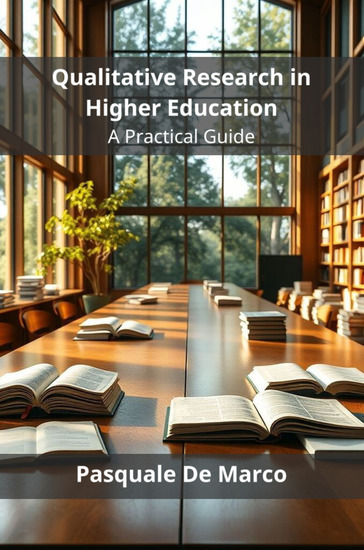
Qualitative Research in Higher Education - A Practical Guide - cover

Qualitative Research in Higher Education - A Practical Guide

Pasquale De Marco

Editorial: Publishdrive

  • 0
  • 0
  • 0

Sinopsis

In the dynamic realm of higher education, "Qualitative Research in Higher Education: A Practical Guide" emerges as an invaluable resource for researchers, educators, and practitioners seeking to navigate the intricacies of qualitative inquiry. This comprehensive guide unveils the foundations, applications, and ethical considerations of qualitative research, empowering readers to conduct rigorous and impactful studies that contribute to a deeper understanding of the human experience in higher education.

Through a blend of theoretical insights and practical guidance, this book provides a roadmap for designing, conducting, and analyzing qualitative research studies. It delves into the various types of qualitative research, including phenomenology, grounded theory, and ethnography, equipping readers with the knowledge and skills necessary to select the most appropriate methodology for their research questions.

Furthermore, the book explores the ethical dimensions of qualitative research, emphasizing the importance of informed consent, confidentiality, and power dynamics. It offers strategies for navigating the challenges of conducting research with vulnerable populations and ensuring the integrity of the research process.

With a focus on real-world applications, this book showcases how qualitative research can be utilized to address pressing issues and inform decision-making in higher education. It presents case studies and examples from diverse contexts, demonstrating the transformative power of qualitative inquiry to illuminate hidden issues, generate new knowledge, and promote positive change.

Key features of the book include:

* A comprehensive overview of the foundations of qualitative research, including its philosophical underpinnings, types, and methods
* In-depth exploration of ethical considerations in qualitative research, ensuring the protection of human subjects and the integrity of the research process
* Practical guidance on designing, conducting, and analyzing qualitative research studies, from selecting participants to interpreting findings
* Applications of qualitative research in higher education, across teaching and learning, student affairs, institutional research, and policymaking
* Emerging trends and future directions in qualitative research, including the use of technology and mixed methods

"Qualitative Research in Higher Education: A Practical Guide" is an essential resource for graduate students, researchers, faculty, and administrators seeking to conduct rigorous and impactful qualitative research studies. It is also a valuable tool for policymakers, educational leaders, and anyone interested in understanding the complexities of qualitative research and its transformative potential in shaping the future of higher education.


If you like this book, write a review!
Disponible desde: 02/06/2025.
Longitud de impresión: 176 páginas.


Otros libros que te pueden interesar

  • Medieval Warfare and Crusades - Battles and Conquests of the Medieval World (5 in 1) - cover

    Medieval Warfare and Crusades -...

    Harris Ropes

    • 0
    • 0
    • 0
    This volume presents five major narratives that shaped the geopolitics and religious landscape of Europe and the Near East from the 8th to the 15th centuries. 
    The story of Joan of Arc brings to life the courage and mysticism of a teenage girl who led French forces to victory during the Hundred Years' War, claiming divine guidance in her quest to drive out the English. Her legacy endures as both a national heroine and a symbol of spiritual resistance. 
    The Albigensian Crusade explores a lesser-known but brutal campaign within Europe itself—where the Catholic Church sought to eradicate the Cathar heresy in southern France. It reveals the tangled web of religious persecution, regional power struggles, and papal authority. 
    The Crusades section covers the series of holy wars between Christian Europe and the Muslim world over control of Jerusalem and other sacred territories. From the First Crusade’s initial fervor to the eventual decline of Christian military ambitions in the East, this section paints a vivid portrait of religious zeal, political ambition, and cultural exchange. 
    The Battle of Tours recounts the pivotal clash in 732 between Frankish forces under Charles Martel and invading Muslim armies. Often hailed as a turning point that halted Islamic expansion into Western Europe, this battle shaped the future of European Christendom. 
    The Hundred Years' War examines the long, bitter struggle between England and France over territorial claims and dynastic rights. It highlights major battles, key figures like Edward the Black Prince, and the war’s impact on national identity and military tactics. 
    Together, these five accounts offer a compelling and detailed portrait of warfare in the medieval world—where faith, politics, and ambition collided on the battlefield, forging the course of European history.
    Ver libro
  • Analytic Idealism in a Nutshell - A straightforward summary of the 21st century's only plausible metaphysics - cover

    Analytic Idealism in a Nutshell...

    Bernardo Kastrup

    • 0
    • 0
    • 0
    As the failures of physicalism begin to shake the confidence of even the most biased of its supporters, a new view on the nature of reality is establishing itself as the only tenable alternative: Analytic Idealism. According to it, there is a world out there independent of our individual minds, but such world is—just like ourselves—also mental or experiential. While being a realist, naturalist, rationalist, and even reductionist view, Analytic Idealism flips our culture-bound intuitions on their head, revealing that only through understanding our own inner nature can we understand the nature of the world. This book embodies its author's years-long experience on how best to explain Analytic Idealism to someone who has never studied it before and has no background in the technical fields involved. It meets the listeners where they are, holding their hand as they are shown—through a series of evocative metaphors—how to see through their own unexamined assumptions, so to realize how the impossible dilemmas of physicalism disappear when nature is regarded from a slightly different slant. The conclusions have tremendous implications for our values and way of life, as well as our understanding of purpose, self, identity, and death.
    Ver libro
  • Tutankhamen's Curse - The Legend of the Pharaoh's Deadly Tomb - cover

    Tutankhamen's Curse - The Legend...

    John Harpoon

    • 0
    • 0
    • 0
    The discovery of Tutankhamen's tomb in 1922 remains one of the most significant archaeological events in history, but it also brought with it a mysterious and terrifying legend—the Curse of the Pharaoh. For centuries, the tomb of the young Egyptian king, who ruled during the 18th dynasty, lay hidden beneath the sands of the Valley of the Kings. It wasn’t until British archaeologist Howard Carter and his financial backer, Lord Carnarvon, unearthed the tomb that the world was introduced to the wonder and mystique surrounding King Tutankhamen’s final resting place. 
    Tutankhamen, who ascended to the throne as a child, died young under uncertain circumstances, leaving behind a legacy that has fascinated historians, archaeologists, and the public alike. His tomb, filled with precious artifacts, murals, and the famous golden mask, was unlike anything ever discovered in ancient Egyptian tombs. Yet, the treasures would be overshadowed by an eerie series of deaths, leading many to believe in a curse linked to the tomb. 
    The first death tied to the curse was that of Lord Carnarvon, who financed the excavation. His sudden death just months after entering the tomb in 1923 shocked the world, and rumors of a deadly curse spread rapidly. Over the next few years, several individuals connected to the tomb’s discovery met untimely and mysterious deaths, fueling the belief that the wrath of Tutankhamen had been unleashed upon those who dared to disturb his resting place.
    Ver libro
  • Richard Nixon - The Prominent Republican President from California - cover

    Richard Nixon - The Prominent...

    Kelly Mass

    • 0
    • 0
    • 0
    Richard Milhous Nixon was the United States' 37th president, serving from 1969 to 1974. Nixon, a Republican politician, formerly worked as the 36th Vice President from 1953 to 1961, after rising to country prominence as a California agent and senator. 
    Following the Watergate occurrence, he ended up being the only president to leave from office after 5 years in the White Home that observed the end of the Vietnam War, détente with the Soviet Union and China, the first manned moon landings, and the starting of the Epa. 
    Let’s learn more about this president who was serving in a crucial time period in American history.
    Ver libro
  • 80K per month from Instagram - cover

    80K per month from Instagram

    Sindhy Kashyap

    • 0
    • 0
    • 0
    This woman found her niche online with Instagram sales and now makes Rs 80k a month
    Ver libro
  • America’s Most Notorious Con Artists: The History and Schemes of Successful Cons in the United States - cover

    America’s Most Notorious Con...

    Editors Charles River

    • 0
    • 0
    • 0
    The art of the confidence trick is a controversial craft that is as old as time itself. In the early years of civilization, unscrupulous folks bottled and peddled assortments of fake cures and potions. Snake oil salesmen aside, charlatans posed as mystical beings with supernatural powers, promising to end droughts and other misfortunes of the gullible with what were in reality parlor tricks and illusions.  
    	Indeed, throughout history, unabashedly brazen characters managed to make careers out of deception. 17th century Britain, for instance, was terrorized by William Chaloner, the most infamous serial counterfeiter and con artist of his time before he was ultimately bested by Sir Isaac Newton himself. The British trickster posed as a quack doctor and a clairvoyant who dispensed false fortunes (most likely via an early form of cold reading) and bogus healing antidotes, but these were bush-league frauds in comparison to one of his most renowned claims to fame: he once bribed four Jacobite sympathizers to crank out pamphlets regarding King James II's denunciation of His Royal Highness William, and later double-crossed his co-conspirators by tipping off the cops and swiftly decamping with the 1,000 reward.  
    	Confidence women were equally active players in such dirty, fixed games. Doris Payne was a professional pilferer of jewels whose unconventional vocation spanned six decades. Throughout all her hits across the United States, Europe, and Asia, Payne adhered to a simple, yet effective method of operation: she donned stylish, pricey clothes, singled out impressionable male shopkeepers and distracted them with flirtatious small talk, and secretly palmed jewelry with sleight-of-hand tricks. One of the most recent was Frank Abagnale, a career impersonator, former forger of bank checks turned FBI employee, and the subject of the 2002 film Catch Me If You Can.  
    Ver libro
