¡Acompáñanos a viajar por el mundo de los libros!
Añadir este libro a la estantería
Grey
Escribe un nuevo comentario Default profile 50px
Grey
Suscríbete para leer el libro completo o lee las primeras páginas gratis.
All characters reduced
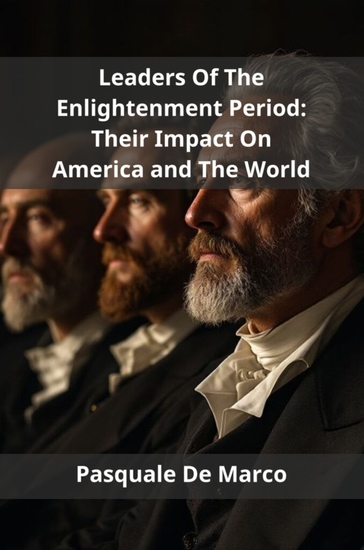
Leaders Of The Enlightenment Period - Their Impact On America and The World - cover

Leaders Of The Enlightenment Period - Their Impact On America and The World

Pasquale De Marco

Editorial: Publishdrive

  • 0
  • 0
  • 0

Sinopsis

The Enlightenment was a period of intellectual and cultural change that transformed the world. It began in Europe in the 17th century and lasted until the end of the 18th century. During this time, new ideas about science, reason, and human nature challenged traditional beliefs and institutions. The Enlightenment had a profound impact on every aspect of society, from politics and economics to religion and culture.

This book tells the story of the Enlightenment, from its beginnings in the salons of Paris to its spread across Europe and America. It examines the work of some of the most important Enlightenment thinkers, including John Locke, Voltaire, Jean-Jacques Rousseau, and Montesquieu. It also explores the impact of the Enlightenment on the American Revolution, the French Revolution, and the development of modern democracy.

**Leaders Of The Enlightenment Period: Their Impact On America and The World** is a comprehensive and accessible introduction to one of the most important periods in history. It is essential reading for anyone who wants to understand the roots of the modern world.

**In this book, you will learn about:**

* The major ideas of the Enlightenment
* The lives and work of the most important Enlightenment thinkers
* The impact of the Enlightenment on politics, economics, religion, and culture
* The legacy of the Enlightenment for the modern world

**Leaders Of The Enlightenment Period: Their Impact On America and The World** is a fascinating and informative book that will appeal to anyone interested in history, philosophy, or politics.


If you like this book, write a review!
Disponible desde: 02/06/2025.
Longitud de impresión: 166 páginas.
Otros libros que te pueden interesar

  • Aristotle for Novelists - 14 Timeless Principles on the Art of Story - cover

    Aristotle for Novelists - 14...

    Douglas Vigliotti

    • 0
    • 0
    • 0
    In many ways, we've been telling the same stories, over and over, for the last 2300 years. This book will show you why, and how you can do it too. 
    For centuries, dramatic writers have relied on Aristotelian principles to write their stories for the screen and stage—the same stories you stream and watch today. But for the first time ever, the timeless principles from Aristotle’s esteemed Poetics have been adapted for novelists. 
    With succinct clarity, novelist Douglas Vigliotti shows you exactly how to write a novel using tried-and-true principles that have been used since antiquity to tell great stories. These principles are the foundation on which any story can be written. Whether you are writing your first or tenth novel, Aristotle for Novelists has something to offer any serious writer of fiction. It is both a challenge to writers to simplify their craft and a no-frills, impassioned outcry for novelists everywhere.
    Ver libro
  • Mummies and Magic - The Preservation of Ancient Egyptian Bodies - cover

    Mummies and Magic - The...

    Omar Khalil

    • 0
    • 0
    • 0
    Mummification is one of the most fascinating and iconic aspects of ancient Egyptian culture. The practice, rooted in both religious beliefs and practical preservation techniques, developed over thousands of years. Understanding the origins of mummification requires a look into early burial practices, the evolution of the methods used, and the profound spiritual significance behind this ancient tradition. 
    In the Predynastic period, before the rise of the Pharaohs, ancient Egyptians buried their dead directly in the hot, dry desert sands. The natural arid conditions acted as a primitive form of preservation, desiccating the bodies and preventing decomposition. These simple burials, often in shallow pits, led to accidental mummification as the desert sands rapidly absorbed moisture. Early communities likely noticed that bodies buried in this way remained intact, sparking the realization that dryness was key to preservation. 
    As Egyptian society evolved, so did burial practices. The transition from pit burials to more elaborate tombs posed new challenges, as the enclosed environments led to faster decomposition. To counter this, early experiments with artificial preservation began. Initially, these efforts were rudimentary, involving simple wrappings and the use of resins. Over time, embalmers refined their techniques, experimenting with salts, oils, and various substances to dry and protect the body. By the Old Kingdom period, the practice had transformed into a highly ritualized and sophisticated process.
    Ver libro
  • Horace - Poet on a Volcano (Ancient Lives) - cover

    Horace - Poet on a Volcano...

    Peter Stothard

    • 0
    • 0
    • 0
    A biography of Horace, one of the most popular poets from antiquity, revealing the little-known man behind his famous lines 


    Quintus Horatius Flaccus (65–8 BCE) wrote some of ancient Rome's greatest poetry, melding languages and cultures with youthful ideals and a realist's recognition of the dictatorial world around him. Horace is famed for his fine phrases, lyric sex, and guidance on how to live, but he was a poet maddened by war, and many of his most self-revealing poems have rarely been read. He could be sublime and obscene, amusing and abusive, a model of moderation and anything but. 


    In this book, the first modern retelling of Horace's life, Peter Stothard follows the poet from his birth as the son of a formerly enslaved father through his rise to the highest circles of Roman society. He shines a light on how shattering experiences in the war to save Rome's republic shaped the loyal servant and revolutionary artist he became. With astute scholarship and sympathy, Stothard follows Horace's rise from humble beginnings to the social and political heights of the autocracy he had fought to prevent.
    Ver libro
  • Empath - The Final Guide to Overcoming Narcissists Fear and Anxiety Find Your Sense of Self Use Emotional Intelligence and Creating a Joyous and Full Life - cover

    Empath - The Final Guide to...

    Amin Rampa

    • 0
    • 0
    • 0
    If you want to know how you can find your gifts as an empath and develop your potential, then keep reading… 
    Being an empath is a gift but only when you can hone your skills properly. The downside of being an empath is the emotional burden that you have to face. 
    Since the empaths are like emotional sponges, they soak up others’ feelings and start putting themselves in the shoes of that person. They start feeling the exact same grief, depression, fear, or anything that the person in front of them is feeling. This can leave make them exhausted over time. They cannot figure out any distinction between the feelings of the person they are talking to and their own emotions. 
    If the emotional feelings of other people put a strain on your psyche and you have no idea how to protect your mental space, then keep reading. 
    This audiobook skips the fluff and shows you how to connect with your inner self, improve your relationships and gain a firm handle on your emotions with no-nonsense, practical advice. 
    In this Audiobook:The science behind how empaths work on a neurological levelHow empaths may be sensitive to certain things and what they areHow to take advantage of your "inner voice" as an empath and overcome your challengesA simple meditation technique for empaths to help you get rid of negative thoughtsWhat life as an empath can be like and how to embrace the gift of true empathyThe effects of empathy on your daily life and how to live fully with this gift
    Ver libro
  • Plotting a fantasy novel - learn elements of plot and structure outlining scenes outlining chapters and create a compelling book - cover

    Plotting a fantasy novel - learn...

    Tasha Dunn

    • 0
    • 0
    • 0
    In Plotting a Fantasy Novel, you’ll discover: 
    ●       How to create a novel outline in 5 easy steps 
    ●       The 3 essential elements of the fantasy genre that will help you elevate your story and create an original and captivating world 
    ●       The 4 types of outline-building techniques you need to know to add more variety to your writing skills 
    ●       In-depth knowledge of creating and setting plot points and writing a cohesive story 
    ●       A detailed discussion of different POVs to help you identify the narrative voice of your story and make sure it stays consistent 
    ●       Solid tips for writing great characters, followed by practical exercises to stimulate your imagination and sharpen your skills 
    ●       How to write hypnotic scenes while maintaining a straightforward and linear narrative 
    ●       How to end your story with a powerful climax that gives the readers’ every pennyworth of satisfaction 
    And so much more! 
    Fantasies are our secret escape to utopia. And with the right tools and techniques, you can create many more escape gateways by writing compelling fantasy novels… novels your readers will be itching to get their hands on. 
    If you dream of seeing your name among the masters of storytelling, it’s time to learn the secrets.
    Ver libro
  • Rules - A Short History of What We Live By - cover

    Rules - A Short History of What...

    Lorraine Daston

    • 0
    • 0
    • 0
    Rules order almost every aspect of our lives. They set our work hours, dictate how we drive and set the table, tell us whether to offer an extended hand or cheek in greeting, and organize the rites of life, from birth through death. We may chafe under the rules we have, and yearn for ones we don't, yet no culture could do without them. In Rules, historian Lorraine Daston traces their development in the Western tradition and shows how rules have evolved from ancient to modern times. Drawing on a rich trove of examples, including legal treatises, cookbooks, military manuals, traffic regulations, and game handbooks, Daston demonstrates that while the content of rules is dazzlingly diverse, the forms that they take are surprisingly few and long-lived. 


    Daston uncovers three enduring kinds of rules: the algorithms that calculate and measure, the laws that govern, and the models that teach. She illustrates how rules can change—how supple rules stiffen, or vice versa, and how once bothersome regulations become everyday norms. Rules have been devised for almost every imaginable activity and range from meticulous regulations to the laws of nature. Daston probes beneath this variety to investigate when rules work and when they don't, and why some philosophical problems about rules are as ancient as philosophy itself while others are as modern as calculating machines.
    Ver libro