¡Acompáñanos a viajar por el mundo de los libros!
Añadir este libro a la estantería
Grey
Escribe un nuevo comentario Default profile 50px
Grey
Suscríbete para leer el libro completo o lee las primeras páginas gratis.
All characters reduced
Global Languages - Unraveling the Nuances - cover

Global Languages - Unraveling the Nuances

Pasquale De Marco

Editorial: Publishdrive

  • 0
  • 0
  • 0

Sinopsis

In this captivating exploration of global languages, we embark on a linguistic voyage that unveils the rich tapestry of human communication. From the nuances of accents and dialects to the intricacies of grammar and vocabulary, we delve into the fascinating world of language, revealing the profound impact it has on our lives.

Through the lens of linguistics, we discover how language shapes our perception of the world, influences our cultural identities, and connects us to others across borders and generations. We explore the challenges and rewards of multilingualism, celebrating the ability of individuals to navigate multiple languages and embrace the beauty of diverse linguistic expression.

The book also addresses the pressing need to preserve endangered languages, highlighting the importance of safeguarding linguistic heritage and promoting linguistic diversity. We examine the role of technology in both revitalizing endangered languages and transforming the way we communicate in an increasingly interconnected world.

With vivid examples and engaging narratives, this book brings to life the complexities of global languages, shedding light on their historical evolution, social significance, and enduring power. It invites readers to appreciate the beauty and diversity of human expression, fostering a deeper understanding of the human experience and promoting cross-cultural dialogue.

Whether you are a language enthusiast, a student of linguistics, or simply someone curious about the world's languages, this book offers a captivating journey into the realm of global communication. Prepare to be amazed by the intricacies of language and inspired by the power it holds to shape our lives and connect us to each other.


If you like this book, write a review!
Disponible desde: 02/06/2025.
Longitud de impresión: 162 páginas.

Otros libros que te pueden interesar

  • Speaking for Success - Public Speaking and the Art of a Charismatic Confident and Compelling Presentation - cover

    Speaking for Success - Public...

    Ofer Reshef

    • 0
    • 0
    • 0
    Learn to conquer anxiety, sway any audience, and get results like the best public speakers in the world. 
    Why do we feel anxious whenever we are called to give a talk or presentation at work? 
    What makes some people exceptional speakers we want to listen to, while others have trouble maintaining even a semblance of our attention? 
    What makes people lead, follow, or stand in our way? 
    The answer? The difference between those who have mastered the art of presentation and those who have not. 
    An effective presentation is a critical component of success. It empowers the speaker and rallies the audience to their cause. It makes good messages great and great messages inspiring. 
    You don’t need to be a natural-born storyteller who instantly wins every argument or even talks like a TED speaker. These skills can be learned. In Speaking for Success, expert public speaking coach Ofer Reshef, who has already inspired tens of thousands of public speakers to succeed in business and leadership, shows you how. 
    From experts to novices, this book is a must-read for anyone who engages with others, forms connections, or conveys ideas in their daily lives. In Speaking for Success, you will discover how to:Face your fears of speaking upBuild an effective presentation specifically for your causeEffortlessly inspire audiencesBuild and maintain attentionTell your unique storyForm powerful openings and conclusionsWork on building excellent body languageKnow when and where to use visual aidsDeal with disruption, distraction, and negate resistanceUnlock the number one secret for video presentationAnd much more
    Ver libro
  • Saving Ourselves - From Climate Shocks to Climate Action - cover

    Saving Ourselves - From Climate...

    Dana R. Fisher

    • 0
    • 0
    • 0
    We've known for decades that climate change is an existential crisis. For just as long, we've seen the complete failure of our institutions to rise to the challenge. Fossil fuel interests maintain a stranglehold on political and economic power. Even though we have seen growing concern from everyday people, civil society has succeeded only in pressuring decision makers to adopt watered-down policies. Is there any hope of achieving the systemic change we need? 


    Dana R. Fisher argues that there is a realistic path forward for climate action—but only through mass mobilization that responds to the growing severity and frequency of disastrous events. She assesses the current state of affairs and shows why public policy and private-sector efforts have been ineffective. Spurred by this lack of progress, climate activism has become increasingly confrontational. Fisher examines the radical flank of the climate movement: its emergence and growth, its use of direct action, and how it might evolve as the climate crisis worsens. She considers when and how activism is most successful, identifying the importance of creating community, capitalizing on shocking moments, and cultivating resilience. Clear-eyed yet optimistic, Saving Ourselves offers timely insights on how social movements can take power back and open windows of opportunity for transformative climate action.
    Ver libro
  • Hitler's Banker - cover

    Hitler's Banker

    Jean-François Bouchard

    • 0
    • 0
    • 0
    1932. The economic crisis in Germany was unprecedented—a severe recession, 6 million unemployed, and a collapse in the popularity of Chancellor Brüning, who was criticized for his lack of foresight and who stubbornly focused on a single objective—reducing public deficits and restoring the state's finances under pressure from other European countries. All the while far-right parties, which would soon take power, were experiencing an irrepressible rise.
    How can one not be struck by the similarity between the economic and political situation in Germany in 1932 and that of some Western countries in 2022?
    In a fictionalized biography tracing the astonishing career of Hjalmar Schacht, a German financial genius of the last century, Jean-François Bouchard indirectly highlights the interest in drawing inspiration from the economic methods that worked at that time. With this perspective, the current economic situation does not seem to be without a solution.
    It was the end of unemployment that became the factor of social stabilization for Adolf Hitler, and of consolidation of his power and of military hegemony. In this regard, sadly, the incredible story of Hjalmar Schacht is the most painful demonstration of this process.
    Ver libro
  • Mysterious Advanced Astronomy in Mesoamerica - cover

    Mysterious Advanced Astronomy in...

    Norah Romney

    • 0
    • 0
    • 0
    Of all the geographical classifications of the indigenous cultures of America that inhabited the continent, only the region called Mesoamerica had, from very early in its history, the use of letters to transmit messages. It is known that the Inca cultures and perhaps some of those that preceded them used a system to memorize stories, but such systems never used signs with values, whether they were logographic or phonetic. This uniqueness places the Mesoamerican area on a par with the cultures of the old continent and Asia, concerning the transmission of the historical memory of its peoples. 
    All writing is an information storage system. Indeed, long before writing was invented, human memory existed, and often specific groups of people were trained to ensure the community safeguarding their past. However, there is a significant difference between the transmission of information in written form, that is, utilizing sculpted or painted drawings or signs, and that is, therefore, more efficient and easier to save than that which depends only on the memory and oral transmission.
    Ver libro
  • Grief - Finding Hope Again - cover

    Grief - Finding Hope Again

    Paul David Tripp

    • 0
    • 0
    • 0
    No matter what the circumstances, death shakes us to the core. It seems so wrong, and it is! We long for comfort, but we don't know where to look. Can God really help when we are overwhelmed with grief? With compassion and biblical wisdom, Paul David Tripp shows us how to think and what to do when death enters our door in CCEFs Grief: Finding Hope Again.  He reminds us that we have a Savior who knows our sorrows, hears our cries, and promises to one day wipe away all tears. Hope and healing come from our relationship with Jesus, the One who promises to walk all the way through the valley of the shadow of death with us. All the minibooks in our Christian bookstore offer gospel-centered hope for everyday issues like parenting, marriage, and personal change.
    Ver libro
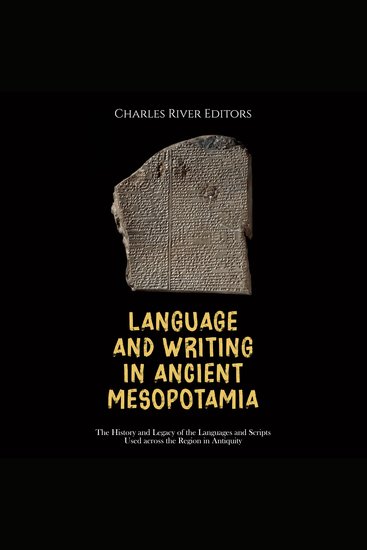
  • Language and Writing in Ancient Mesopotamia: The History and Legacy of the Languages and Scripts Used across the Region in Antiquity - cover

    Language and Writing in Ancient...

    Editors Charles River

    • 0
    • 0
    • 0
    Along with Egypt, the cultural and geographic region known as Mesopotamia was home to some of the world’s earliest civilizations and also the first known form of writing, cuneiform. Many different ethnic groups vied for power in ancient Mesopotamia over the course of antiquity, spanning about 3,000 years, and many of them spoke different languages. Despite these differences, the people in Mesopotamia shared many cultural attributes, including similar religious practices, a common art and architecture style, and a shared use of the cuneiform script.  
    	As this suggests, language and writing were different but also interconnected. The languages spoken by the peoples of Mesopotamia were as diverse as the many ethnic groups, but as those groups asserted their military, economic, and cultural power over the other groups, two languages became dominant in the region: Sumerian and Akkadian. These were the two languages that were primarily used by the people of Mesopotamia to record their myths, religious rituals, government records, and historiographical accounts.  
    	Indeed, the languages and written scripts of Mesopotamia were not just enduring over time in the region, but they also had wide geographic influence, much more than any language groups or scripts at the time. The Sumerian language continued to be learned by scribes throughout Mesopotamia centuries after it had become a “dead language,” and the Akkadian language eventually became the lingua franca of the Near East by the Late Bronze Age. Akkadian became the language of diplomacy and trade, while cuneiform was used to record agreements in Akkadian between the "Great Powers” of the era. Cuneiform was also adopted by people outside of Mesopotamia, such as the Hittites and Elamites, who modified the script to fit the lexicons and rules of grammar for their own languages.
    Ver libro