Join us on a literary world trip!
Add this book to bookshelf
Grey
Write a new comment Default profile 50px
Grey
Subscribe to read the full book or read the first pages for free!
All characters reduced
Creativity - Unlocking the Potential - cover

Creativity - Unlocking the Potential

Pasquale De Marco

Publisher: Publishdrive

  • 0
  • 0
  • 0

Summary

In a world that is constantly changing, creativity is more important than ever before. Creativity is the ability to generate new ideas, solve problems, and see the world in new ways. It is essential for success in all aspects of life, from our personal lives to our professional careers.

This book is a comprehensive guide to creativity. Drawing on insights from a wide range of fields, including psychology, neuroscience, and philosophy, it provides a deep understanding of the creative process and how to cultivate creativity in our own lives.

The book begins by exploring the nature of creativity and its sources. It then discusses the creative process, from the initial spark of inspiration to the final realization of a creative idea. The book also examines the challenges that creatives face, such as creative blocks and self-doubt.

The second part of the book provides practical advice on how to develop our own creativity. It offers exercises and techniques that can help us to generate new ideas, solve problems, and see the world in new ways. The book also discusses the importance of creating environments that foster creativity, both in our personal lives and in our workplaces.

The final part of the book explores the role of creativity in solving some of the world's most pressing problems, such as climate change, poverty, and disease. It argues that creativity is essential for finding new solutions to old problems and for imagining a better future.

This book is an essential read for anyone who wants to learn more about creativity and how to develop their own creative potential. It is also a valuable resource for educators, business leaders, and anyone who works in a field that requires creativity.

With its clear and engaging writing style, this book is accessible to readers of all levels. It is packed with insights and practical advice that can help you to unlock your creativity and make a positive impact on the world.


If you like this book, write a review!
Available since: 06/02/2025.
Print length: 158 pages.
Other books that might interest you

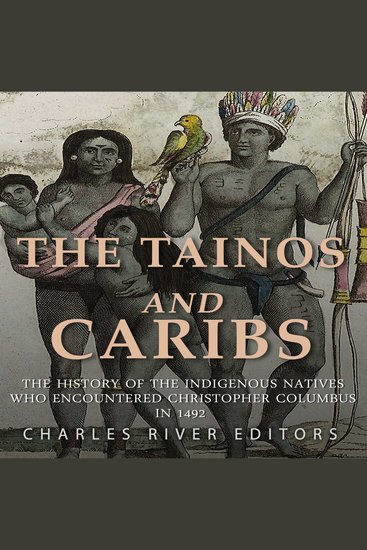
  • Tainos and Caribs The: The History of the Indigenous Natives Who Encountered Christopher Columbus in 1492 - cover

    Tainos and Caribs The: The...

    Editors Charles River

    • 0
    • 0
    • 0
    On October 12, 1492, one of the most important “first contacts” of the modern era was made when three ships of Spanish origin approached the island archipelago now known as the Bahamas, cautiously dropping anchor as the captain of the fleet gazed across to what he assumed was the coast of India. According to the popular version of the story, amazed at the sight of ships and men of such unfamiliar appearance, the native people of the island plunged into the clear waters of the western Atlantic, expertly swimming or aboard dugout canoes, and came out to greet the strangers. 
    	In all probability, the meeting was much more cautious and incremental, but the idea that these innocent people, raised in a tropical Eden, might embrace with such open enthusiasm their own destruction is picturesque, and no doubt appeals to contemporary perceptions. By whatever means one might choose to view it, this meeting of cultures certainly did mark the beginning of a bold new chapter in the history of Europe, and the beginning of the end of an ancient race of native people occupying a vast new continent.  
    	The entries into Christopher Columbus’ log as he recorded his first encounters with the indigenous people of the “Indies” are very telling. The island people arrived alongside his ships, offering humble gifts that Columbus described as “parrots and balls of cotton and spears and many other things, which they exchanged for the glass beads and hawks' bells.” These were the Taínos people, or the “Arawaks” as they would come to be known, and Columbus described them as “well built…with good bodies and handsome features.”  
    	This description, while deceptively simple, had a chilling implication, because Columbus was not taking note of these facts out of idle interest but in terms of how best to exploit them. As the natives offered up gifts aand by implication the freedom of their islands, Columbus remarked simply on their primitive appearance.
    Show book
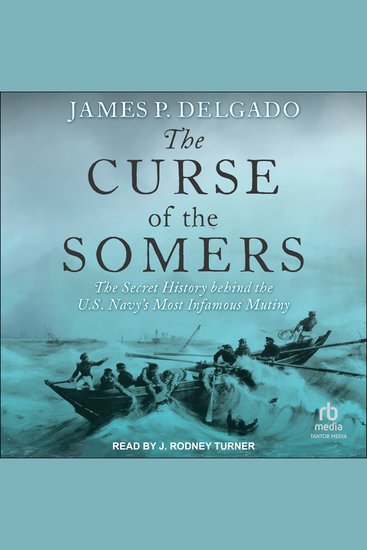
  • The Curse of the Somers - The Secret History behind the US Navy's Most Infamous Mutiny - cover

    The Curse of the Somers - The...

    James P. Delgado

    • 0
    • 0
    • 0
    The greatest controversy in the history of the US Navy of the early American Republic was the revelation that the son of the Secretary of War had seemingly plotted a bloody mutiny that would have turned the US brig Somers into a pirate ship. The plot discovered, he and his coconspirators were hastily condemned and hanged at sea. 


    The repercussions of those acts brought headlines, scandal, a fistfight at a cabinet meeting, a court martial, ruined lives, lost reputations, and tales of a haunted ship "bound for the devil" and lost tragically at sea with many of its crew. The "Somers affair" led to the founding of the US Naval Academy and it remains the Navy's only acknowledged mutiny in its history. The story also inspired Herman Melville's White-Jacket and Billy Budd. Others connected to the Somers included Commodore Perry, a relation and defender of the Somers's captain Mackenzie; James Fenimore Cooper, whose feud with the captain, dating back to the War of 1812, resurfaced in his reportage of the affair; and Raphael Semmes, the Somers's last captain, who later served in the Confederate Navy. 


    The Curse of the Somers is a thorough recreation of this classic tale, told with the help of recently uncovered evidence.
    Show book
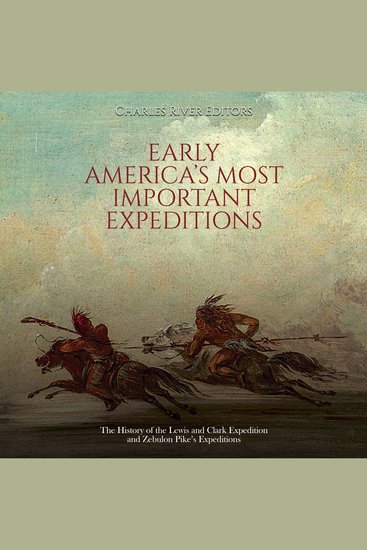
  • Early America’s Most Important Expeditions: The History of the Lewis and Clark Expedition and Zebulon Pike’s Expeditions - cover

    Early America’s Most Important...

    Editors Charles River

    • 0
    • 0
    • 0
    Throughout his presidency at the beginning of the 19th century, Thomas Jefferson had worried about the future of the western U.S., seeing that settlements in the Ohio Valley and lower South relied upon the Mississippi River. France’s controls over the region, in his estimation, put the U.S. at a severe disadvantage. His solution proved successful beyond his wildest imagination, for Napoleon did not only sell New Orleans to the U.S, the portion that Jefferson instructed his ministers to make an offer on, but all of “New France,” the entire area of Louisiana. Jefferson might have said later that his purchase of the territory “strained” but did not “break” the Constitution, but also should have boasted that, with one stroke, he had removed one less obstacle to American expansionism. The Louisiana Purchase encompassed all or part of 15 current U.S. states and two Canadian provinces, and it allowed Jefferson to plan something he had talked about since taking office: an expedition deep into the unmapped and largely unknown continent with the final destination being the Pacific Ocean. This could prove the most significant of the goals that Jefferson - a person who thought of himself as a scientifically-minded thinker - wanted to accomplish as president. 
    	In the aftermath of the Louisiana Purchase, the Lewis and Clark expedition was a much-heralded blow for American rights in the face of international competition, but that was only one of four expeditions authorized by Jefferson. Four years before Lewis and Clark set off, an army officer from New Jersey led two long-distance treks, one northward to the headwaters of the Mississippi River and the other to the Southwest. These were the only expeditions authorized by Jefferson while they were already en route, planned and launched by subordinates within the military. Indeed, the career of Zebulon Pike was “dominated by ambiguously motivated explorations of the American West.”
    Show book
  • Sigma Male & Mental Toughness 2 BOOKS IN 1 - Ultimate Guidebook Of The Lonewolf Dating With Self-Confidence Enhanced Mental State - cover

    Sigma Male & Mental Toughness 2...

    CHARLES REMINGTON VIKRAM PATEL

    • 0
    • 0
    • 0
    By developing certain personality traits, a person can become a Sigma male. But to develop these skills and personality traits, one must be open to change and accept it. 
    Without an open mindset, it can become impossible for a person to learn new personality traits. 
    Nobody is born a natural leader. Leadership qualities are learned. Similarly, nobody is born as a Sigma male. These qualities have to be learned as one goes through life. While some people put in efforts to develop their personalities, most people don't. 
    Those who go the extra mile to develop their personality, end up being identified as a Sigma male, while the rest fall into the beta category. 
    Here is a brief summarized version incorporating all the vital points that are discussed in this particular book – 
    A brief discussion about the SMART goals method 
    Understanding why finding out your inner potential is essential for unlocking your mental toughness 
    Advantages of being self-aware 
    The reason behind celebrating minor victories 
    A better comprehension of the connection between full potential and success 
    Tips to prepare a to-do list 
    Advantages of keeping an achievement list 
    Gathering knowledge regarding the necessity of starting with baby steps 
    Several tips to look for your potential in the best possible way 
    Ways of reaching your full potential with the assistance of discipline and simplicity 
    Scroll up and click on the Buy Now button!
    Show book
  • Naturally Divergent - A Neuro-affirming Framework to Communication Connection and Collaboration - cover

    Naturally Divergent - A...

    Calial McCarty

    • 0
    • 0
    • 0
    In a society built for neurotypical individuals, daily life can feel like playing a game without the rulebook. 
    Naturally Divergent offers an empowering, affirming, and compassionate framework to 
    help neurodivergent individuals thrive amidst societal expectations. 
    Whether seeking to navigate specific environments, advocate for yourself, or 
    simply embrace your identity, this book is an essential companion on your 
    journey to living authentically and confidently.
    Show book
  • The Architecture of Jihad - Inside the Ideology Law and Global Strategy Driving Islam’s Multi-Front Expansion - cover

    The Architecture of Jihad -...

    Aynaz Anni Cyrus

    • 0
    • 0
    • 0
    Western civilization is under assault, not by accident and not by ignorance. It is happening by design. 
    The Architecture of Jihad is not a book about terrorism headlines or isolated acts of violence. It is a forensic examination of an ideology and an operational system that functions across multiple fronts, legal, financial, political, demographic, and cultural, to undermine free societies from within. Using Islam’s own primary texts, including the Quran, Hadith, and classical Islamic jurisprudence, alongside the historical record and modern case studies, Aynaz “Anni” Cyrus documents how jihad operates as a coordinated strategy rather than a series of disconnected events. 
    This book is not an attack on Muslims, nor does it target individuals who choose to practice Islam. It distinguishes clearly between people and doctrine, and between private belief and political ideology. The focus of this work is the system of jihad as defined and executed within Islamic law and history, and the institutional consequences of denying or obscuring that reality. 
    Cyrus writes not as a detached academic, but as a survivor of Sharia and a former child bride who understands both the human cost of silence and the danger of denial. Each chapter functions as a briefing, equipping readers with evidence, clarity, and pattern recognition rather than slogans or fear. 
    The Architecture of Jihad is written for policymakers, educators, pastors, law enforcement professionals, and informed citizens who want to understand what is happening before the damage becomes irreversible. 
    This is not a call to fear. It is a call to clarity, evidence, and informed action.
    Show book