Join us on a literary world trip!
Add this book to bookshelf
Grey
Write a new comment Default profile 50px
Grey
Subscribe to read the full book or read the first pages for free!
All characters reduced
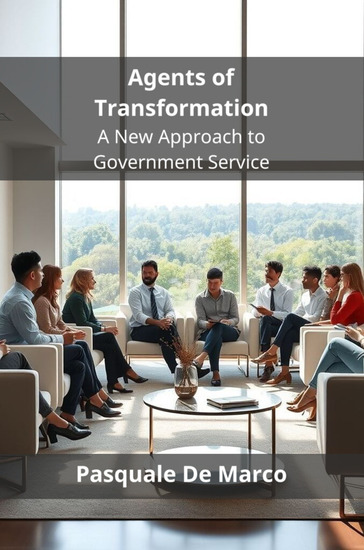
Agents of Transformation - A New Approach to Government Service - cover

Agents of Transformation - A New Approach to Government Service

Pasquale De Marco

Publisher: Publishdrive

  • 0
  • 0
  • 0

Summary

In an era of unprecedented challenges and opportunities, Agents of Transformation: A New Approach to Government Service offers a refreshing and transformative perspective on the role of government and the people who serve it. This comprehensive guidebook challenges the conventional wisdom that bureaucracy and rigid adherence to rules are the only way to achieve efficiency and accountability in government.

With compelling arguments and real-world examples, the book exposes the limitations of the bureaucratic paradigm and its unintended consequences. It argues that the traditional focus on central control, rigid rules, and economy often leads to a decline in accountability, a misallocation of resources, and a stifling of innovation.

Agents of Transformation introduces a new approach to government service, one that is customer-centric, collaborative, and empowered. At the heart of this transformation are the Agents of Transformation—public servants who are passionate about making a difference and are willing to challenge the status quo. The book delves into the qualities and characteristics of effective Agents of Transformation and provides practical guidance on how to develop these skills.

Moreover, the book emphasizes the importance of creating a culture of innovation within government. It argues that innovation is not just about implementing new technologies or processes, but also about fostering a mindset that encourages creativity, experimentation, and risk-taking. The authors provide strategies for cultivating a culture of innovation and offer examples of successful innovation initiatives in the public sector.

Agents of Transformation: A New Approach to Government Service is a clarion call for public servants, policymakers, and citizens alike to reimagine the role of government and embrace a new era of public service. It is a thought-provoking and inspiring guide for anyone who is committed to creating a government that is responsive, effective, and truly serves the needs of the people.

This book is essential reading for public servants at all levels of government, as well as for students of public administration, policymakers, and anyone who is interested in improving the effectiveness and responsiveness of government.


If you like this book, write a review!
Available since: 06/02/2025.
Print length: 160 pages.

Other books that might interest you

  • Plowshares into Swords - Weaponized Knowledge Liberal Order and the League of Nations - cover

    Plowshares into Swords -...

    David Ekbladh

    • 0
    • 0
    • 0
    An in-depth look at how the ideas formulated by the interwar League of Nations shaped American thinking on the modern global order. 
    Plowshares into Swords recaptures the power of knowledge and information developed between World War I and World War II by an international society of institutions and individuals committed to liberal international order and given focus by the League of Nations in Geneva. That information and analysis revolutionized critical debates in a world in crisis. In doing so, David Ekbladh transforms conventional understandings of the United States’ postwar hegemony, showing that important elements of it were profoundly influenced by ideas that emerged from international exchanges. The League’s work was one part of a larger transnational movement that included the United States and which saw the emergence of concepts like national income, gross domestic product, and other attempts to define and improve the standards of living, as well as new approaches to old questions about the role of government. Forged as tools for peace these ideas were beaten into weapons as World War II threatened. Ekbladh recounts how, though the US had never been a member of the organization, vital parts of the League were rescued after the fall of France in 1940 and given asylum at the Institute for Advanced Study in Princeton. However, this presence in the US is just one reason its already well-regarded economic analyses and example were readily mobilized by influential American and international figures for an Allied “war of ideas,” plans for a postwar world, and even blueprints for the new United Nations. How did this body of information become so valuable? As Ekbladh makes clear, the answer is that information and analysis themselves became crucial currencies in global affairs: to sustain a modern, liberal global order, a steady stream of information about economics, politics, and society was, and remains, indispensable.
    Show book
  • Lincoln on Leadership - Executive Strategies for Tough Times - cover

    Lincoln on Leadership -...

    Donald T. Phillips

    • 0
    • 0
    • 0
    Lincoln on Leadership is the first book to examine Abraham Lincoln's diverse leadership abilities and how they can be applied to today's complex world.You think you have it rough?Only ten days before Abraham Lincoln took the oath of office in 1861, the Confederate States of America seceded from the Union, taking all Federal agencies, forts, and arenas within their territory. To make matters worse, Lincoln, who was elected by a minority of the popular vote, was thought of by his own advisors as nothing more than a gawky second-rate country lawyer with no leadership experience.What Lincoln did to become our most honored and revered president is history; now his wisdom and leadership philosophy can help you run your business. In Lincoln on Leadership you'll discover why you should:Seize the initiative and never relinquish it.Wage only one war at a time.Avoid issuing order and instead request, imply, or make suggestions.Once in a while, let things slip, unbeknownst-like... and much much more.
    Show book
  • Statecraft - The New Rules of Power in a Divided World - cover

    Statecraft - The New Rules of...

    Jack Watling

    • 0
    • 0
    • 0
    From top defence analyst Jack Watling, Statecraft reveals how states collaborate, compete and fight in this era of global turmoil. For readers of Prisoners of Geography or Material WorldWhy did Russia struggle in the early months of its full-scale invasion of Ukraine?Why does Israel ignore international pressure on Gaza?Why does the UK spend billions on aircraft carriers that it struggles to support at sea?How do smaller states shape world events when dwarfed by superpowers?The world today is gripped by conflict. Whether in Ukraine, the Middle East or Taiwan, we are in a period of intense power competition. In Statecraft, Dr Jack Watling takes you behind the scenes to meet the world’s powerbrokers in their wood-panelled offices, and the bunkers from which battles are coordinated.With a career spent on the ground in conflict zones, and advising generals and political leaders, Watling examines the dilemmas that states face to get ahead, no matter their size. From economic alliances and global trade to sea power and military technology, Statecraft provides a powerful new lens to understand geopolitics in a divided world.
    Show book
  • Biblical Basis For Human Rights - cover

    Biblical Basis For Human Rights

    John Warwick Montgomery

    • 0
    • 0
    • 0
    Dr. Montgomery served as director of studies at the prestigious International Institute of Human Rights in Strasbourg. France for three years. For thirteen years he has integrated biblical theology and human rights through a summer program in Strasbourg. Learn why only a serious biblical theology can supply the foundations for human rights in our world.
    Show book
  • The Civic Bargain - How Democracy Survives - cover

    The Civic Bargain - How...

    Josiah Ober, Brook Manville

    • 0
    • 0
    • 0
    A powerful case for democracy and how it can adapt and survive—if we want it to 


    Is democracy in trouble, perhaps even dying? Pundits say so, and polls show that most Americans believe that their country's system of governance is being "tested" or is "under attack." But is the future of democracy necessarily so dire? In The Civic Bargain, Brook Manville and Josiah Ober push back against the prevailing pessimism about the fate of democracy around the world. Instead of an epitaph for democracy, they offer a guide for democratic renewal, calling on citizens to recommit to a "civic bargain" with one another to guarantee civic rights of freedom, equality, and dignity. That bargain also requires them to fulfill the duties of democratic citizenship: governing themselves with no "boss" except one another, embracing compromise, treating each other as civic friends, and investing in civic education for each rising generation. 


    Manville and Ober trace the long progression toward self-government through four key moments in democracy's history: Classical Athens, Republican Rome, Great Britain's constitutional monarchy, and America's founding. Comparing what worked and what failed in each case, they draw out lessons for how modern democracies can survive and thrive.
    Show book
  • The Locust and the Bee - Predators and Creators in Capitalism's Future - cover

    The Locust and the Bee -...

    Geoff Mulgan

    • 0
    • 0
    • 0
    How to harness capitalism's dynamism to create an economy that promotes well-being and rewards creationThe recent economic crisis was a dramatic reminder that capitalism can both produce and destroy. It's a system that by its very nature encourages predators and creators, locusts and bees. But, as Geoff Mulgan argues in this compelling, imaginative, and important book, the economic crisis also presents a historic opportunity to choose a radically different future for capitalism, one that maximizes its creative power and minimizes its destructive force.In an engaging and wide-ranging argument, Mulgan digs into the history of capitalism across the world to show its animating ideas, its utopias and dystopias, as well as its contradictions and possibilities. Drawing on a subtle framework for understanding systemic change, he shows how new political settlements reshaped capitalism in the past and are likely to do so in the future. By reconnecting value to real-life ideas of growth, he argues, efficiency and entrepreneurship can be harnessed to promote better lives and relationships rather than just a growth in the quantity of material consumption. Healthcare, education, and green industries are already becoming dominant sectors in the wealthier economies, and the fields of social innovation, enterprise, and investment are rapidly moving into the mainstream—all indicators of how capital could be made more of a servant and less a master.This is a book for anyone who wonders where capitalism might be heading next—and who wants to help make sure that its future avoids the mistakes of the past. This edition of The Locust and the Bee includes a new afterword in which the author lays out some of the key challenges facing capitalism in the twenty-first century.
    Show book