

Unisciti a noi in un viaggio nel mondo dei libri!
Aggiungi questo libro allo scaffale
Grey
Scrivi un nuovo commento Default profile 50px
Grey
Iscriviti per leggere l'intero libro o leggi le prime pagine gratuitamente!
All characters reduced
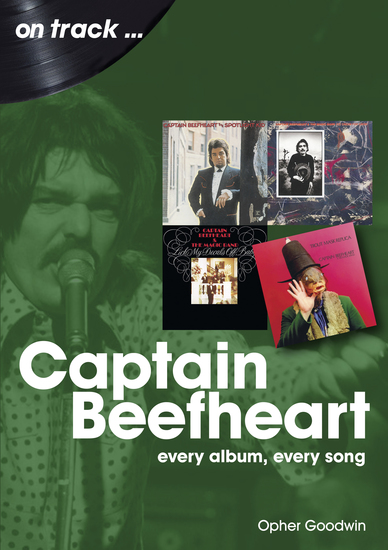
Captain Beefheart - Every Album Every Song - cover

Captain Beefheart - Every Album Every Song

Opher Goodwin

Casa editrice: Sonicbond Publishing

  • 0
  • 0
  • 0

Sinossi

Captain Beefheart (Don Vliet) was undoubtedly the creator of the most bizarre and wonderful music. A child prodigy sculptor, he applied his artistic approach to music, creating 'aural sculptures'. After befriending Frank Zappa in high school, they collaborated on a teenage rock opera and science fiction/fantasy film entitled Captain Beefheart vs The Grunt People. It was from this film that Don took his name. His Magic Band started out as a blues group in the mid-sixties, but soon, with lysergic propulsion, surreal poetry, free-form jazz, polyrhythms and African beats, they established themselves at the forefront of West Coast acid rock. A series of hugely inventive albums, including the infamous Trout Mask Replica, and some legendary live performances, established them as the foremost avant-garde rock band. Few bands were as influential, with The Beatles, The Fall, PJ Harvey and Tom Waits all paying homage, and as a result, The Magic Band have inspired a myriad of tribute bands and created a mythology like no other. This book sets the history of the band in context, analysing every track and attempting to interpret both the music and Don Vliet's poetry. It is essential reading for diehard fans and the Beefheart-curious alike.
 
Opher Goodwin is the author of many books on rock music and science fiction and taught the first 'History of Rock Music' classes in the UK. He was fortunate to spend the sixties in London, the epicentre for the underground explosion of rock music and culture, where he was able to see everyone from Pink Floyd, Hendrix and Cream to The Doors, Captain Beefheart and Roy Harper. He was introduced to Captain Beefheart in 1967 and attended that first amazing gig at Middle Earth. He never fully recovered but now lives happily in East Yorkshire, UK.
Disponibile da: 09/05/2025.
Lunghezza di stampa: 160 pagine.

Altri libri che potrebbero interessarti

  • The Biology of Belief - Unleashing the Power of Consciousness Matter and Miracles - cover

    The Biology of Belief -...

    Bruce H. Lipton PhD

    • 0
    • 0
    • 0
    Learn how your thoughts hold the power to transform your life from the cells up. 
    It has been more than 15 years since the publication of The Biology of Belief, Dr. Bruce H. Lipton’s seminal book that changed the way we think about our lives, our health, and our planet. During that time, research in the field of epigenetics has grown exponentially, and Dr. Lipton’s groundbreaking experiments have been reinforced by more than a decade of rigorous scientific study. 
    Now, this unabridged audio of the book explores Dr. Lipton’s experiments and those of other leading-edge scientists who have unraveled the profound connections between the mind, body, and spirit. 
    It is now widely recognized that genes and DNA do not control our biology. Instead, they are controlled by signals from outside the cell, including energetic messages emanating from our thoughts. This profoundly hopeful synthesis of the latest and best research in cell biology and quantum physics puts the power to create a healthy, joyous life back in our own hands. 
    Through simple language, humor, and real-life examples, you’ll discover how epigenetics is revolutionizing our understanding of the link between mind and matter. When we transform our conscious and subconscious thoughts, Dr. Lipton teaches, we transform our lives - and in the process, we help humanity evolve to a new level of understanding and peace.
    Mostra libro
  • Medieval Education - The Rise of Universities - cover

    Medieval Education - The Rise of...

    Harris Ropes

    • 0
    • 0
    • 0
    During the early medieval period, education in Europe was primarily shaped by the influence of the Church. With the decline of the Western Roman Empire, formal education systems deteriorated, leaving monasteries and cathedral schools as the main centers of learning. These institutions preserved classical knowledge and played a crucial role in the intellectual revival of the Middle Ages. Monastic and cathedral schools provided education for clergy members and, over time, expanded their reach to include nobles and, in some cases, commoners. 
    Monastic schools were among the earliest centers of learning, with monks serving as teachers and scribes. These schools focused on religious instruction, teaching Latin, biblical texts, and theological commentaries. The goal was to prepare future clergy members for service in the Church. Monastic scriptoria were responsible for copying and preserving important texts, ensuring the transmission of classical and Christian knowledge. While most students in monastic schools were destined for religious life, some noble families sent their sons for education in literacy and administration, as the Church held significant political influence. 
    Cathedral schools emerged as a response to the growing demand for education beyond monastic settings. They were often attached to large churches or bishoprics and provided instruction to a wider audience, including future clergymen, royal officials, and scholars. These schools offered a more structured curriculum, covering subjects such as grammar, rhetoric, and logic, which formed the foundation of medieval education. Over time, cathedral schools developed into important intellectual hubs, attracting students from various regions. The presence of prominent teachers and scholars helped establish certain cathedral schools as precursors to medieval universities.
    Mostra libro
  • Permian Period The: The History and Legacy of the Era with the Largest Mass Extinction Event - cover

    Permian Period The: The History...

    Editors Charles River

    • 0
    • 0
    • 0
    Among the most interesting of the prehistoric eras is the Permian age, the most extreme period in the planet’s history. It spanned 47 million years, beginning with an ice age, warming, and ending with the most cataclysmic volcanic episode in the planet’s history. The great bulk of all life on the Earth was almost immediately snuffed out, barely crawling back over the following 10 to 30 million years, and it set the stage for the “Age of Dinosaurs.” 
    	What is termed by some as the “Pennsylvanian” or “Carboniferous” period prepared the emergence of the Permian age. Named for the abundance of rocks from the period found in the state of Pennsylvania, many prefer the term “Silesian” or “Carboniferous” era. In the preceding “Mississippian era,” warm, shallow seas disappeared causing serious upheaval to marine life in a tendency toward glaciation.  
    	“Significant glaciation” marks the beginning of the Carboniferous immediately preceding the Permian. Carboniferous glaciation began in the late Ordovician Period long before. The eventual Andean-Saharan glaciation, a minor ice age, occurred later in the Silurian Age. These were all remnants of the “Snowball Earth” period of the Cryogenian. 
    	The resultant sea level drop as the Carboniferous ice age set in produced conditions much like that of today, with ice on both poles, wet tropics near the equator and temperate regions in between. Despite similar conditions, the Carboniferous lacked the output of greenhouse gases produced by humans. 
    	Fragments of plates collided as continents were still fusing into the supercontinent Pangea. During glaciation, “latitudinal climactic belts were widespread.” Permian rocks have been found on all the continents and some have been displaced “considerable distances from their original latitudes” in the Mesozoic and Cenozoic eras that followed the Permian.
    Mostra libro
  • The Sun Also Rises - cover

    The Sun Also Rises

    Ernest Hemingway

    • 0
    • 0
    • 0
    The debut novel from the Nobel Prize-winning author that is both a tragic love story and a searing group portrait of hapless American expatriates drinking, dancing, and chasing their dreams in postwar Europe. 
    “An absorbingly beautiful and tenderly absurd, heart-breaking narrative ... It is a truly gripping story.” —The New York Times 
    Ernest Hemingway, winner of the Nobel Prize in Literature in 1954, exerted a lasting influence on fiction in English through his economical prose style that conceals more than it reveals. His first novel, published in 1926, is narrated by world-weary journalist Jake Barnes, who is burdened by a wound acquired in World War I and by his utterly hopeless love for the flamboyantly decadent Lady Brett Ashley. The Sun Also Rises tracks the Lost Generation of the 1920s from the nightclubs of Paris to the bullfighting arenas of Spain
    Mostra libro
  • Tracing Time - Seasons of Rock Art on the Colorado Plateau - cover

    Tracing Time - Seasons of Rock...

    Craig Childs

    • 0
    • 0
    • 0
    "An engaging glimpse into a world both fascinating and fundamentally unknowable to those who aren't born into it." —R. E. BURRILLO, author of Behind the Bears Ears 


    Craig Childs bears witness to rock art of the Colorado Plateau—bighorn sheep pecked behind boulders, tiny spirals in stone, human figures with upraised arms shifting with the desert light, each one a portal to the open mouth of time. With a spirit of generosity, humility, and love of the arid, intricate landscapes of the desert Southwest, Childs sets these ancient communications in context, inviting listeners to look and listen deeply.
    Mostra libro
  • So You Want To Do A Solo Show? - cover

    So You Want To Do A Solo Show?

    Gareth Armstrong

    • 0
    • 0
    • 0
    A unique guide to every aspect of putting on your own solo show: choosing the subject, raising the finance, booking the venue - and performing it!
    More and more actors – faced with ever longer periods of unemployment – are turning to the solo show as a way of keeping active, keeping visible, and keeping the wolf from the door! This book is essential reading for anyone contemplating such a move, and comprehensively covers every aspect of putting on your own one-person show.
    Being a veteran of the solo-show circuit, as a writer, performer and director, Gareth Armstrong is the ideal guide. He takes you step by step through each stage of the process:
    Choosing the right material – or devising your own
    Raising the finance
    Finding the venues
    Hiring a bookings manager and other personnel
    Arranging publicity
    Winning an audience
    There is a special section on that mecca for solo shows, the Edinburgh Fringe, and an extensive appendix covering funding bodies, venues, festivals and more. Throughout the book, Armstrong illustrates his points with case studies of actual solo shows by performers such as Miriam Margolyes, Linda Marlowe and Guy Masterson.
    'So You Want To Do A Solo Show? is a thorough, meticulous, hands-on, "how-to-do" manual, covering everything from the germination of an idea right through to the costing of the flyers. It is, I think, the most valuable read for any performer who has ever thought "If only I could have some control over the way my career is going"' Maureen Lipman, from her Foreword
    Mostra libro
