Junte-se a nós em uma viagem ao mundo dos livros!
Adicionar este livro à prateleira
Grey
Deixe um novo comentário Default profile 50px
Grey
Assine para ler o livro completo ou leia as primeiras páginas de graça!
All characters reduced
Smell Memory Connection - cover
LER

Smell Memory Connection

Olivia Clarke

Tradutor A AI

Editora: Publifye

  • 0
  • 0
  • 0

Sinopse

Smell Memory Connection explores the profound link between our sense of smell, memory, and emotion. It examines how specific scents can trigger vivid memories and strong feelings, offering insights into the underlying neuroscience and psychology. One intriguing fact is how olfactory information bypasses the thalamus, a sensory processing center, leading to a more direct emotional response compared to sight or sound. This direct connection to the amygdala and hippocampus—key structures in the limbic system—explains why smell-related memories are often so potent and emotionally charged.

 
The book systematically guides readers through the anatomy and physiology of olfaction, tracing the neural pathways involved in memory formation, and delving into the various types of olfactory memories. It presents empirical evidence from neuroimaging studies and clinical cases, showcasing the practical applications of this knowledge in areas like memory enhancement and emotional disorder treatment. By integrating perspectives from neuroscience, psychology, and marketing, Smell Memory Connection provides a holistic understanding of how scents shape our experiences.
Disponível desde: 04/03/2025.
Comprimento de impressão: 84 páginas.

Outros livros que poderiam interessá-lo

  • The Buddha’s Practical Teaching - cover

    The Buddha’s Practical Teaching

    John D. Ireland

    • 0
    • 0
    • 0
    "To summarise what has been indicated above, our aim should be complete deliverance from suffering, or stated positively, the unconditioned and perfect happiness of Nibbāna; to be differentiated from other forms of happiness which are imperfect because ‘conditioned’ by impermanence, and thus liable to revert to suffering when circumstances or ‘the conditions’ change. By an understanding of the Four Noble Truths of Buddhism we are set in the right direction to achieve this aim. But to reach this understanding the mind must be carefully prepared by moral discipline and other virtues, released from the grip of worldly pleasures and emotions and reach a state of clarity and purity through meditation and wise discrimination. Then by reflection on the three characteristics of existence, the impermanence, suffering and absence of an underlying entity, this understanding will arise giving assurance and confidence. The practical nature of the Buddha’s teaching is that it leads one gradually step by step, like a building raised brick by brick upon secure foundations." —John D. Ireland
    Ver livro
  • Interesting Questions - Insightful Answers : Curtain Raiser - cover

    Interesting Questions -...

    Dr. King, Swami Satyapriya

    • 0
    • 0
    • 0
    In this series of books, I have put together a small set of questions in my favorite area, namely, Yoga and meditation , religious beliefs, and philosophy. These are the subjects that I normally write about. I have answered  some of these questions based on my decades of pondering and serious study. The result is, a series of books packed with very intriguing questions, and equally illuminating answers.
    Ver livro
  • Philosophy - A Christian Introduction - cover

    Philosophy - A Christian...

    Paul M. Gould, James K. Dew Jr.

    • 0
    • 0
    • 0
    Two experienced educators offer an up-to-date introduction to philosophy from a Christian perspective that covers the four major areas of philosophical thought: epistemology, metaphysics, philosophy of religion, and ethics. Written from an analytic perspective, the book introduces key concepts and issues within the main areas of philosophical inquiry in a comprehensive yet accessible way, inviting readers on a quest for goodness, truth, and beauty that ultimately points to Jesus as the source of all.
    Ver livro
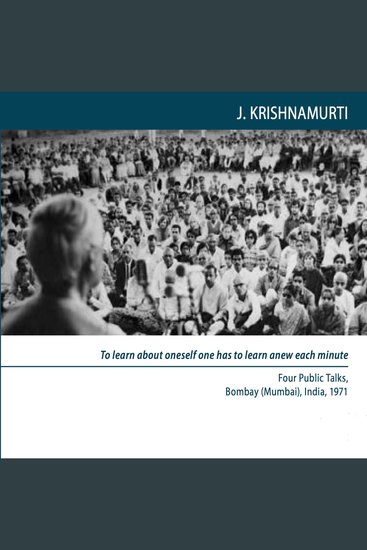
  • To Learn About Oneself One Has to Learn Anew Each Minute - Four Public Talks Bombay (Mumbai) India 1971 - cover

    To Learn About Oneself One Has...

    Jiddu Krishnamurti

    • 0
    • 0
    • 0
    "To perceive 'what is' is the basis of truth," 7 February 1971. Duration: 86 minutes.
    Where there is division, there must be conflict. A mind in conflict must inevitably be distorted, and therefore it cannot possibly see clearly what is truth.
    
    We need a total change, a deep revolution, psychological revolution, the inward revolution, without which you cannot possibly create a new society. Is it possible to observe, to perceive without the observer?
    
    How are images formed? Can the image building come to an end? Knowledge is absolutely necessary. Is it possible that knowledge, which the brain has accumulated through centuries, does not interfere with relationships?
    
    "Direct perception is freedom," 10 February 1971. Duration: 80 minutes.
    Can the mind living in this world ever be free, not only superficially but profoundly, at the very root of its existence? 'Freedom from' is an abstraction, but freedom in observing 'what is' and going beyond it is actual freedom.
    
    How do I observe greed? Do I observe it as an outsider looking in, or do I observe it without the observer? Without the mind being free, you cannot live in order. Three years have passed; I have no energy to be aware of my reactions. Can we seek God through observation?
    
    "Love is that quality of mind in which there is no division," 14 February 1971. Duration: 89 minutes.
    To live in this world with intelligence, in spite of all the complications. Is it possible to be free of fear, not only the superficial fear in relationship but the deep-rooted fear? Thought nourishes, sustains and gives continuity to fear and pleasure.
    
    When you are learning, your mind is awake. Truth isn't second-hand; you can't get it through a guru, a book; you have to learn about it. The beauty of learning is that you don't know what truth is.
    
    What is love? A man who has not love in his heart but the things made by thought will make a monstrous world, will construct a society that is totally immoral. To find out, you must undo everything that you have done.
    
    What does it mean to die?
    
    "A mind in meditation is concerned only with meditation, not with the meditator," 17 February 1971. Duration: 87 minutes.
    If you can put aside your favourite systems, if you can understand that concentration is merely a resistance and therefore constant conflict and wastage of energy, then we can find out for ourselves what is necessary for a mind that is in a state of meditation. To learn about oneself, a living thing, you have to watch, learn anew each minute.
    
    What is will? Consciousness is heritage, the result of time. Consciousness is the content of itself, which is time, sorrow, confusion, misery. Intelligence has no heritage.
    
    What is a mind that is completely silent? How does one cope with the extraordinary energy that human beings have?
    Ver livro

  • On The Shortness Of Life - Stop living your life for anything except yourself in the present moment - cover

    On The Shortness Of Life - Stop...

    L Anneus Seneca, Aubrey Stewart

    • 0
    • 0
    • 0
    In this Stoic epistolary essay, addressed to his father-in-law Paulinus—a prefect of the Roman grain supply—Seneca challenges the conventional lament that life is too short. He argues instead that life is long enough, but is made brief and miserable by our habits: we waste time on trivial pursuits, anxious ambition, social obligations, and regret for the past or longing for the future.  
    Through a series of crisp rhetorical contrasts—between biological duration and genuinely lived time, between busyness and meaningful leisure—Seneca insists that the present moment, when fully seized and reflected upon, yields a span ample for wisdom. He famously distinguishes between those who “die” and those who have merely “spent” their lives without ever possessing them.  
    In twenty short chapters, the essay dissects common forms of temporal waste: mourning lost opportunities while repeating the same errors, chasing posthumous fame, and treating life as a rehearsal for some deferred “living.” Drawing on Epicurean and earlier Stoic sources, Seneca offers practical criteria for measuring a life’s true duration: awareness, intentionality, and the cultivation of inner freedom from external demands. Stop living for money, or fame, or your master; live for yourself, in the moment you're in. 
    A compact critique of Roman imperial ambition and a perennial guide to temporal autonomy, On the Shortness of Life is a foundational text in the Stoic approach to mortality, agency, and the ethics of attention. Its influence has permeated Western culture for millennia, including lumiaries such as Jean-Jacques Rousseau, Michel de Montaigne, and Francis Bacon.
    Ver livro
  • Anwar As-Sadat: A short biography - 5 Minutes: Short on time – long on info! - cover

    Anwar As-Sadat: A short...

    5 Minutes, 5 Minute Biographies,...

    • 0
    • 0
    • 0
    Anwar As-Sadat, Egyptian president: Life and work in a short biography! Everything you need to know, brief and concise. Infotainment, education and entertainment at its best!
    Ver livro