Junte-se a nós em uma viagem ao mundo dos livros!
Adicionar este livro à prateleira
Grey
Deixe um novo comentário Default profile 50px
Grey
Assine para ler o livro completo ou leia as primeiras páginas de graça!
All characters reduced
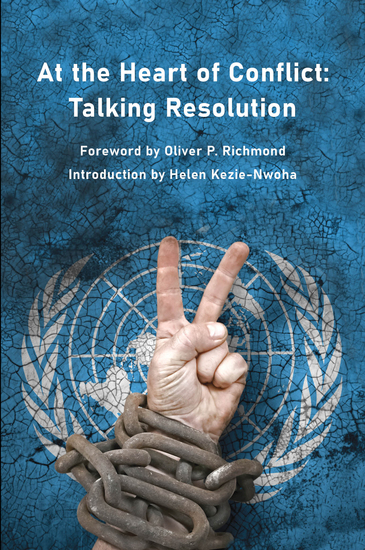
At the Heart of Conflict - Talking Resolution - cover
LER

At the Heart of Conflict - Talking Resolution

Oliver P. Richmond

Editora: Supernova Books

  • 0
  • 0
  • 0

Sinopse

A ground-breaking new book that dares to bridge the divide between peacemakers and military strategists.
 
As the world reels from an unprecedented surge in destructive wars and international crises, a new and critically important book challenges conventional wisdom and asks: Can peace be built by dialogue alone? When is the use of force necessary? Is there cause for hope? With 20 unflinching first-person accounts, the book uniquely gives voice to both sides of the conflict resolution debate from seasoned UN negotiators and grassroots peacebuilders to intelligence experts and military veterans.
 
This book is an essential read for those studying conflict resolution, international relations, or working in the field, looking to know more about the lived experiences of UN officials, translators, ambassadors, NGOs and military personnel.
 
“At the Heart of Conflict: Talking Resolution is a profoundly hopeful book. In these pages, we hear directly from practitioners who have not only witnessed conflict but have actively worked to transform it. Their voices bring a rare depth and texture to our understanding of mediation and peacebuilding — grappling with the political conditions on the ground and reflecting on how those moments fit into larger historical arcs. These accounts offer more than technical and political insight — they remind us that in the midst of violence and fragility, there are always individuals building bridges, nurturing resilience, and creating space for hope.”
 
– Dr Christine Cheng, War Studies, King’s College London
 
“A fascinating insight into the challenging world of conflict resolution that is likely to be as relevant tomorrow as it is today.”
 
-York Membery, writer and journalist, Sunday Times.
Disponível desde: 30/05/2025.
Comprimento de impressão: 296 páginas.

Outros livros que poderiam interessá-lo

  • Wars & Conflicts - Battles Power Struggles and Their Global Consequences (3 in 1) - cover

    Wars & Conflicts - Battles Power...

    Fredrich Hazelton

    • 0
    • 0
    • 0
    This book contains the following titles: 
    - The 2024 Israeli-Palestinian Conflict: The Israeli-Palestinian conflict is one of the most complex and enduring disputes in modern history. Rooted in competing nationalist aspirations, territorial claims, and historical grievances, the conflict has shaped the Middle East and drawn international attention for over a century. To understand the events of 2024, it is essential to examine the historical context that underpins this struggle. 
    - The Syrian Civil War: The Syrian Civil War, which began in 2011, stands as one of the most devastating conflicts in modern history, reshaping not only Syria but the entire Middle East and the international political landscape. The war has drawn in numerous global powers, each with their own motivations, and has sparked a humanitarian crisis of unparalleled scale. This conflict is not merely a battle between the Assad regime and opposition groups but a complex web of local, regional, and international rivalries, ideologies, and geopolitical interests. As the fighting continues, the war has resulted in staggering human loss, displacement, and destruction, leaving a country in ruins and millions of people displaced across borders. 
    - The Rise of ISIS: The rise of the Islamic State of Iraq and Syria (ISIS) stands as one of the most significant and alarming phenomena of the 21st century. Emerging from the chaos of regional conflicts and geopolitical missteps, ISIS transformed from a little-known insurgent group into a global threat that captured the world’s attention. At its height, ISIS declared a self-styled caliphate, controlling vast territories across Iraq and Syria, and wielded its influence far beyond the Middle East. Through acts of brutality, strategic propaganda, and a sophisticated recruitment network, the group redefined the face of modern terrorism. 
    Ver livro
  • The Lyceum Address - The Perpetuation of Our Political Institutions - cover

    The Lyceum Address - The...

    Abraham Lincoln

    • 0
    • 0
    • 0
    Abraham Lincoln's Lyceum Address, delivered in 1838, reflects on the fragility of American democracy and the potential dangers of lawlessness and mob rule. Lincoln begins by honoring the Founding Fathers and their sacrifices, emphasizing the importance of preserving their legacy. He warns against the threat posed by individuals who seek to undermine the rule of law and exploit public discontent for personal gain. Lincoln argues that the true danger to the nation comes not from external enemies but from internal strife and moral decay. 
    Central to Lincoln's message is the idea that respect for laws and institutions is essential for maintaining a stable and just society. He calls for citizens to uphold the principles of justice and equality, stressing the need for education and moral guidance to foster responsible citizenship. Lincoln uses historical examples, including the rise and fall of ancient republics, to illustrate the consequences of unchecked lawlessness and civic indifference. 
    Throughout the address, Lincoln's eloquence and deep concern for the future of democracy in America are evident. He urges his audience to cherish and protect the nation's democratic ideals, emphasizing that the strength of the United States lies in the unity and moral character of its people. Lincoln's Lyceum Address remains a timeless reminder of the enduring values that underpin a free and democratic society.
    Ver livro
  • The Baltic Sea - A Geopolitical History - cover

    The Baltic Sea - A Geopolitical...

    Anônimo

    • 0
    • 0
    • 0
    The Baltic Sea is more than an inland sea – it is a historic geopolitical stage. From maritime travel in the Viking era toa NATO-dominated region, this brackish inland sea has been a lifeline for people and countries in northern Europe. The Baltic Sea has served as a hub for economic and political relations – with the dominance of the Hanseatic League in the Middle Ages, the Great Power Battles between Sweden, Poland-Lithuania and Russia, and the dramatic shifts in the aftermath of the Napoleonic Wars as well as two World Wars and the Cold War. But the Baltic Sea is also a place of cooperation. Since the fall of the Soviet Union, the region has been characterized by integration and growth – a development that once again is being challenged by new geopolitical tensions. How will the future be affected by energy flows, climate change and military strategies? In this comprehensive anthology, leading scholars in history, political science, international relations and other subjects are brought together to examine the driving forces that have formed the Baltic Sea region from the 13th century until today.
    Ver livro
  • Dissidently Speaking - Change the Words Change the War - cover

    Dissidently Speaking - Change...

    Brent Hamachek

    • 0
    • 0
    • 0
    Mostly Americans need to take a fresh look at ourselves. To do that we need to apply critical thinking, add some skepticism, and be willing to replace answers with questions. 
    Compiled from a decade of writings and contemplation, and further aided by a forty-year career in the world of business dealing with hundreds of companies, this book represents a synthesis between the theoretical and the empirical. Each chapter stands entirely on its own, but each stands stronger when joined with the others. The author’s goal is simply to have the reader challenge their preconceived notions. 
    This book is for you if you feel confident enough to challenge everything you might think about the American political dynamic, how honestly and effectively you communicate with others, and how you process what you find in the news or on social media. Do you have what it takes to become a political dissident? Find out. Finally, and most difficult of all, are you up to taking a look into the mirror and asking yourself: Am I ethical? 
    Get ready to have your toy box dumped all over the floor. Prepare to check all your premises. Be willing to think!
    Ver livro
  • Progress and poverty: Book Summary & Analysis - cover

    Progress and poverty: Book...

    Henry George

    • 0
    • 0
    • 0
    "Progress and Poverty" is a seminal work written by Henry George, first published in 1879. The book addresses economic and social issues, particularly focusing on the unequal distribution of wealth and the causes of poverty in the midst of progress and economic growth. In "Progress and Poverty," Henry George explores the relationship between economic progress and the persistence of poverty. He critiques the existing economic system and advocates for a single tax on land as a solution to address wealth inequality and eradicate poverty. George argues that land, as a resource, should be treated as a common good, and the benefits of land value increases should be shared by the community. The book gained widespread attention and sparked discussions on economic reform and social justice.
    Ver livro
  • The Petroleum Papers - Inside the Far-Right Conspiracy to Cover Up Climate Change - cover

    The Petroleum Papers - Inside...

    Geoff Dembicki

    • 0
    • 0
    • 0
    Burning fossil fuels will cause catastrophic global warming: this is what top American oil executives were told by scientists in 1959. But they ignored that warning. Instead, they developed one of the biggest, most polluting oil sources in the world—the oil sands in Alberta, Canada. As investigative journalist Geoff Dembicki reveals in this explosive book, the decades-long conspiracy to keep the oil sands flowing into the US would turn out to be one of the biggest reasons for the world's failure to stop the climate crisis. 


    In The Petroleum Papers, Dembicki draws from confidential oil industry documents to uncover for the first time how companies like Exxon, Koch Industries, and Shell built a global right-wing echo chamber to protect oil sands profits—a misinformation campaign that continues to this day. He also tells the high-stakes stories of people fighting back: a Seattle lawyer who brought down Big Tobacco and is now going after Big Oil, a Filipina activist whose family drowned in a climate disaster, and a former Exxon engineer pushed out for asking hard questions. 


    With experts now warning we have less than a decade to get global emissions under control, The Petroleum Papers provides a step-by-step account of how we got to this precipice—and the politicians and companies who deserve our blame.
    Ver livro