Join us on a literary world trip!
Add this book to bookshelf
Grey
Write a new comment Default profile 50px
Grey
Subscribe to read the full book or read the first pages for free!
All characters reduced
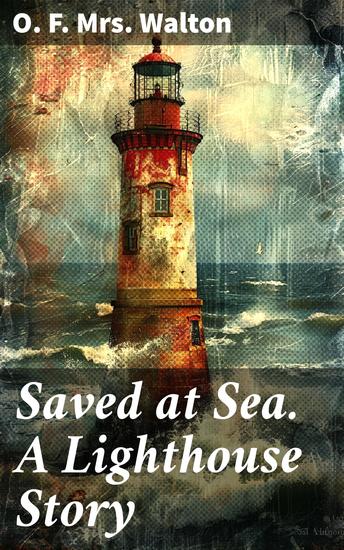
Saved at Sea A Lighthouse Story - Enriched edition A Tale of Redemption and Rescue on the High Seas - cover

Saved at Sea A Lighthouse Story - Enriched edition A Tale of Redemption and Rescue on the High Seas

O. F. Walton

Publisher: Good Press

  • 0
  • 0
  • 0

Summary

In "Saved at Sea: A Lighthouse Story," O. F. Mrs. Walton crafts a vivid narrative that intertwines adventure and moral lessons against the dramatic backdrop of coastal life. Written in the Victorian tradition, the novel features intricate character development and a richly descriptive style that brings the lighthouse setting to life. The storyline delves into themes of courage, faith, and the struggle against nature, emphasizing the importance of community and resilience in the face of adversity. Through the use of detailed imagery and a steady rhythm, Walton immerses readers in a world where the lighthouse stands not only as a physical beacon but also as a symbol of hope and guidance amidst turbulent seas. O. F. Mrs. Walton, a pioneering female author of her time, was known for her ability to weave moralistic tales that resonated with younger audiences. Her experiences and background deeply influenced her writing, particularly her appreciation for maritime life, as she grew up near the coast of England. This intimate familiarity with the sea, combined with her understanding of moral imperatives within society, reflects in the narrative of "Saved at Sea." This book is highly recommended for readers who appreciate classic literature imbued with profound ethical insights and adventure. Walton's ability to balance thrilling escapades with heartfelt reflections makes this tale suitable for both young readers and adults seeking to revisit the timeless themes of bravery and redemption. A compelling read for anyone fascinated by the complexities of human spirit when 'saved at sea'.

In this enriched edition, we have carefully created added value for your reading experience:
- A succinct Introduction situates the work's timeless appeal and themes.
- The Synopsis outlines the central plot, highlighting key developments without spoiling critical twists.
- A detailed Historical Context immerses you in the era's events and influences that shaped the writing.
- A thorough Analysis dissects symbols, motifs, and character arcs to unearth underlying meanings.
- Reflection questions prompt you to engage personally with the work's messages, connecting them to modern life.
- Hand‐picked Memorable Quotes shine a spotlight on moments of literary brilliance.
- Interactive footnotes clarify unusual references, historical allusions, and archaic phrases for an effortless, more informed read.
Available since: 08/12/2023.
Print length: 36 pages.

Other books that might interest you

  • History of the Philippines A (Unabridged) - cover

    History of the Philippines A...

    David P. Barrows

    • 0
    • 0
    • 0
    A History of the Philippines is a short, dense and temporally expansive book. It starts with the Evolution of the Land 100 million years ago. The writing is predominantly dry, dispassionate and academic. It's full of details, and often presumes an existing familiarity with Philippine history and culture, introducing terms with no definition provided.
    Show book
  • The Perfumed Garden - cover

    The Perfumed Garden

    Sheikh Nefzaoui

    • 0
    • 0
    • 0
    The Perfumed Garden of Sensual Delight (Arabic: الروض العاطر في نزهة الخاطر Al-rawḍ al-ʿāṭir fī nuzhaẗ al-ḫāṭir) is a fifteenth-century Arabic sex manual and work of erotic literature by Muhammad ibn Muhammad al-Nefzawi, also known simply as "Nefzawi".
    The book presents opinions on what qualities men and women should have to be attractive and gives advice on sexual technique, warnings about sexual health, and recipes to remedy sexual maladies. It gives lists of names for the penis and vulva, has a section on the interpretation of dreams, and briefly describes sex among animals. Interspersed with these there are a number of stories which are intended to give context and amusement.
    Show book
  • A Hunger Artist - A study in artistic pursuit and the sacrifices one must make - cover

    A Hunger Artist - A study in...

    Franz Kafka

    • 0
    • 0
    • 0
    Franz Kafka was born on 3rd July 1883 in Prague, then in Bohemia, the eldest of 6, into a middle-class Jewish family. 
     
    Life for the young Kafka and his passion for literature was often made an ordeal by his over-bearing and domineering entrepreneur of a father.   
     
    In 1889 Kafka was sent to the Deutsche Knabenschule, an elementary school in Prague. His father would only allow him to be educated in German-speaking schools and even went so far as to limit visits to the synagogue to four a year. 
     
    In 1901 he graduated from the classics-oriented Altstädter Gymnasium. Kafka did well there and across a large range of subjects.  He now enrolled at the Charles Ferdinand University, to study chemistry, but quickly switched to law for which he obtained his degree in June 1906 and then performed the mandatory year of unpaid service as clerk at the civil and criminal courts. 
     
    A job at an Italian insurance company left him little time to write and after a year he took another job with the Worker's Accident Insurance Institute for the Kingdom of Bohemia where he stayed until ill health led to his resignation in 1922. 
     
    Although he saw work as a means to pay the bills and to allow him time to write, he received several promotions and was noted as a good employee. 
     
    By 1917 Kafka was suffering from tuberculosis, which required frequent periods of convalescence. Interspersed with this, were several intense affairs before he settled in Berlin with Dora Diamant, a 25-year-old kindergarten teacher who herself having left the ghetto now influenced Kafka's interest in the book of Jewish law, the Talmud. 
     
    Kafka’s on-going health was littered with problems. Apart from TB there were several other ailments, including migraines, insomnia, boils, depression, all usually brought on by excessive stresses and strains. He attempted to counteract all of this by naturopathic treatments, a vegetarian diet and consuming large quantities of unpasteurized milk. 
     
    His tuberculosis still worsened. He returned to Prague, where he died on 3rd June 1924. He was 40. 
     
    His literary works are few in number but towering in influence.  His masterpieces include ‘The Trial’, ‘The Metamorphosis’ as well as a number of short stories which reveal facets of humankind that truthfully could only be born from Kafka’s brain and pen.
    Show book
  • Sherlock Holmes A Study in Scarlet - Audiobook - cover

    Sherlock Holmes A Study in...

    Arthur Conan Doyle, Classic...

    • 0
    • 0
    • 0
    "A Study in Scarlet" is the first novel by Arthur Conan Doyle introducing the legendary detective Sherlock Holmes and his loyal companion, Dr. John Watson. The story begins with their initial meeting and the establishment of their famous partnership. Together, they unravel a complex murder mystery that spans continents and involves revenge, love, and the secretive practices of a religious group. This gripping tale combines brilliant deductive reasoning with unexpected twists, setting the stage for one of the most iconic characters in literary history.
    Show book
  • Hunchback of Notre-Dame The (Book 1) - cover

    Hunchback of Notre-Dame The...

    Victor Hugo

    • 0
    • 0
    • 0
    Book 1: The Hunchback of Notre-Dame or Notre-Dame de Paris is a French Gothic novel by Victor Hugo, published in 1831. - The story is set in Paris in 1482 during the reign of Louis XI. The gypsy Esmeralda (born as Agnes) captures the hearts of many men, including those of Captain Phoebus and Pierre Gringoire, but especially Quasimodo and his guardian Archdeacon Claude Frollo. Frollo is torn between his obsessive lust for Esmeralda and the rules of Notre Dame Cathedral. He orders Quasimodo to kidnap her, but Quasimodo is captured by Phoebus and his guards, who save Esmeralda. Gringoire, who attempted to help Esmeralda but was knocked out by Quasimodo, is about to be hanged by beggars when Esmeralda saves him by agreeing to marry him for four years.
    Show book
  • A midsummer's Night Dream - Full Cast Drama - cover

    A midsummer's Night Dream - Full...

    William Shakespeare

    • 0
    • 0
    • 0
    One of William Shakespeare's most beloved and whimsical comedies. This enchanting play weaves together the stories of several groups of characters as they navigate the magical and mischievous world of the fairy kingdom and the Athenian woods. The play opens in the court of Athens, where Duke Theseus is preparing for his upcoming marriage to Hippolyta, the Queen of the Amazons. The young lovers, Hermia and Lysander, are also introduced. However, Hermia's father, Egeus, insists that she marry Demetrius, whom she does not love. 
    Faced with the choice of marrying Demetrius, facing execution, or a life of chastity in a nunnery, Hermia and Lysander plan to escape to the nearby woods. They are pursued by Demetrius, who is himself pursued by Helena, Hermia's friend, who is infatuated with him. In the forest, a group of bumbling and amateurish actors led by the comical Bottom are preparing a play for the upcoming wedding of Duke Theseus and Hippolyta. Unbeknownst to them, the forest is also home to the fairy king Oberon, his queen Titania, and their mischievous servant, Puck. 
     
    Oberon and Puck, with the help of a magic flower, create a web of love and mischief in the forest. Puck mistakenly causes both Demetrius and Lysander to fall in love with Helena, leading to comical and chaotic misunderstandings. Titania, under the influence of Oberon's magic, falls in love with Bottom, who has been given the head of an ass. As the night unfolds, the characters' romantic entanglements and conflicts are resolved. Oberon releases Titania from her enchantment, and Demetrius and Lysander are restored to their proper loves. The lovers and the amateur actors return to the court, where their antics are performed as humorous entertainment. 


    Show book