¡Acompáñanos a viajar por el mundo de los libros!
Añadir este libro a la estantería
Grey
Escribe un nuevo comentario Default profile 50px
Grey
Suscríbete para leer el libro completo o lee las primeras páginas gratis.
All characters reduced
Study Group Dynamics - cover

Study Group Dynamics

Nora Bexley

Traductor A AI

Editorial: Publifye

  • 0
  • 0
  • 0

Sinopsis

Study Group Dynamics explores the crucial role study groups play in legal education and academic success. It addresses whether law students are truly maximizing collaborative learning or if inefficiencies hinder their exam preparation. The book investigates how to optimize these groups through collaborative learning techniques, concept clarification strategies, and targeted exam preparation practices, essential for both students and legal educators. Discover how understanding the dynamics of study groups can lead to improved learning outcomes and a more supportive academic environment.

 
This book examines common study group structures, analyzing elements like group size, leadership roles, and communication patterns, which significantly affect group performance. It offers practical strategies for productive discussions, conflict resolution, and effective exam preparation. By using a mixed-methods approach that includes quantitative data and qualitative insights from law students and faculty, the book provides evidence-based practices and actionable tools. It also emphasizes academic integrity within group settings.

 
The book begins by establishing a theoretical framework for understanding group learning, then transitions to analyzing common structures and practices. It dedicates a significant portion to optimizing study group performance, culminating in a discussion of ethical considerations. Ultimately, Study Group Dynamics aims to equip law students and legal educators with strategies to improve study group effectiveness, enhance understanding of legal concepts, and develop essential teamwork skills.
Disponible desde: 07/04/2025.
Longitud de impresión: 112 páginas.

Otros libros que te pueden interesar

  • Entrepreneurial Marketing - Beyond Professionalism to Creativity Leadership and Sustainability - cover

    Entrepreneurial Marketing -...

    Hermawan Kartajaya, Philip...

    • 0
    • 0
    • 0
    In Entrepreneurial Marketing: Beyond Professional Marketing, a renowned team of marketing leaders, including the "Father of Modern Marketing," professor Philip Kotler, delivers a groundbreaking and incisive redefinition of entrepreneurial marketing. In the book, some of the marketing sector's brightest minds explore the increasingly essential initiative to build new capabilities beyond the mainstream marketing approach that also consider the effect of digital connectivity on consumers and companies everywhere. This book also discusses what marketers need to do to break the stagnation of normative marketing approaches that are often no longer effective in dealing with dynamic business environments. 


    The authors introduce a fresh entrepreneurial marketing approach, converging dichotomies into a coherent form. The book also includes: a post-entrepreneurial-marketing view of the commercial landscape which puts the operational aspect at the center of the action, converging marketing and finance, and adopting technology for humanity; discussions of the strategies and techniques that will drive the actions of the marketing departments to create value with values that will lead the company to success through the year 2030; and explorations of the paradox between the development of core competencies and collaboration with various parties, including competitors.
    Ver libro
  • Stop Checking the Price! - Lose money every time you look at the stock market? The simple investing strategy for beginners to pick winners by trading only 4 times a year! - cover

    Stop Checking the Price! - Lose...

    J. F. Dodaro

    • 0
    • 0
    • 0
    Do you check your account every day and feel like you're always losing money? Worried the next recession will crash your portfolio? Pulling out your hair while the daily news fills you with fear? 
    Then you are a VICTIM OF INFORMATION OVERLOAD! 
     This book provides a simple trading strategy to Preserve And Grow Your Wealth by filtering the noise to get more valuable information in less time, reducing your stock research and trading effort by over 99%, and betting on long-term value creation to achieve financial success! 
    We are told the money managers on Wall Street who spend all day checking every stock price movement, every CEO tweet, and every company filing footnote have an edge in the stock market... But the pixelated truth is that information has mathematical limits: zooming into a single blurry pixel of an image tells you nothing about the big picture – the stock market is no different. And even if we did know every detail of the business, the laws of nature tell us we can't predict the future stock price in a complex marketplace anyway! 
    In "Stop Checking The Price" you will LEARN HOW TO:Follow the 1st Law of Investing for maximum long-term compounding… And why the "risk-return trade-off" is backwards. Use "80-20 Rule" to cut your research time and stock trading effort down by 99%. Filter bad apples (stocks) before they spoil the whole barrel (portfolio). Steal a page from the venture capitalist's playbook for explosive growth… And how to beat Warren Buffett! Set a timer and evaluate any stock in 60 seconds from a data snapshot.  
    Don't get lost in the blurry pixels – ZOOM OUT!
    Ver libro
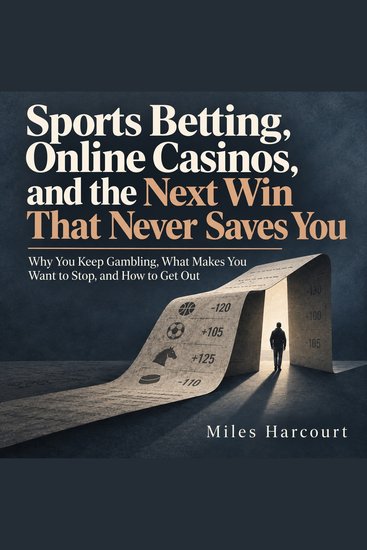
  • Sports Betting Online Casinos and the Next Win That Never Saves You - Why You Keep Gambling What Makes You Want to Stop and How to Get Out - cover

    Sports Betting Online Casinos...

    Miles Harcourt

    • 0
    • 0
    • 0
    This audiobook is narrated by an AI Voice. 
    If money were the point, a win would end the session. 
     
    It never does. A win extends it. The balance stays in the account and goes back through, and somebody who has just hit something does not withdraw and walk away. If you have done this you already know that, and you have probably never once asked why. 
     
    Here is why. Put someone in a scanner and show them a near miss — two symbols lined up and the third stopping just short. Financially that is a total loss. The brain recruits much of the same reward circuitry a win recruits, and the urge to keep going rises rather than falls. 
     
    You are being rewarded for losing. Which is why the plan almost everyone makes cannot work. Eventually it will get bad enough and I will stop assumes losses accumulate into a decision. They do not, because losing was built into the pattern that trained the behaviour in the first place. 
     
    What people actually become dependent on is a state. Some are buying the feeling of being sharp, of having a judgment tested and returned with a verdict inside a fixed window, which nothing else in an adult life supplies. Some are buying the opposite, the narrowing of attention so complete that they stop existing for an hour. Which one you have been buying decides what will work and what is wasted effort. 
     
    This covers what that means in practice. Why knowledge is the mechanism in sports betting rather than the protection. Why chasing is identity repair and not an attempt to recover money. Why your own memory of what you have lost is a forgery, and what the hours figure does that the money figure cannot. Why quitting collapses on days when nothing went wrong, because stopping is a grief problem rather than a discipline problem. Why debt is held in place by the same mechanism as the gambling, and how compulsive play is undone by barriers and delay rather than by resolve at eleven at night.
    Ver libro
  • Roots of Igbo People - Cultures Values and Tradition - cover

    Roots of Igbo People - Cultures...

    Bethel Egwuatu

    • 0
    • 0
    • 0
    This engaging and informative book offers readers a comprehensive exploration of the Igbo people, one of Africa's largest ethnic groups, renowned for their vibrant customs, deep-rooted values, and resilient spirit. 
    Through captivating narratives and insightful analysis, readers will delve into the key aspects of Igbo life, including the significance of community, the importance of kinship, and the celebration of life events. From traditional birth and naming ceremonies to elaborate funeral rites, each chapter illuminates the profound rituals that shape the Igbo experience. 
    Immerse yourself in the festive atmosphere of Igbo celebrations, where colourful festivals and traditional dances come alive, reflecting the community's rich artistic heritage. Discover the wisdom embedded in Igbo proverbs, which offer valuable lessons on morality, resilience, and unity. 
    As modernisation influences the world, this book also addresses the challenges and opportunities faced by the Igbo community in preserving their culture. Explore how traditions are being adapted and celebrated in contemporary society, showcasing the dynamic nature of Igbo identity. 
    Whether you are an Igbo descendant seeking to reconnect with your roots or a curious reader eager to learn about a fascinating culture, "Embracing the Igbo Heritage" serves as a gateway to understanding and appreciating the beauty and complexity of Igbo traditions. Join us on this enlightening journey and celebrate the enduring legacy of the Igbo people.
    Ver libro
  • The Shocking Truth about Workplace Harassment - cover

    The Shocking Truth about...

    Zoey Fraisers

    • 0
    • 0
    • 0
    Workplace harassment is an issue that extends far beyond isolated incidents—it is a systemic problem that affects employees across industries and at all levels of employment. From overt discrimination and verbal abuse to more insidious forms of intimidation and exclusion, workplace harassment can take many shapes. Yet, despite growing awareness, countless cases go unreported, leaving victims to suffer in silence while companies turn a blind eye. The consequences of this widespread problem are severe, impacting not only individuals but entire organizations.  
      
    At its core, workplace harassment is about power and control. It is often perpetuated by those in positions of authority or influence, creating a culture where victims fear retaliation if they speak up. In some cases, even when complaints are filed, they are dismissed or mishandled by employers who prioritize their company’s reputation over the well-being of their employees. This failure to address harassment fosters a toxic work environment, leading to decreased productivity, high turnover rates, and lasting emotional damage for those affected.  
      
    While laws and regulations exist to protect workers from harassment, enforcement remains inconsistent. Many employees are unaware of their rights, and even those who do understand them may hesitate to take legal action due to the stigma attached to being labeled a troublemaker. Human resources departments, which are meant to serve as a safeguard against workplace misconduct, often struggle to balance their duty to employees with their loyalty to the company. As a result, the burden of addressing workplace harassment frequently falls on the victims themselves, leaving them with difficult choices that can impact their careers and mental health. 
    Ver libro
  • Campus Free Speech - A Pocket Guide - cover

    Campus Free Speech - A Pocket Guide

    Cass R. Sunstein

    • 0
    • 0
    • 0
    Free speech is indispensable on college campuses: allowing varied views and frank exchanges of opinion is a core component of the educational enterprise. But free speech does not mean a free-for-all. The First Amendment prohibits "abridging the freedom of speech," yet laws against perjury or bribery, for example, are still constitutional. In the same way, valuing freedom of speech does not stop a university from regulating speech when doing so is necessary for its educational mission. So where is the dividing line? How can we distinguish reasonable restrictions from impermissible infringement? 


    In this pragmatic, no-nonsense explainer, Cass Sunstein takes us through a wide range of scenarios involving students, professors, and administrators. He discusses why it's consistent with the First Amendment to punish students who shout down a speaker, but not those who chant offensive slogans; why a professor cannot be fired for writing a politically charged op-ed, yet a university might legitimately consider an applicant's political views when deciding whether to hire her. He explains why private universities are not legally bound by the First Amendment yet should, in most cases, look to follow it. And he addresses the thorny question of whether a university should officially take sides on public issues or deliberately keep the institution outside the fray.
    Ver libro