Join us on a literary world trip!
Add this book to bookshelf
Grey
Write a new comment Default profile 50px
Grey
Subscribe to read the full book or read the first pages for free!
All characters reduced
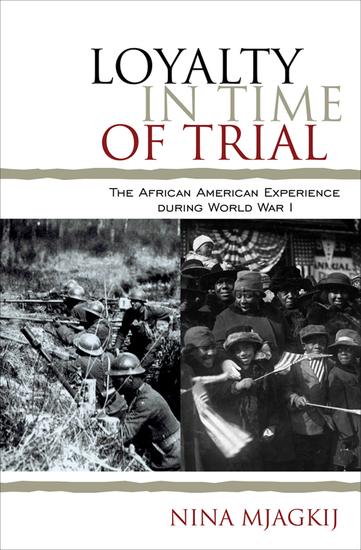
Loyalty in Time of Trial - The African American Experience During World War I - cover

Loyalty in Time of Trial - The African American Experience During World War I

Nina Mjagkij

Publisher: Rowman & Littlefield Publishers

  • 0
  • 0
  • 0

Summary

The little-known history of black soldiers and defense workers in the First World War, and what happened afterward: “Highly recommended.” —Choice   In one of the few book-length treatments of the subject, historian Nina Mjagkij conveys the full range of the African American experience during the “Great War.” Prior to World War I, most African Americans did not challenge the racial status quo. But nearly 370,000 black soldiers served in the military during the war, and some 400,000 black civilians migrated from the rural South to the urban North for defense jobs.    Following the war, emboldened by their military service and their support of the war on the home front, African Americans were determined to fight for equality—but struggled in the face of indifference and hostility in spite of their combat-veteran status. America would soon be forced to confront the impact of segregation and racism—beginning a long, dramatic reckoning that continues over a century later.   “Painstakingly describes the frustration, sometimes anger, and frequent courage demonstrated by southern and northern African Americans in their attempts to include themselves in the national crusade of making the world safe for democracy . . . one of the most comprehensive treatments of the race issue in the early twentieth century that this reader has seen.” —Journal of Southern History
Available since: 06/14/2023.
Print length: 250 pages.

Other books that might interest you

  • The Golden State Killer Case - cover

    The Golden State Killer Case

    William Thorp

    • 0
    • 0
    • 0
    In 2018, police announced that they had finally arrested the "Golden State Killer," a man responsible for over 140 burglaries, fifty rapes, and at least thirteen murders committed in California throughout the 1970s and '80s. That man turned out to be a former California police officer, Joseph James DeAngelo Jr. 


    Just two months earlier, the publication of I'll Be Gone in the Dark by Michelle McNamara had rocked the world of true crime. Published two years after her death, the book charts McNamara's obsessive search for the prolific criminal who had been known over the years as the East Area Rapist, the Original Night Stalker, and the Visalia Ransacker, among other epithets. McNamara is credited with coining the "Golden State Killer" moniker and heightening public awareness of the—at the time—still unsolved case. 


    William Thorp dives into the investigation, exploring the dark side of sunny California, the advances in forensic innovation that made solving this case possible, and the story inside the story—one of an amateur sleuth who dedicated the last years of her life to understanding how one of the country's worst criminals could have spent so many decades undetected.
    Show book
  • The Bible of Influence and Power - 23 Unbreakable Laws to Understand What People Think How to Change Their Mind and Redirect Actions - cover

    The Bible of Influence and Power...

    Halbert Ward

    • 0
    • 0
    • 0
    The Psychology on How to Command Respect and Influence 
    Looking for ways how you can improve your social skills, grab that big yes to start that business or project you've always wanted?  
      
    Curious about how you can convince people to go in the direction you want the ethical way?  
    Aristotle.....Lionel Messi.....Beyonce...Barack Obama...Albert Einstein... what do they have in common?  
    People are social creatures. From birth up until the last breath we need people to help us to live comfortably, especially in this modern world we are living in. From asking your friends to join you somewhere, winning that declamation contest, and making your boss say yes to your dream project, influence is involved. The question is, can you execute this correctly to make sure winning is always on your side?  
    I've got you covered.  In my new book, "The Bible of Influence and Power"  I will tell you everything you need to know. I will divulge the secrets behind influence. From what it's about, its different types, and how to apply it without sounding like you are trying to deceive people. Be careful now, there is a thin line between persuasion and manipulation so you need to read it with complete focus. 
    With the application of my expertise and everyday practice plus tips I gathered from other professionals, soon you will be on your way to getting those yeses you're been dreaming of. Who knows, maybe one day people will be making books about you, asking for your autograph, and your name will be known all across the globe along with those big names! What are you waiting for? Let's get things going!  
    Grab a Copy Today! 
    Show book
  • The Princes in the Tower - Solving History's Greatest Cold Case - cover

    The Princes in the Tower -...

    Philippa Langley

    • 0
    • 0
    • 0
    Philippa Langley took the world by storm when, against all the odds and a seven-year investigation, she discovered the grave of King Richard III (1452-1485) in a Leicester car park. A king finally laid to rest, the rediscovery and reburial of Richard III was watched by an estimated global audience of over 366 million. 
     
    Now, Langley reveals the findings of a remarkable new research initiative: ‘The Missing Princes Project’. In the summer of 1483, Edward V (aged 12) and his brother Richard Duke of York (aged 9), disappeared from the Tower of London. For over 500 years, history has judged that they were murdered on the orders of their uncle Richard III. 
     
    Following years of intensive research in UK, American and European archives, astonishing new archival discoveries have been uncovered that change what we know about the fate of the Princes in the Tower. Established by Langley in 2016, ‘The Missing Princes Project’ employed the methods of a cold-case police enquiry. Using investigative methodology, it aimed to place this most enduring of mysteries under a forensic microscope for the first time. 
     
    In The Princes in the Tower: Solving History's Greatest Cold Case, Langley records the painstaking investigative work and research of the project. By questioning received wisdom, she and her team shed light upon one of history's greatest miscarriages of justice, revealing a phenomenal untold story.
    Show book
  • Nothing Means Anything (And That's Like Profound) - A Guide to Postmodernism - cover

    Nothing Means Anything (And...

    Sophia Blackwell

    • 0
    • 0
    • 0
    Finally, a philosophy book that doesn't take itself as seriously as the theorists it eviscerates! "Nothing Means Anything" mercilessly skewers postmodernism's most pretentious thinkers with savage wit and zero academic mercy. 
    Journey through the impenetrable jargon, circular logic, and breathtaking hypocrisy of French intellectuals who made careers out of stating the obvious in the most confusing way possible. From Derrida's word games to Foucault's paranoid power trips, from Baudrillard's reality-denial to Lyotard's grand narrative about the end of grand narratives, this book translates postmodern gobbledygook into hilarious plain English. 
    Whether you're a traumatized humanities student seeking revenge on the theorists who destroyed your GPA, a curious reader wondering what all the fuss is about, or just someone who enjoys watching pretentious nonsense get thoroughly roasted, this irreverent guide delivers. You'll learn how to sound profound while saying absolutely nothing, why your IKEA catalog is more meaningful than your actual life, and how to win any argument by claiming everything is a "discourse" (don't forget the air quotes). 
    Warning: Reading this book in public may cause uncontrollable snorting, concerned looks from strangers, and a weird sense of relief that someone finally said what we've all been thinking about these turtleneck-wearing, cigarette-smoking harbingers of intellectual doom. May cause spontaneous clarity and the disturbing realization that these insufferable French people might occasionally have been right about something.
    Show book
  • Bagavad Gita in Tamil - Chapter 6 - cover

    Bagavad Gita in Tamil - Chapter 6

    Viyasar

    • 0
    • 0
    • 0
    The Bhagavad Gita is a 700-verse Hindu scripture embedded within the epic Mahabharata, depicting a dialogue between Arjuna and Krishna on the battlefield of Kurukshetra. Arjuna, facing his relatives in battle, experiences despair and a crisis of conscience. Krishna, his charioteer and an avatar of Vishnu, provides philosophical and spiritual guidance, addressing themes of duty (dharma), action (karma), devotion (bhakti), and knowledge (jnana). The Gita explores the nature of the self, the divine, and humanity's place in the world, offering paths to liberation and spiritual fulfillment. 
    Show book
  • Red Dawn - What If the Soviets Had Prevailed in the Cold War? - cover

    Red Dawn - What If the Soviets...

    Marcus Draysun

    • 0
    • 0
    • 0
    The Cold War, which dominated much of the 20th century, was a clash of ideologies, political ambitions, and global power struggles. It was a battle between two superpowers, the United States and the Soviet Union, each determined to impose its vision of the future upon the world. The Cold War never boiled over into full-scale war, but the fear of nuclear annihilation and the constant threat of conflict shaped the political landscape. But what if the Soviet Union had won this prolonged battle, and the world as we know it had unfolded differently? 
    In the original timeline, the collapse of the Soviet Union in 1991 marked the end of the Cold War, leaving the United States as the undisputed global superpower. However, in this alternate reality, the Soviets have triumphed, their system of governance and ideology proving resilient and successful. How did this shift happen? The end of the Cold War came not with the fall of the Berlin Wall, but with the extension of Soviet influence across Europe, Asia, and beyond, ushering in a new age of global communism. 
    The victory of the Soviets would have drastically altered the political and economic systems of the world. The capitalist model, so dominant in the West, would have been eclipsed by socialism, and Western governments would have been forced to adopt forms of governance that more closely resembled the Soviet model. The United States, long a symbol of free-market capitalism and democracy, would have seen its institutions transformed, as the Soviet Union’s ideals spread through every corner of the globe.
    Show book