¡Acompáñanos a viajar por el mundo de los libros!
Añadir este libro a la estantería
Grey
Escribe un nuevo comentario Default profile 50px
Grey
Suscríbete para leer el libro completo o lee las primeras páginas gratis.
All characters reduced
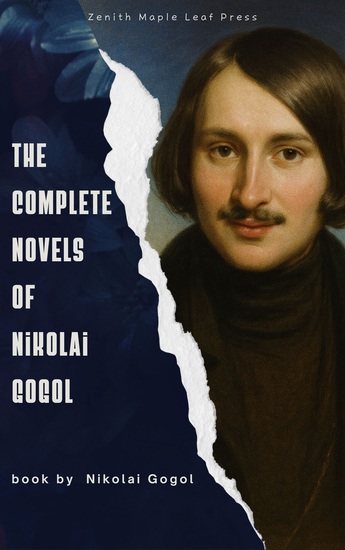
The Complete Novels of Nikolai Gogol - cover

The Complete Novels of Nikolai Gogol

Nikolai Gogol

Editorial: Zenith Maple Leaf Press

  • 0
  • 0
  • 0

Sinopsis

Grotesque, satirical, unforgettable — Gogol's novels changed Russian literature forever.

Nikolai Gogol, one of the most original voices of the 19th century, combined biting satire, vivid imagination, and deep social commentary. The Complete Novels of Nikolai Gogol gathers all of his long-form works into one definitive edition, showcasing the strange humor, surreal vision, and moral depth that made him a literary giant.

Why readers love it:

Complete collection. Every novel by Gogol in one essential volume.

Unique style. Blends comedy, absurdity, and the uncanny with social critique.

Foundational influence. Gogol paved the way for great Russian novelists like Dostoevsky and Tolstoy.

A lasting legacy
From bizarre bureaucrats to haunting mysteries, Gogol's novels portray a Russia both real and surreal — a world where the absurd reveals the deepest truths about human society. His works remain classics of world literature, essential for anyone who loves satire, philosophy, and imaginative storytelling.

✨ Step into Gogol's strange, satirical world — dark, witty, and timeless.

👉 Click "Buy Now" and own The Complete Novels of Nikolai Gogol—a definitive collection of Russian literary masterpieces.
Disponible desde: 28/08/2025.
Longitud de impresión: 1287 páginas.
Otros libros que te pueden interesar

  • A Rich Woman - From their pens to your ears genius in every story - cover

    A Rich Woman - From their pens...

    Katharine Tynan

    • 0
    • 0
    • 0
    Katharine Tynan was born on 23rd January 1859 into a large family in Clondalkin, County Dublin. 
    The family business was cattle rearing and the farmhouse, set with the mountains for a backdrop, was a wonderful world for a young mind to learn and imagine. 
    She was educated at the convent school, St Catherine of Sienna, in Drogheda.  A stubborn streak inhibited her ability to learn as easily as the school wished. However she did learn on her own terms and soon began to take her ‘forbidden literature’, hidden in her clothing, to her loft in a stable hideaway.  
    Until she turned seventeen nothing appeared to point to a literary career.  But some verse printed in a Dublin newspaper changed everything. It led to a sonnet being printed in the Spectator.  Thereafter the Graphic published several others and even paid a half guinea for the privilege.   
    In 1884 Katharine dispatched herself to London and made an abiding friendship in Alice Meynell.  Alice was an established poet and helped, with her husband Wilfred, to publish many poets. The following year it was arranged for the publication of her first poetry volume, ‘Louise de la Vallière’.  
    She formed valuable friendships with the poets Gerard Manley Hopkins, William Butler Yeats and later Francis Ledwidge.  
    As she gathered friends and contacts into her life her literary output began to gather pace. Katharine had begun to write prose for the Speaker and for the Scots and National Observer.  
    In 1892 she married Henry Albert Hinkson, a fellow writer and a barrister.  They moved to England and had five children although two were to tragically die in infancy.   
    By now her output was prolific and ranged from poetry to novels to short stories.  It would later include a biography and further extend to editing and reviewing.   
    In 1912 the family returned to Claremorris, County Mayo, when her husband was appointed magistrate, a post he held until his early death in 1919.     
    Tynan is sometimes grouped amongst the War Poets of the First World War. Her experience was not direct but as a Mother with one son serving in France and another in Palestine, the emotions, fears and doubts are expressed in a beautiful and heart-felt way.  
    Involved in the Irish Literary Revival, Tynan expressed concern for feminist causes, the poor, and the effects of World War I in her work. She also meditated on her Catholic faith. 
    She is said to have written over 100 novels, 12 collections of short stories, plays and many volumes of enduring poetry as well as five volumes of autobiography. 
    Katharine Tynan Hinkson died at age 72 on 2nd April 1931 in London and is buried in Kensal Green Cemetery.
    Ver libro
  • The Champdoce Mystery - cover

    The Champdoce Mystery

    Émile Gaboriau

    • 0
    • 0
    • 0
    A duke's heir substituted at birth, a father who ruined his own son to make him, and twenty years of a secret that several people have a use for. Gaboriau invented the French detective novel out of the police gazettes; here the crime is an old one and the detection almost incidental — what he is really writing is how a family's money makes people behave.
    Ver libro
  • Aristopia: a Romance-History of the New World - cover

    Aristopia: a Romance-History of...

    Castello Newton Holford

    • 0
    • 0
    • 0
    "Aristopia: A Romance-History of the New World is an 1895 utopian novel written by Castello Holford. It holds the distinction of being considered the first novel-length alternate history in English and is among the earliest examples of alternate histories in general1.    In this captivating tale, Ralph Morton, an early settler in Virginia, stumbles upon a reef made of solid gold. Rather than squandering his newfound wealth, Morton shrewdly uses it to establish a planned society called Aristopia (derived from the Greek word for "the best place"). Drawing inspiration from Sir Thomas More's Utopia, Morton introduces his own innovations and adaptations.    Here are some key features of Aristopia:    Land Ownership: In Aristopia, all land is owned by the government, which then leases it to businesses and private citizens.  Monopolized Trade: Large-scale trade is monopolized by the state.  Wealth Limitations: Inherited wealth is limited.  Productive Refugees: Morton welcomes productive refugees from European conflicts, including Huguenots, Irish fugitives, and skilled artisans from northern Italy and Switzerland.  Prosperity and Expansion: The colony thrives, expands westward, and even supports the American Revolution. Eventually, Aristopia conquers Canada and comes to dominate all of North America north of Mexico.  This novel offers a unique twist on the utopian genre by imagining an alternate history where the United States was founded under different circumstances, leading to a superior society in the author's own time"
    Ver libro
  • The American - cover

    The American

    Henry James

    • 0
    • 0
    • 0
    "The American" by Henry James follows Christopher Newman, a wealthy and confident American businessman, as he ventures to Europe seeking adventure and romance. In Paris, he becomes infatuated with the beautiful and enigmatic Claire de Cintré, a young widow from a noble French family. Driven by his passion, Newman pursues Claire despite her family's disapproval. As their relationship develops, cultural disparities, social expectations, and financial considerations complicate their love. Claire's aristocratic relatives, particularly her controlling mother, present formidable obstacles, and Newman's American directness clashes with European subtleties.
    Ver libro
  • The Spirit of the Range - From their pens to your ears genius in every story - cover

    The Spirit of the Range - From...

    B M Bower

    • 0
    • 0
    • 0
    Bertha Muzzy was born on 15th November 1871 in Otter Tail County, Minnesota.   
    At 18 she and her family moved to Great Falls, Montana where she began teaching at a nearby 12 pupil school. Although the experiences would prove valuable for characters in her later books after one term as a schoolteacher, Bower returned to her family's home. 
    In December 1890, Bower shocked her family by eloping with Clayton J Bower. Although the marriage was to prove unhappy, it produced three children and opened her eyes and literary thoughts to cowboy life.  She became friendly with their boarder Bill Sinclair. She lent him books and tutored him in writing and he explained the finer points of cowpunching and Western life. 
    Bower began writing to give her a focus and for some financial independence. She began sending stories to publishers in 1900 and had her first published locally the next year; ‘Strike of the Dishpan Brigade.’ Four years later she went national when ‘Ghost in the Red Shirt,’ appeared in Lippincott’s Magazine. 
    Later that year, Bower serialized her first Western novel ‘Chip of the Flying U’ and the "Happy Family" of cowboys who lived there. Centered on a cowboy, Chip, and his romance with Dr. Della Whitmore, a self-reliant doctor from the East, the book was wildly popular and rocketed Bower to fame. Many more novels from the Flying U Ranch would follow.  
    She now divorced Clayton and married Sinclair in August 1905. That same year Bower signed a short-story contract with Popular Magazine. 
    A daughter was born during a blizzard in January 1907. That brutal Montana winter also destroyed their breeding horses and their planned new business venture. They now moved to Santa Cruz, California to pursue careers as writers. Four years later they separated. Bower now signed with the prestigious Boston publishers Little, Brown & Company. 
    By 1920, Bower was in Hollywood and with a third husband. The novels and stories continued to flow as did film adaptations.   
    In all she wrote 57 Western novels as well as many articles and short stories.  It is said that her sales fell when her audience despite appreciating the often-realistic settings and language of her work discovered she was a woman. 
    B M Bower died on 23rd July 1940 in Los Angeles, California, at the age of 68.
    Ver libro
  • Stephen Leacock - A Short Story Collection - Widely renowned Canadian writer and humourist - cover

    Stephen Leacock - A Short Story...

    Stephen Leacock

    • 0
    • 0
    • 0
    Stephen P H Butler Leacock FRSC was born on 30th December 1869 in Swanmore, near Southampton, England, the third of eleven children. 
    The family emigrated to Canada in 1876, settling on a 100-acre farm in Sutton, Ontario.  There he was home-schooled until, funded by his grandfather, he was enrolled into the elite Upper Canada College in Toronto.  Academically he was very strong and thence proceeded on to the University of Toronto to study languages and literature.  After completing two years of study in only one, he was obliged to leave because his alcoholic father had abandoned the family and finances could not stretch to cover his education.  Leacock now enrolled in a 3 month course to become a qualified high school teacher and thereby gain a regular income.  For the next decade he worked at Upper Canada College.  
    His passion was economics and political theory and in 1899 he became a postgraduate student at the University of Chicago and earned his PhD.  In 1906, he wrote ‘Elements of Political Science’, quickly adopted as a standard academic textbook for the next two decades and his most profitable book.   
    Although he had already published several humorous pieces it was only in 1910 that these works were collected and published and turned him into a commercially successful writer.  Volume after volume now appeared almost annually and it was often said that more people had heard of him than of Canada. 
    Politically he was a social conservative.  He opposed women’s right to vote and was a champion of Empire but also an advocate of social welfare legislation and wealth redistribution, but often caused friction with his racist views. 
    Stephen Leacock died on 28th March 1944 of throat cancer in Toronto, Canada.  He was 74.
    Ver libro