¡Acompáñanos a viajar por el mundo de los libros!
Añadir este libro a la estantería
Grey
Escribe un nuevo comentario Default profile 50px
Grey
Suscríbete para leer el libro completo o lee las primeras páginas gratis.
All characters reduced
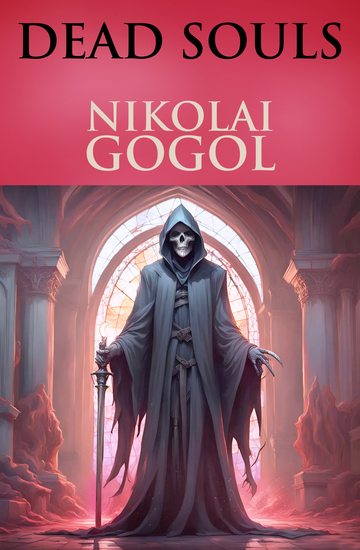
Dead Souls - cover

Dead Souls

Nikolai Gogol

Traductor D. J. Hogarth

Editorial: E-Kitap Projesi & Cheapest Books

  • 0
  • 0
  • 0

Sinopsis

Dead Souls, is a novel by Nikolai Gogol, first published in 1842, and widely regarded as an exemplar of 19th-century Russian literature. The purpose of the novel was to demonstrate the flaws and faults of the Russian mentality and character. Gogol masterfully portrayed those defects through Pavel Ivanovich Chichikov (the main character) and the people whom he encounters in his endeavours. These people are typical of the Russian middle-class of the time. Gogol himself saw it as an "epic poem in prose", and within the book as a "novel in verse". Despite supposedly completing the trilogy's second part, Gogol destroyed it shortly before his death. Although the novel ends in mid-sentence (like Sterne's Sentimental Journey)

"To the door of an inn in the provincial town of N. there drew up a smart britchka—a light spring-carriage of the sort affected by bachelors, retired lieutenant-colonels, staff-captains, land-owners possessed of about a hundred souls, and, in short, all persons who rank as gentlemen of the intermediate category.

In the britchka was seated such a gentleman—a man who, though not handsome, was not ill-favoured, not over-fat, and not over-thin. Also, though not over-elderly, he was not over-young. His arrival produced no stir in the town, and was ac-companied by no particular incident, beyond that a couple of peasants who happened to be standing at the door of a dramshop exchanged a few comments with reference to the equipage rather than to the individual who was seated in it. "Look at that carriage," one of them said to the other. "Think you it will be going as far as Moscow?"

"I think it will," replied his companion. "But not as far as Kazan, eh?" "No, not as far as Kazan." With that the conversation ended. Presently, as the britchka was approaching the inn, it was met by a young man in a pair of very short, very tight breeches of white dimity, a quasi-fashionable frockcoat, and a dickey fastened with a pistol-shaped bronze tie-pin.

The young man turned his head as he passed the britchka and eyed it attentively; after which he clapped his hand to his cap (which was in danger of being removed by the wind) and resumed his way.."
Disponible desde: 25/01/2024.
Longitud de impresión: 500 páginas.

Otros libros que te pueden interesar

  • Animal Farm by George Orwell (Book analysis) - Summary Analysis and Reading Guide - cover

    Animal Farm by George Orwell...

    Bright Summaries

    • 0
    • 0
    • 0
    In this clear and detailed reading guide, we've done all the hard work for you!Animal Farm by George Orwell is an allegory of the early communist regime in Russia. It tells the story of a group of animals who overthrow the owner of their farm and make their own set of rules to govern their existence.This practical and insightful reading guide includes:   • A complete plot summary   • Character studies   • Key themes and symbols   • Questions for further reflectionWhy choose BrightSummaries.com?Available in print and digital format, our publications are designed to accompany you in your reading journey. The clear and concise style makes for easy understanding, providing the perfect opportunity to improve your literary knowledge in no time.Shed new light on your favorite books with BrightSummaries.com!
    Ver libro
  • Madame Bovary - cover

    Madame Bovary

    Gustave Flaubert

    • 0
    • 0
    • 0
    "Madame Bovary" is a novel by French author Gustave Flaubert, first published in 1857. It is considered one of the greatest works of world literature and a seminal example of literary realism. The story follows the life of Emma Bovary, a young woman married to a country doctor, Charles Bovary. Dissatisfied with her provincial life and longing for romance and luxury, Emma becomes increasingly entangled in a web of debt and adultery. Flaubert's novel is a scathing critique of the French bourgeoisie and a masterful exploration of the consequences of romantic idealism and societal expectations.
    Ver libro
  • Shadow over Innsmouth The (Unabridged) - cover

    Shadow over Innsmouth The...

    H. P. Lovecraft

    • 0
    • 0
    • 0
    The Shadow over Innsmouth is a horror novella by American author H. P. Lovecraft, written in November-December 1931. It forms part of the Cthulhu Mythos, using its motif of a malign undersea civilization, and references several shared elements of the Mythos, including place-names, mythical creatures, and invocations. The Shadow over Innsmouth is the only Lovecraft story that was published in book form during his lifetime. The narrator is a student conducting an antiquarian tour of New England. He travels through the nearby decrepit seaport of Innsmouth which is suggested as a cheaper and potentially interesting next leg of his journey. There he interacts with strange people and observes disturbing events that ultimately lead to horrifying and personal revelations.
    Ver libro
  • Be This Her Memorial - From their pens to your ears genius in every story - cover

    Be This Her Memorial - From...

    Caradoc Evans

    • 0
    • 0
    • 0
    The bookshelves of British literature are incredible collections that have gathered together centuries of very talented authors.  From these Isles their fame spread and whilst among their number many are now forgotten or neglected their talents endure.  Among them is Caradoc Evans.
    Ver libro
  • The Open Boat - cover

    The Open Boat

    Stephen Crane

    • 0
    • 0
    • 0
    After battling the tempestuous sea, four men in a boat finally spy land. But will the process of getting to the land be their undoing? Based upon Crane’s experience of surviving a shipwreck when traveling to Cuba, The Open Boat is an excellent example of literary Naturalism. H.G. Wells considered it “the crown of all [Crane’s] work”.
    Ver libro
  • A Hunger Artist - cover

    A Hunger Artist

    Franz Kafka

    • 0
    • 0
    • 0
    A Hunger Artist is a short story by Franz Kafka first published in 1922. The protagonist, a hunger artist who experiences the decline in appreciation of his craft, is typically Kafkaesque: an individual marginalized and victimized by society at large. A Hunger Artist explores themes such as death, art, isolation, asceticism, spiritual poverty, futility, personal failure and the corruption of human relationships.
    Ver libro