Join us on a literary world trip!
Add this book to bookshelf
Grey
Write a new comment Default profile 50px
Grey
Subscribe to read the full book or read the first pages for free!
All characters reduced
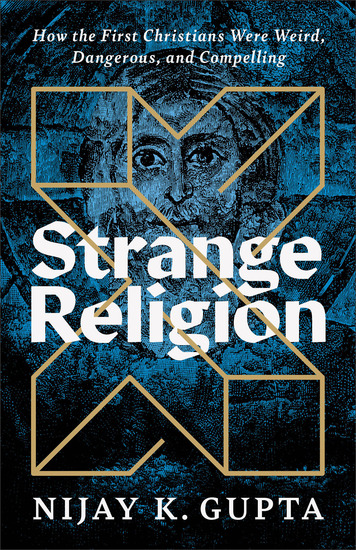
Strange Religion - How the First Christians Were Weird Dangerous and Compelling - cover

Strange Religion - How the First Christians Were Weird Dangerous and Compelling

Nijay K. Gupta

Publisher: Brazos Press

  • 0
  • 0
  • 0

Summary

Outreach 2025 Recommended Resource of the Year (Culture) 
 
The first Christians were weird. 
 
Within Roman society, the earliest Christians stood out for the oddness of their beliefs and practices. They believed unusual things, worshiped God in strange ways, and practiced a whole new way of doing religion that would have been viewed as bizarre and dangerous compared to other religions of the ancient world. 
 
In Strange Religion, award-winning author and New Testament teacher Nijay Gupta traces the emerging Christian faith in its Roman context, showing how the first Christians 
 
● dared to be different and pushed the boundaries of what was acceptable 
● believed, worshipped, and lived in radical ways 
● transformed how others thought about religion 
● started a movement that grew like wildfire 
 
Brought to life with numerous images, this book shows how the example of the earliest Christians can offer today's believers encouragement and hope. 
 
"A fresh and rigorously researched take on Christianity's founding."--Publishers Weekly
Available since: 02/27/2024.
Print length: 240 pages.

Other books that might interest you

  • Empath and Psychic Abilities - A Survival Guide for Highly Sensitive People to awaken your psychic and telepathic abilities - cover

    Empath and Psychic Abilities - A...

    Christian Dollwet

    • 0
    • 0
    • 0
    If you've spent your entire life being told this, chances are good that you're an empath or a very sensitive person. Our environment continually exhorts us to be more resilient. However, consider this: You cannot simply turn off your empathic abilities. There isn't a switch you can turn to turn it all off. You were born with it; it's an essential component of who you are. You shouldn't try to change it about yourself since you can't. 
    Being an empath is a wonderful gift that should be valued, fostered, and enhanced. With the weight of the entire planet on their shoulders, empaths are among the strongest people in the world. You can make your sensitivity your greatest superpower once you accept who you are! 
     In this book, you'll discover:What being an empath implies and why it's a gift rather than a burdenHow to resist being exhausted and overpowered by toxic individuals and circumstances even if you are unable to avoid themHow to harmonize and restore your chakras for a more centered and in charge feelingYou can use energy cleaning methods, meditation, and visualization to help you thrive as an empath rather than just get by.Essential oils and healing crystals for psychic development, healing, and protectionHow to communicate with your spirit guides so you can get strong advice and assistance to help you get through lifeHow to recognize and decipher auras to gain a deeper understanding of both yourself and others 
     The advantages are innumerable. So scroll up and click "Buy Now" if you're ready to start leading a more powerful life.
    Show book
  • A Rare Recording of Evelyn Waugh - cover

    A Rare Recording of Evelyn Waugh

    Evelyn Waugh

    • 0
    • 0
    • 0
    Arthur Evelyn St. John Waugh (October 28, 1903 - April 10, 1966) was an English writer of novels, biographies, and travel books; he was also a prolific journalist and book reviewer. His most famous works include Decline and Fall (1928) and A Handful of Dust (1934), the novel, Brideshead Revisited (1945). He is recognized as one of the great prose stylists of the English language in the 20th century. In this recording, Waugh discusses God, religion, writing, and his conversion to Catholicism.
    Show book
  • Twenty-One Boxes - Robin's Story and the Tragedy of the Edenton Seven - cover

    Twenty-One Boxes - Robin's Story...

    Betsy Hester, Robin Couto

    • 0
    • 0
    • 0
    In 1989, the Little Rascals Day Care in Edenton, North Carolina, was suddenly thrust into the national spotlight. One day, the owner's husband disciplined a boy at naptime, and soon an angry mother suggested that it was more than just a slap. Rumors quickly morphed into charges of unimaginable crimes against dozens of little children. Panic consumed the town, as the police, therapists, and parents relentlessly pressured the children who attended the day care to name their teachers responsible for multiple allegations of abuse. The Edenton Seven were caught up in the accusations, including nineteen-year-old teacher Robin Boles Byrum. She spent nearly a year in jail under an enormous bond meant to pressure her to "tell the truth" while she had a new baby at home. Eerily reminiscent of the hysteria that gripped Salem, Massachusetts, during the witch trials of the seventeenth century, the Little Rascals case ultimately became the longest and most expensive criminal trial in North Carolina history. 
    Three decades later, Betsy Hester met Robin Byrum Couto and together, they joined forces to tell the truth. In this book, Betsy shares insights from legal and medical experts and reveals the facts from twenty-one boxes and dozens of bound testimonies from the courtroom long since buried away. Intertwined with the case history is Robin's never-before-told story of her harrowing journey through the court system. Finally, this book serves as a modern-day warning about the danger of mass hysteria and the consequences of a judicial system that blindly refused to hear and seek the truth.
    Show book
  • Small Medium Large - How Government Made the US into a Manufacturing Powerhouse - cover

    Small Medium Large - How...

    Colleen A. Dunlavy

    • 0
    • 0
    • 0
    We live in a world of seemingly limitless consumer choice. Yet, as every shopper knows without thinking about it, many everyday goods—from beds to batteries to printer paper—are available in a finite number of "standard sizes." What makes these sizes "standard" is an agreement among competing firms to make or sell products with the same limited dimensions. But how did firms—often hotly competing firms—reach such collective agreements? 


    In exploring this question, Colleen Dunlavy puts the history of mass production and distribution in an entirely new light. She reveals that, despite the widely publicized model offered by Henry Ford, mass production techniques did not naturally diffuse throughout the US economy. On the contrary, formidable market forces blocked their diffusion. It was only under the cover of collectively agreed-upon, industry-wide standard sizes—orchestrated by the federal government—that competing firms were able to break free of market forces and transition to mass production and distribution. Without government promotion of standard sizes, the twentieth-century American variety of capitalism would have looked markedly less "Fordist." 


    Small, Medium, Large will make all of us think differently about the everyday consumer choices we take for granted.
    Show book
  • Modern Discovery of Australia and New Zealand The: The History of the Indigenous Natives and the Initial European Expeditions and Settlements - cover

    Modern Discovery of Australia...

    Editors Charles River

    • 0
    • 0
    • 0
    A land of almost 3 million square miles has lain since time immemorial on the southern flank of the planet, so isolated that it remained entirely outside of European knowledge until 1770. However, the first human footprints on this vast territory were felt 70,000 years earlier, as people began to cross the periodic land bridges and the short sea crossings from Southeast Asia. 
    By the mid-17th century, the existence of a land in the south referred to as Terra Australis was generally known and understood by the Europeans, and incrementally, its shores were observed and mapped. Van Diemen’s Land, an island off the south coast of Australia now called Tasmania, was identified in 1642 by Dutch mariner Abel Tasman, and a few months later, the intrepid Dutchman would add New Zealand to the map of the known world. 
    At the time, the English were the greatest naval power in Europe, but they arrived on the scene rather later. The first to appear was William Dampier, captain of the HMS Roebuck, in 1699, after he had been granted a Royal Commission by King William III to explore the east coast of New Holland. By then, the general global balance of power was shifting, and with the English gaining a solid foothold in India, their supremacy in the Indian Ocean trade zone began. The Dutch, once predominant in the region, began slowly to lose ground, slipping out of contention as a major global trading power. So too were the Portuguese, also once dominant in the region. It was now just the French and the English who were facing one another down in a quest to dominate the world, but their imperial interests were focused mainly in India and the East Indies, as well as the Caribbean and the Americas. As a result, the potential of a vast, practically uninhabited great southern continent did not yet hold much interest. By then the world was largely mapped, with just regions such as the Arctic Archipelago and the two poles remaining terra incognita.
    Show book
  • Saving Ourselves From Suicide - Before and After - How to Ask for Help Recognize Warning Signs and Navigate Grief - cover

    Saving Ourselves From Suicide -...

    LInda Pacha

    • 0
    • 0
    • 0
    HELP, HOPE, AND HEALING - 125 FIVE STAR AMAZON REVIEWS 
    An up-close look at Suicide Prevention and Grief in one best-selling book. Why? They relate more than you realize. Considering how loved ones would grieve might be what keeps someone here. Likewise, grief can become so intense that prevention tools are needed to keep safe those left behind. 
    Pacha, an attorney with a degree and post graduate studies in psychology, public speaks about prevention and grief through her nonprofit, Nick's Network of Hope. She lost her teen son and holds nothing back to help others. 
    SELF-HELP: Reasons to stay; make a safety plan; yell for help and allow it; you're not a burden; people care more than you think; how to reach out when hope is lost; and risk factors and warning signs with real-life examples 
    HOW TO HELP PEOPLE STRUGGLING: Okay to ask if suicidal; listen and ask open-ended questions; don't be a cheerleader if more is needed; believe behavior more than words; and seek professional help 
    GRIEF: Why push on; release guilt and anger; emotions of the first year; second year and beyond; grieving individually and together; new family dynamics; getting back into society; answering difficult questions; parenting surviving kids; keeping your marriage intact; what to avoid; siblings of suicide 
    HOW TO HELP THOSE GRIEVING: Don't avoid; listen but don't try to fix; talk about loved ones; and birthdays and anniversaries 
    STIGMA: Why it exists; ways to reduce it, complexities of mental health; misconceptions of suicide; and how mental health stigma morphs and attaches to survivors 
    HOW TO REDUCE PRESSURE: What is the pressure and ways to reduce it; and recommendations for parents and schools 
    A BETTER TOMORROW: Ways for kinder world; how to reduce bullying and teach kids to live with more compassion
    Show book