¡Acompáñanos a viajar por el mundo de los libros!
Añadir este libro a la estantería
Grey
Escribe un nuevo comentario Default profile 50px
Grey
Suscríbete para leer el libro completo o lee las primeras páginas gratis.
All characters reduced
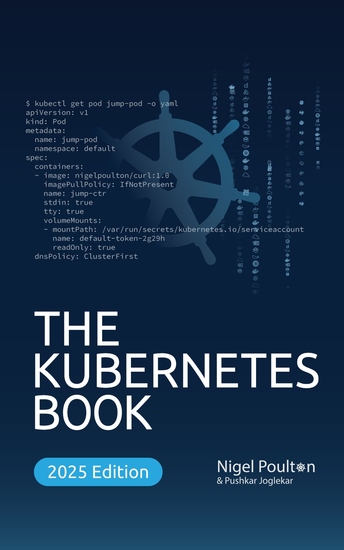
The Kubernetes Book 2025 Edition - cover

¡Lo sentimos! La editorial o autor ha eliminado este libro de nuestro catálogo. Pero no te preocupes, tenemos más de 500.000 otros libros que puedes disfrutar.

The Kubernetes Book 2025 Edition

Nigel Poulton

Editorial: Publishdrive

  • 0
  • 0
  • 0

Sinopsis

The #1 Best-Selling Kubernetes book –Fully Updated for 2025! 
 
For nearly a decade, The Kubernetes Book has been the go-to resource for developers, DevOps engineers, and IT professionals looking to master Kubernetes. With thousands of reviews and a track record as the most popular Kubernetes book, this Amazon bestseller is the ultimate guide to Kubernetes mastery.What’s New in the 2025 Edition?✅ All content & examples updated for the latest versions of Kubernetes✅ Native sidecar containers with hands-on examples✅ Wasm integration—build & deploy WebAssembly apps on Kubernetes✅ Real-world node failure scenarios to enhance troubleshooting skills✅ Simplified cluster setup for both cloud-based & local environmentsWhy Learn Kubernetes?Kubernetes is the foundation of modern cloud computing, and demand for Kubernetes expertise is at an all-time high. Whether you’re running production workloads in the cloud or experimenting locally, this book equips you with the skills needed to succeed.What You’ll Learn:✔️ Set up Kubernetes clusters (for free!)✔️ Understand Kubernetes architecture, scheduling, and networking✔️ Master Pods, Deployments, Services, StatefulSets, Ingress, and more✔️ Deploy Wasm applications to Kubernetes✔️ Gain real-world troubleshooting & security skills✔️ Demystify the Kubernetes API, service discovery, and load balancing✔️ Learn Kubernetes jargon-free, with practical, hands-on examplesWho Is This Book For?🔹 Developers & DevOps Engineers – Want to level up your containerization and cloud-native skills? This book has you covered.🔹 IT Professionals – Need Kubernetes knowledge for managing cloud infrastructure? This book delivers exactly what you need.Why This Book?📖 Most comprehensive Kubernetes guide—trusted by thousands of professionals🛠️ Packed with examples—not just theory, but practical hands-on learning🚀 Covers the latest Kubernetes features—so you stay ahead of the curveMaster Kubernetes faster and more efficiently than ever before. Get your copy today and take your cloud-native skills to the next level!
Disponible desde: 29/06/2023.
Longitud de impresión: 355 páginas.

Otros libros que te pueden interesar

  • Agile Transformation with an Agile Coaching Mindset - Adoption of agile methodology in software development - cover

    Agile Transformation with an...

    Jimmy Mathew

    • 0
    • 0
    • 0
    Agile Transformation with an Agile Coaching Mindset: Moving to agile software development. 
    Coaching, Agile Coaching, Transformation, Agile Transformation, Agile Coach, Transformation Coach…. Lots of combinations we hear in everyday life. We are discussing agile transformation here. The approach we follow in this training is “Agile Transformation with an Agile Coaching Mindset”. 
    The dictionary meaning for agile is "able to move quickly and easily". Also, a much talked about attribute of agile is flexibility, ability to respond to changes. 
    How agile can an “agile transformation be"? In our approach, we believe the transformation itself must be agile. It must be an empirical process with an adaptive plan, which is flexible enough to accommodate new learnings accrued during the transformation journey. We keep improving every moment, and the agility evolves as we progress through this journey. 
    We believe in “Agile Transformation with an Agile Coaching Mindset”. 
    Let’s try to list down various phases a typical transformation journey goes through. These steps are negotiable. Based on the organization, team, and environment, these steps may change, be replaced, or be removed. The team may go through phases like… 
    Understand the Organisation, Culture, and Practices; Understand the drivers and set goals; Define Road map; Make Agile visible; Establish Agile training; Align Organisation structure and high-level processes; Start with Agile Practices; Team level transformation; Inspect and Adapt. 
    There is not any specific order for executing many of these steps in our journey. These may even go in parallel or in a different order based on the situation. This book discusses each phase in detail.
    Ver libro
  • Eye Movement Desensitization and Reprocessing (EMDR) - Processing Trauma through Eye Movement - cover

    Eye Movement Desensitization and...

    Vivian Westlake

    • 0
    • 0
    • 0
    Eye Movement Desensitization and Reprocessing (EMDR) is a therapeutic approach that has garnered widespread recognition for its effectiveness in treating trauma, particularly post-traumatic stress disorder (PTSD). Developed by Francine Shapiro in the late 1980s, EMDR is founded on the concept that distressing memories can become “stuck” in the brain, leading to emotional and psychological difficulties. By using bilateral stimulation—usually in the form of guided eye movements—EMDR aims to facilitate the processing of these memories, enabling individuals to integrate them in a way that reduces emotional distress. 
    At its core, EMDR is grounded in the understanding that trauma can impair the brain's natural processing abilities. When a traumatic event occurs, the brain’s memory systems may not fully encode the memory, leaving the experience fragmented and unresolved. As a result, individuals may experience intrusive thoughts, flashbacks, and heightened emotional responses associated with the unresolved trauma. EMDR aims to "unstick" these memories and allow the brain to reprocess them, turning them from vivid, emotionally charged experiences into less distressing memories that can be stored in a more adaptive manner. 
    The key to EMDR's effectiveness lies in its use of bilateral stimulation. During the therapy session, the client follows the therapist’s fingers or another form of rhythmic bilateral stimulation (e.g., auditory tones or tactile taps) while focusing on distressing memories. This process is thought to mimic the natural mechanisms the brain uses during REM sleep, a stage associated with memory consolidation and emotional processing. By engaging both hemispheres of the brain in this way, EMDR helps clients process traumatic memories, alleviating their emotional charge and reducing their impact on daily life.
    Ver libro
  • Space Trek - cover

    Space Trek

    Raphael Terra

    • 0
    • 0
    • 0
    This audiobook has been recorded using Text to speech (TTS). 
     
    For decades we have all grown up watching science fiction movies and TV shows. And we have all dreamed of going where no man has gone before. That time is here and now. We are on the very edge of a new era in humanity. Within the next few years mankind will be not only journeying to other planets, we will be inhabiting them. Our ultra-high technology robots are even now walking upon the surface of Mars, sending back information and preparing the ground for our coming. 
     
    This is not science fiction. This is science fact. And just as before in the history of humanity, the process is being led by several unique, intelligent and talented individuals such as Elon Musk. 
     
    Rocket ships take off vertically and return to Earth vertically. Humans are shuttled to the International Space Station as if they're travelling from New York to Los Angeles. Supersonic space craft fly mankind around the globe virtually in space, just to make things faster. 
     
    But what does the future hold for us? We cannot maintain peace on Earth. How can we do so in space? NASA, SpaceX and Virgin are not the only ones with eyes upon the stars. Russia and especially China, also have desires in that direction. 
     
    The race for space is on and all bets are off.
    Ver libro
  • Atomic Hide-and-Seek - The Ongoing Quest for a Concealed Weapon of Mass Destruction - cover

    Atomic Hide-and-Seek - The...

    John Harpoon

    • 0
    • 0
    • 0
    In the annals of modern history, few inventions have cast as long and dark a shadow as the atomic bomb. Its birth marked a seismic shift in human capability, wielding the power to obliterate entire cities and reshape geopolitical landscapes. Yet, from its inception, the atom's power has not merely been a matter of spectacle but of concealment. Beneath the publicized detonations and treaty negotiations lies a quieter, more insidious game—one where nations and non-state actors seek to hide their most devastating weapons in plain sight. 
    This hidden game began almost as soon as the atomic bomb was developed. During the Manhattan Project, secrecy was paramount, not just to protect scientific progress but to ensure strategic advantage. The veil of secrecy surrounding nuclear weapons set the stage for an enduring tradition of concealment. As the technology proliferated, so too did the techniques for hiding these weapons: underground silos, mobile launchers, and entire programs buried under bureaucratic misdirection. The Cold War, in particular, saw the emergence of elaborate strategies of obfuscation, where intelligence agencies and military powers engaged in a high-stakes game of hide-and-seek. 
    At the heart of this game lies a paradox. The destructive potential of nuclear weapons is unparalleled, yet their true power is magnified when shrouded in uncertainty. A hidden arsenal not only evades preemptive strikes but also exerts a psychological toll on adversaries, forcing them to account for every possibility. This uncertainty has become a tool of diplomacy, coercion, and deterrence, embedding itself deeply into the fabric of international relations.
    Ver libro
  • Gunpowder and the Printing Press: The History and Legacy of the Inventions that Modernized Europe - cover

    Gunpowder and the Printing...

    Editors Charles River

    • 0
    • 0
    • 0
    In addition to the wheelbarrow, the seismograph, the waterwheel, deep drilling, suspension bridges, and ship rudders, among countless other life-changing contraptions, the Chinese developed what were later dubbed the “Four Great Inventions of China.” Two of those were gunpowder and printing, which both spread through South Asia and the Middle East before making it to Europe.  
    For a time, gunpowder was a mere curiosity, but its destructive power and military potential would be realized quickly. The first record of a cannon in Europe comes from a manuscript written in 1326, which has an illustration showing an armored man with what looks like a slow match lighting a vase-shaped object. This crude cannon was called a pot de fer in French and vasi in Italian. While medieval engineers developed new types of cannons and explosives capable of destroying walls and castles, others were making the first handguns possible. European sources first mentioned the widespread use of handgonnes, as they were often called, in the late 14th century, precisely the time when gunpowder became cheaper.  
    	The history of printing was for ancient Asia an advancement in culture and communication, but for Europe in the 15th century, it was much more, plunging the continent into a new paradigm and aligning it for the modern world. Its importance is often overlooked, but the timeliness of the printing machine was equivalent to the invention of alphabets in antiquity and ranks up there with the digital revolution and the introduction of the internet. Put simply, it made the Renaissance possible and led to the modernization of Europe. Based on earlier Asian principles, Johannes Gutenberg’s movable type printing press propelled an industry that led to the education of the West and ultimately removed the tight grip of the Vatican from daily European life. 
    Ver libro
  • Trailblazing Women Mathematicians: The Hidden Story that Defied the Odds - "Discover Hidden Heroines of Math: Audio Lessons for an Inspiring Unmissable Experience!" - cover

    Trailblazing Women...

    Brandon Ashcroft

    • 0
    • 0
    • 0
    Trailblazing Women Mathematicians: The Hidden Story that Defied the Odds 
    ⭐⭐ Simplified Audio Guide ⭐⭐ 
    Are you eager to advance your understanding of trailblazing women mathematicians and uncover the hidden stories that defied the odds? 
    Looking for a comprehensive guide that illuminates the extraordinary lives and contributions of women mathematicians throughout history? 
    Your search ends here! 
    This audiobook serves as your definitive companion for broadening your knowledge, deepening your appreciation of their achievements, and engaging with detailed narratives. With this, you're set for an enriching journey. 
    Updated to include the latest research and insights. 
    Key features of this enriched guide: 
    - Profound insights about trailblazing women mathematicians 
    - Detailed explanations of their contributions and struggles 
    - Inspirational stories and strategies for overcoming obstacles 
    Our audiobook distinguishes itself through comprehensive coverage, essential for a thorough understanding of the subject. Concepts aren't merely skimmed; they are delved into with precision. 
    Designed with a clear structure and easy-to-understand language, our guide on trailblazing women mathematicians ensures smooth transitions between topics. Say goodbye to dense jargon and welcome clear, precise, and technically accurate content. 
    So, why wait? Click the BUY NOW button, secure your audiobook, and begin your journey to uncovering the hidden stories of trailblazing women mathematicians!
    Ver libro