¡Acompáñanos a viajar por el mundo de los libros!
Añadir este libro a la estantería
Grey
Escribe un nuevo comentario Default profile 50px
Grey
Suscríbete para leer el libro completo o lee las primeras páginas gratis.
All characters reduced
Alessandro Verri between Enlightenment and Tradition - cover

Alessandro Verri between Enlightenment and Tradition

Nicola Bizzi

Editorial: Edizioni Aurora Boreale

  • 0
  • 0
  • 0

Sinopsis

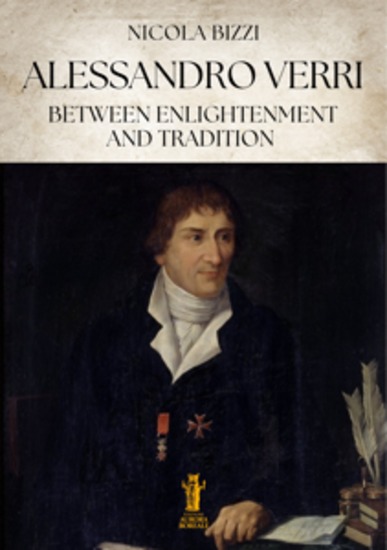
Alessandro Verri (1741-1816) was a remarkable intellectual, philosopher, historian, and man of letters from Milan, lived through the transition from the Enlightenment to Romanticism. He is remembered for his friendship with Cesare Beccaria and his contributions to the magazine Il Caffè, which he founded with his brother Pietro.He began writing his most famous novel, Via di Erostrato (Life of Herostratus), in 1793, a year after being admitted to the Academy of Arcadia in Rome under the initiatory name of Aristander Pentelicus. The work, which was published only in 1815, a year before his death, is a unique and compelling historical novel in which the author, pretending to translate a genuine Greek text—a literary device Verri had already used years earlier in Notti romane al sepolcro degli Scipioni—imaginatively (but not entirely) narrates the adventurous and dramatic life of Herostratus, a Greek from Corinth. After a life filled with failures and disappointments, and for the sole purpose of being remembered by posterity, Erostratus deliberately set fire to the majestic Temple of Artemis at Ephesus, one of the seven wonders of the ancient world.
Disponible desde: 24/08/2025.

Otros libros que te pueden interesar

  • The Australian Wars - The truth about the bloody battles fought to establish a nation - cover

    The Australian Wars - The truth...

    Mina Murray, Stephen Gapps,...

    • 0
    • 0
    • 0
    The truth about the bloody battles fought to establish a nation 
     
    For the first time, The Australian Wars brings what for too long has been considered the historical past into connection with its reverberations in the present. 
     
    It is estimated up to 100,000 people died in the frontier wars that raged across Australia for more than 150 years. This is equivalent to the combined total of all Australians killed in foreign battles to date. But there are few memorials marking these first, domestic wars. 
     
    The Australian Wars was conceived by Rachel Perkins following her award-winning documentary series produced by Blackfella Films for SBS and edited along with Stephen Gapps, Mina Murray and Henry Reynolds. This is the first book to tell the story of the continental sweep of massacres, guerilla warfare, resistance and the contests of firearms and traditional Aboriginal weaponry as Indigenous nations resisted colonial occupation of their lands, territory by territory. At stake was the sovereignty of an entire country. 
     
    Black and white writers tell the stories of these battles across three crucial time periods, and all the states and territories. It notes the lands that were unconquered, as well as the role of disease, weapons and tactics, and the story of women on the frontier. 
     
    This history is still alive in those descendants who carry the stories of their ancestors. The Australian Wars brings what for too long has been considered the historical past into the present so that we might know the truth of the origins of this nation. 
     
     
    'As it peels back the enduring veils of silence and denial about our shared past, The Australian Wars exposes a complex legacy of shame, pride, crime and valour. It offers us an opportunity to ask ourselves, in a spirit of humility and honesty, what it truly means to be an Australian patriot. The authors of this work have delivered a huge favour wrapped in a hard lesson.' TIM WINTON 
     
     
    'An inspiring, game-changing work of collective truth-telling about our shared history.' KATE GRENVILLE 
     
     
    ‘Rachel Perkins and her fellow editors have done us all a great service in bringing this history together.' DAVID KEMP AC 
     
     
    'Together with the TV series The Australian Wars puts down a marker: no more denial, no more cant. These wars happened and we cannot blink them away.' DON WATSON 
     
     
    'This book has the best of contemporary research. It will ensure that the original people of this nation are not denied the dignity of their resistance and the truth telling has the edge it should.' KIM BEAZLEY 
     
     
    'A compelling call to truth-telling and national reckoning. Essential reading for all Australians.' THE HON KEN WYATT AC
    Ver libro
  • Beyond the Secret Garden - The Life of Frances Hodgson Burnett - cover

    Beyond the Secret Garden - The...

    Ann Thwaite, Jacqueline Wilson

    • 0
    • 0
    • 0
    Frances Hodgson Burnett's favorite theme in her fiction was the reversal of fortune, and she herself knew extremes of poverty and wealth. Born in Manchester in 1849, she emigrated with her family to Tennessee because of the financial problems caused by the cotton famine. From a young age she published her stories to help the family make ends meet. Only after she married did she publish Little Lord Fauntleroy that shot her into literary stardom. 


    On the surface, Frances' life was extremely successful: hosting regular literary salons in her home and travelling frequently between properties in the United Kingdom and America. But behind the colorful personal and social life, she was a complex and contradictory character. She lost both parents by her twenty-first birthday, Henry James called her "the most heavenly of women" although avoided her; prominent people admired her and there were many friendships as well as an ill-advised marriage to a much younger man that ended in heartache. Her success was punctuated by periods of depression, in one instance brought on by the tragic loss of her eldest son to consumption. 


    Ann Thwaite creates a sympathetic but balanced and eye-opening biography of the woman who has enchanted numerous generations of children.
    Ver libro
  • Positive Affirmations for Black Male Excellence - Achieve success wealth love and happiness Powerful & uplifting truths for BIPOC men to become confident fearless disciplined motivated & inspired - cover

    Positive Affirmations for Black...

    Elijah Jackson

    • 0
    • 0
    • 0
    Ready to embark on a transformative journey? 
    Dive into Positive Affirmations for Black Male Excellence, a collection of over 230 potent affirmations tailored specifically to uplift and empower Black men. 
    With these affirmations, you'll supercharge your motivation, boost your self-confidence, forge meaningful connections, and enhance your resilience. Gain the tools to master self-discipline and unlock your potential for success. Positive Affirmations for Black Male Excellence is your compass to:Harness the full potential of daily affirmations to reshape your subconscious identityLiberate yourself from the shackles of self-limiting beliefs that hinder your growth.Choose daily affirmations from six distinct sections, tailoring your self-improvement journeyRecite affirmations with conviction, using your voice as a catalyst for transformation.Gradually rewire your mindset, enhancing your productivity and fostering a positive outlook 
    This book is your partner in personal evolution. Simply put on your headphones, select your desired chapter, and immerse yourself in the affirmations. Transform your circumstances by first transforming your mindset. 
    Join the ranks of Black men who are already experiencing life-altering changes with these unique techniques. Be the living embodiment of Black Excellence and watch your dreams materialize before your eyes.
    Ver libro
  • Daily Life in Ancient Egypt - Society Culture and Customs - cover

    Daily Life in Ancient Egypt -...

    Omar Khalil

    • 0
    • 0
    • 0
    Ancient Egyptian society was highly structured, with a rigid hierarchy that defined people’s roles and responsibilities. At the top of this social order was the pharaoh, considered both a political ruler and a divine figure. Below the pharaoh were the nobility and officials who managed the kingdom’s affairs. The middle class consisted of scribes, artisans, and merchants, while the majority of the population comprised farmers, laborers, and slaves. Each social group played a crucial role in maintaining Egypt’s stability and prosperity. 
    The pharaoh was the central authority in Egypt, believed to be the living embodiment of a god. His rule was absolute, and his primary duty was to maintain ma’at, the divine balance of order and justice. He oversaw military campaigns, religious ceremonies, and massive building projects, including temples and pyramids. The royal court and government officials assisted the pharaoh in administration. These officials, often chosen from the nobility, held positions such as viziers, tax collectors, and governors, ensuring the kingdom functioned efficiently. 
    Scribes, artisans, and merchants formed the middle class, contributing to Egypt’s economy and culture. Scribes were essential for maintaining records, writing official documents, and preserving religious texts. Their education was rigorous, requiring years of training in hieroglyphic writing. Artisans, including sculptors, painters, and metalworkers, created the intricate decorations found in tombs and temples. Merchants facilitated trade both within Egypt and with foreign lands, bringing valuable goods such as gold, spices, and precious stones. Although they did not hold political power, the middle class enjoyed a stable livelihood and social respect.
    Ver libro
  • Cryptography in World War I: The History of the Efforts to Make and Break Secret Codes during the Great War - cover

    Cryptography in World War I: The...

    Editors Charles River

    • 0
    • 0
    • 0
    World War I was the first major conflict in which new electronic means of transmitting and receiving messages became a major factor in political and military operations. The electric telegraph was developed in the first half of the 19th century, and by 1850, there were several telegraph companies around the world providing a service that allowed virtually instantaneous communication over long distances. This was a major breakthrough, but the telegraph depended on the availability of wires to transmit messages between stations, meaning that if these wires were broken or damaged, communications were cut off. 
    	Late in the 19th century, there was another new development, the telephone, though this too relied on wires to transmit and receive information. At the same time, there was a new invention that provided instant voice and Morse code communication over long distances that did not require wires. Initially called wireless, radio was quickly adopted by armies around the world as a way of providing rapid communication between military units. By the time World War I began in 1914, all the major nations involved had provided their forces with some form of radio equipment. 
    	Of course, this came with a fundamental problem: radio, telephone, and telegraph messages could be intercepted by the enemy, potentially giving them notice of impending operations. To protect these electronic messages from being read by the enemy, armies began to use codes and ciphers to disguise the meaning of messages. Teams were created to devise effective codes and ciphers, and these were quickly followed by other teams whose role was to attempt to break the codes and ciphers used by the other side. As a result, a secret war began, almost completely hidden from public view, as the belligerents devised complex ways of hiding the real meaning of their own messages while simultaneously attempting to understand those of the enemy. 
    Ver libro
  • On Life After Death - cover

    On Life After Death

    Carl Jung

    • 0
    • 0
    • 0
    C. G. Jung, (Carl Gustav Jung) was a Swiss psychiatrist and psychotherapist who founded analytical psychology. Jung proposed and developed the concepts of extraversion and introversion archetypes, as well as the collective unconscious. His work has been influential in psychiatry and in the study of religion, philosophy, archeology, anthropology, literature, and related fields. He was a prolific writer, many of whose works were not published until after his death. 
    The central concept of analytical psychology is individuation—the psychological process of integrating the opposites, including the conscious with the unconscious, while still maintaining their relative autonomy. Jung considered individuation to be the central process of human development. 
    Jung created some of the best known psychological concepts, including the archetype, the collective unconscious, the complex, and synchronicity. The Myers-Briggs Type Indicator (MBTI), a popular psychometric instrument, has been developed from Jung's theory of psychological types. 
    Though he was a practising clinician and considered himself to be a scientist, much of his life's work was spent exploring tangential areas such as Eastern and Western philosophy, alchemy, astrology, and sociology, as well as literature and the arts. Jung's interest in philosophy and the occult led many to view him as a mystic, although his ambition was to be seen as a man of science. His influence on popular psychology, the psychologization of religion, spirituality, and the New Age movement has been immense.
    Ver libro