Join us on a literary world trip!
Add this book to bookshelf
Grey
Write a new comment Default profile 50px
Grey
Subscribe to read the full book or read the first pages for free!
All characters reduced
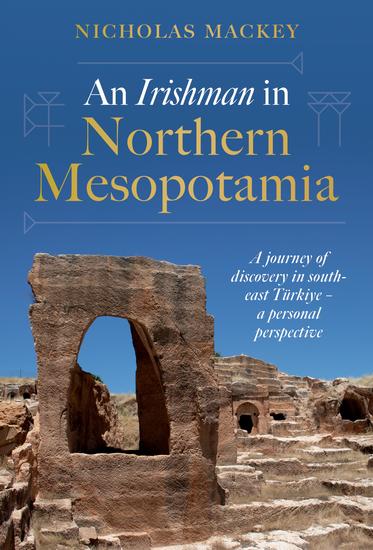
An Irishman in Northern Mesopotamia - A Journey of Discovery in South-East Türkiye – A Personal Perspective - cover

An Irishman in Northern Mesopotamia - A Journey of Discovery in South-East Türkiye – A Personal Perspective

Nicholas Mackey

Publisher: Unicorn

  • 0
  • 0
  • 0

Summary

Embark on an extraordinary odyssey through south-east Türkiye with Nicholas Mackey as he guides you through a captivating region embraced by the legendary Euphrates and Tigris rivers—the Cradle of Civilisation. Here he explores the ancient wonders of Antakya, Dara, Harran, Mardin, Gaziantep, and Diyarbakir, peeling back the layers of empires, cultures and peoples that have shaped millennia. Göbeklitepe and Karahan Tepe, near the contemporary city of Şanlıurfa/Urfa, stand as iconic archaeological landmarks with the promise to revolutionize our understanding of the past. Artefacts from these locations, dating back nearly 12,000 years, challenge established notions of the origins of civilisation.
His daily journal serves as the genesis of this literary tour-de-force: a seamless blend of travelogue, memoir, history, archaeology, poetry, prose, and memorable imagery – evocative of Nicholas coming of age in Ireland with an unquenchable desire to travel, 'to seek and find' (Whitman).
This is not just an eclectic tale but also will remain an enduring presence in your mind, while inviting you to rethink the fabric of our shared human history.
Available since: 10/03/2024.
Print length: 240 pages.

Other books that might interest you

  • Chasing Bruce - Confessions of a Springsteen Fan - cover

    Chasing Bruce - Confessions of a...

    Lori Krein

    • 0
    • 0
    • 0
    Lori’s obsession with Springsteen began in the summer of 1981, when she hid in the bathroom stall of a seaside bar for four hours because she heard Bruce might show up. That experience kicked off a journey of music, mayhem, and magic that’s lasted decades. This memoir is a tribute to the joy and connection Bruce has brought to her life and the lives of fellow fans who've shared their stories, their memories, and their hearts.
    Show book
  • Fort Henry: The History of the Union’s First Major Victory in the West during the Civil War - cover

    Fort Henry: The History of the...

    Jonathan Gianos-Steinberg

    • 0
    • 0
    • 0
    While the Lincoln Administration and most Northerners were preoccupied with trying to capture Richmond in the summer of 1861, it would be the little-known Ulysses S. Grant who delivered the Union’s first major victories, over a thousand miles away from Washington. Grant’s new commission led to his command of the District of Southeast Missouri, headquartered at Cairo, after he was appointed by “The Pathfinder”, John C. Fremont, a national celebrity who had run for President in 1856. Fremont was one of many political generals that Lincoln was saddled with, and his political prominence ensured he was given a prominent command as commander of the Department of the West early in the war before running so afoul of the Lincoln Administration that he was court-martialed. 
    In January of 1862, Grant persuaded General Henry “Old Brains” Halleck to allow his men to launch a campaign on the Tennessee River. As soon as Halleck acquiesced, Grant moved against Fort Henry, in close coordination with the naval command of Flag Officer Andrew Hull Foote. The combination of infantry and naval bombardment helped force the capitulation of Fort Henry on February 6, 1862, and the surrender of Fort Henry was followed immediately by an attack on Fort Donelson on the Cumberland River, which earned Grant his famous nickname “Unconditional Surrender”. Grant’s forces enveloped the Confederate garrison at Fort Donelson, which included Confederate generals Simon Buckner, John Floyd, and Gideon Pillow. In one of the most bungled operations of the war, the Confederate generals tried and failed to open an escape route by attacking Grant’s forces on February 15. Although the initial assault was successful, General Pillow inexplicably chose to have his men pull back into their trenches, ostensibly so they could take more supplies before their escape. Instead, they simply lost all the ground they had taken, and the garrison was cut off yet again.
    Show book
  • Parliamentary America - The Least Radical Means of Radically Repairing Our Broken Democracy - cover

    Parliamentary America - The...

    Maxwell L. Stearns

    • 0
    • 0
    • 0
    Americans face increasingly stark choices each presidential election and a growing sense that our government can't solve the nation's most urgent challenges.  Our eighteenth-century system is ill-suited to our twenty-first-century world. Information-age technology has undermined our capacity to face common problems together and turned our democracy upside down, with gerrymanders letting representatives choose voters rather than voters choosing them. In Parliamentary America, Maxwell L. Stearns argues that the solution to these complex problems is a parliamentary democracy. 


    Stearns considers such leading alternatives as ranked choice voting, the national popular vote, and congressional term limits, showing why these can't solve our constitutional crisis. Instead, three amendments—expanding the House of Representatives, having House party coalitions choose the president, and letting the House end a failing presidency based on no confidence—will produce a robust multiparty democracy. 


    Stearns takes listeners on a world tour—England, France, Germany, Israel, Taiwan, Brazil, and Venezuela—showing what works in government, what doesn't, and how to make the best features our own. Genuine party competition and governing coalitions, commonplace across the globe, may seem like a fantasy in the United States. But we can make them a reality.
    Show book
  • Irish Mythology: Enthralling Myths Folktales and Legends of Gods Goddesses and Mythological Creatures of Ancient Ireland - cover

    Irish Mythology: Enthralling...

    Billy Wellman

    • 0
    • 0
    • 0
    This audiobook beckons you into a world where the veil between the mundane and the magical is whisper-thin, where the landscapes of Ireland are not just settings but also active participants in tales of heroism, love, and betrayal. 
    Within this audiobook lies the heart of Irish identity—a rich heritage of storytelling that has been passed down through the generations, from the mysterious Druids and the formidable Tuatha Dé Danann to legendary heroes whose deeds are still sung. Meet the awe-inspiring gods and goddesses who wielded power over life and death and shaped the destiny of Ireland itself. 
    As you journey through this audiobook, you’ll encounter:Creation Myths - Discover the origins of the cosmos according to Irish lore, in which ancient deities shaped the land and gave life to people.Gods and Goddesses - Meet the pantheon of Irish divine beings, from the mighty Dagda to the enchanting Mórrígan, each wielding power over aspects of life, death, and natureThe Heroic Sagas - Follow the epic adventures of legendary heroes such as Cú Chulainn and Fionn mac Cumhaill, whose deeds of bravery and strength are immortalized in the annals of Irish history.The Otherworld - Venture into the ethereal realms of Tír na nÓg and the mysterious sidhe, where time flows differently and the fae hold court.Folktales and Legends - Delve into the rich tapestry of Irish folk stories, full of wit, wisdom, and whimsy, that have been passed down through generations.Mythological Creatures - Encounter the fantastical beings that roam the Irish landscape, from the fearsome banshee to the mischievous leprechaun. 
    The misty hills of Ireland are calling. Scroll up and “click the add” cart button to begin learning about Irish mythology!
    Show book
  • The Informer a Tale from the Royal Irish Constabulary - by Anonymous - cover

    The Informer a Tale from the...

    Anonymous Anonymous

    • 0
    • 0
    • 0
    This is the story of Patsy Mulligan, a poor Irish lad who fought in the First World War, and who afterwards returned to an Ireland on the verge of civil war. It was published in 1921 as the first chapter of an anonymous book. It is told from the detached perspective of a policeman, but the story does give us a glimpse into the complexities of the Irish situation at the time, and should for this reason be of interest of all students of history. It is also a very dramatic story, of betrayal and love... And it is allegedly true. 
    The narrator is Michael Henrik Wynn, the editor of the educational net radio stream Historyradio.org.
    Show book
  • Residual Governance - How South Africa Foretells Planetary Futures - cover

    Residual Governance - How South...

    Gabrielle Hecht

    • 0
    • 0
    • 0
    In Residual Governance, Gabrielle Hecht dives into the wastes of gold and uranium mining in South Africa to explore how communities, experts, and artists fight for infrastructural and environmental justice. Hecht outlines how mining in South Africa is a prime example of what she theorizes as residual governance—the governance of waste and discard, governance that is purposefully inefficient, and governance that treats people and places as waste and wastelands. She centers the voices of people who resist residual governance and the harms of toxic mining waste to highlight how mining's centrality to South African history reveals the links between race, capitalism, the state, and the environment. In this way, Hecht shows how the history of mining in South Africa and the resistance to residual governance and environmental degradation is a planetary story: the underlying logic of residual governance lies at the heart of contemporary global racial capitalism and is a major accelerant of the Anthropocene.
    Show book