¡Acompáñanos a viajar por el mundo de los libros!
Añadir este libro a la estantería
Grey
Escribe un nuevo comentario Default profile 50px
Grey
Suscríbete para leer el libro completo o lee las primeras páginas gratis.
All characters reduced
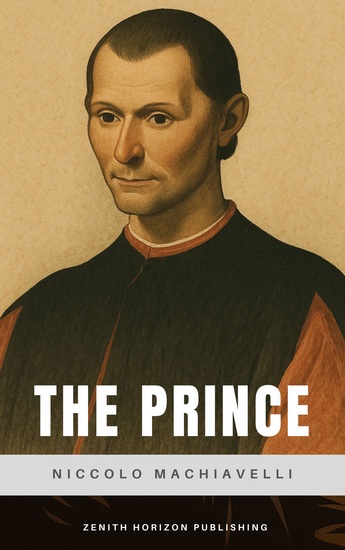
The Prince - Niccolò Machiavelli's Classic Political Strategy Guide - cover

The Prince - Niccolò Machiavelli's Classic Political Strategy Guide

Niccolo Machiavelli, Zenith Horizon Publishing

Editorial: Zenith Horizon Publishing

  • 0
  • 0
  • 0

Sinopsis

Power is never given. It is taken.

The Prince by Niccolò Machiavelli remains one of the most influential political treatises ever written. First published in 1532, this provocative classic lays out the cold, calculated truths of leadership, ambition, and power with startling precision.

Whether you're a student of politics, a strategist, or simply fascinated by the realities of power, this is essential reading.

🏛️ This edition includes:

The full, unabridged original text

Kindle-optimized formatting for smooth reading

A clean layout designed for scholars and modern readers alike

📚 A must-have for anyone interested in leadership, strategy, and political history.

Step into the mind of Machiavelli and rethink how power really works.
Download your copy now.
Disponible desde: 17/06/2025.
Longitud de impresión: 167 páginas.
Otros libros que te pueden interesar

  • Venetian Empire - The Grand History of the Venetians - cover

    Venetian Empire - The Grand...

    Kelly Mass

    • 0
    • 0
    • 0
    When we think of Venice, we think of masks, canals, murals and frescoes, and little “gondoliers” with picturesque boats. Venice, indeed, has an impressive artistic history. But did you know that Venice was also, for a while, a considerably-sized empire? 
    Although no enduring historic records associate with the creation of Venice, the Republic of Venice's history is typically said to start at 12 a.m. on Friday, March 25th, AD 421, when authorities from Padua established the city to develop a trading center in that area of northern Italy. 
    The creation of the Venetian republic is said to have accompanied the starting of the church of St. James at the exact same time. Still, the church (which is believed to be that of Saint Giacomo di Rialto) dates no earlier than the l lth century, and no after the mid-twelfth century. 
    According to legend, the area's first residents were Hun and Germanic refugees escaping succeeding waves of Hun and Germanic intrusions from the mid-second to mid-fifth centuries, who originated from near Roman cities like Padua, Aquileia, Treviso, Altino, and Concordia (contemporary Concordia Sagittaria), and the undefended countryside. 
    Let’s dive deeper into the history of the Venetian Empire. Let’s find out what made them so unique and successful at what they did.
    Ver libro
  • Philadelphia Experiment The: The History of World War II’s Most Unshakable Urban Legend - cover

    Philadelphia Experiment The: The...

    Editors Charles River

    • 0
    • 0
    • 0
    The borderlands of the paranormal include some bizarre stories. However, none are more strange or unsettling than the tale of what became known as the Philadelphia Experiment, an alleged effort during World War II to make a US Navy ship invisible by using electrical power. 
    The purported experiment gained international fame with the publication of a book by Charles Berlitz in 1978 and has now entered the lexicon of popular imagination. More than one movie has featured this experiment, but even as more people have heard about the Philadelphia Experiment, there are a number of different accounts of just what is said to have happened. The most dramatic accounts involve the brief teleportation of a US Navy warship and its crew into another dimension, with subsequent and horrifying effects for the men on board when it returned. Other versions are a little more mundane, but all seem to agree that something very odd happened to a US Navy ship in 1943. 
    This is a complex story, first emerging in the late 1950s before coming to international attention in the 1970s and developing in the 1980s and after. It involves some of the foremost scientists of the 20th century, and while it is a truly fascinating tale, it is one that has caused (and continues to generate) a great deal of debate. Is the Philadelphia Experiment a hoax, a myth, or somehow partly true, and how did this story first emerge? Readers may be more than a little surprised at the outcome.
    Ver libro
  • Enquiry Concerning Human Understanding An - cover

    Enquiry Concerning Human...

    David Hume

    • 0
    • 0
    • 0
    "An Enquiry Concerning Human Understanding" is a philosophical work written by David Hume in the 18th century. It is one of the most influential works in Western philosophy and is considered a cornerstone of modern empiricism and skepticism. 
    In this book, Hume investigates the nature and limits of human knowledge, arguing that all knowledge is based on our experiences and observations of the world. He asserts that we cannot know anything beyond what we have observed or experienced, and that there is no rational basis for many of the beliefs that we hold. 
    Hume's philosophy is deeply skeptical, and he questions many of the traditional ideas of Western philosophy, including causation, induction, and the existence of God. He argues that our beliefs in these concepts are not based on reason, but rather on habit or custom, and that they cannot be rationally justified. 
    Hume also explores the nature of morality and human nature, arguing that moral judgments are based on sentiment rather than reason, and that human beings are fundamentally motivated by self-interest rather than by any innate moral principles. 
    Overall, "An Enquiry Concerning Human Understanding" is a profound and influential work that challenges many of the fundamental assumptions of Western philosophy. It is notable for its skepticism and empiricism, and for its rejection of many traditional metaphysical and theological concepts.
    Ver libro
  • Vasco da Gama: A short biography - 5 Minutes: Short on time - long on info! - cover

    Vasco da Gama: A short biography...

    5 Minutes, 5 Minute Biographies,...

    • 0
    • 0
    • 0
    Vasco da Gama, discoverer and surveyor of the globe: Life and work in a short biography! Everything you need to know, brief and concise. Infotainment, education and entertainment at its best!
    Ver libro
  • The Battle of Gettysburg - Turning Point of the Civil War - cover

    The Battle of Gettysburg -...

    Nova Ashford

    • 0
    • 0
    • 0
    The Battle of Gettysburg stands as one of the most significant events in the American Civil War. Fought from July 1 to July 3, 1863, it marked a turning point in the conflict, shifting momentum firmly in favor of the Union. It was the largest battle ever fought in North America, involving over 160,000 soldiers and resulting in nearly 50,000 casualties. The immense scale of the battle and the high human cost underscore its importance, but Gettysburg's significance goes beyond just the number of lives lost. It was a critical moment in the war, a pivotal clash that ultimately determined the future direction of the United States. 
    Before Gettysburg, the Confederate Army, led by General Robert E. Lee, had gained significant victories in the Eastern Theater, including the battles of Fredericksburg and Chancellorsville. Lee’s Army of Northern Virginia was emboldened by these successes and was determined to continue its efforts to win independence for the South. In the spring of 1863, Lee decided to take the fight to the North, hoping that a victory on Union soil would weaken Northern morale, pressure the U.S. government for a peace settlement, and gain international recognition for the Confederacy. His strategy was bold but fraught with risk, as it carried the potential to either decisively break the Union or set the stage for a resounding Confederate defeat. 
    On the other side, the Union Army, led by Major General George G. Meade, was in a period of transition. Meade had only recently been appointed to command, replacing General Joseph Hooker. The Union Army had been struggling to achieve decisive victories after a series of failures, and morale was low. However, the Union leadership understood that they could not afford another loss to the Confederacy. Gettysburg would become their test—a chance to halt Lee’s advance and potentially reverse the tide of the war.
    Ver libro
  • Beyond Shame - Creating a Healthy Sex Life on Your Own Terms - cover

    Beyond Shame - Creating a...

    Matthias Roberts, Tina Schermer...

    • 0
    • 0
    • 0
    We all carry sexual shame. Whether we grew up in the repressive purity culture of American Evangelical Christianity or not, we've all been taught in subtle and not-so-subtle ways that sex (outside of very specific contexts) is immoral and taboo. Psychotherapist Matthias Roberts helps readers overcome their shame around sex by overcoming three unhealthy coping mechanisms we use to manage that shame. 


    Beyond Shame encourages each of us to determine our own definition of healthy sex, while avoiding the ditches of boundaryless sex positivity on the one hand and strict moralistic boundaries on the other. Define your sexual values on your own terms, overcome your shame, and start having great, healthy sex.
    Ver libro