Junte-se a nós em uma viagem ao mundo dos livros!
Adicionar este livro à prateleira
Grey
Deixe um novo comentário Default profile 50px
Grey
Assine para ler o livro completo ou leia as primeiras páginas de graça!
All characters reduced
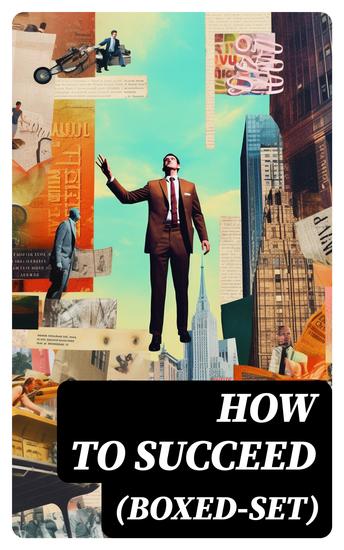
How to Succeed (Boxed-Set) - As a Man Thinketh Hidden Treasures The Power of Concentration The Master Key System The Science of Getting Rich… - cover
LER

How to Succeed (Boxed-Set) - As a Man Thinketh Hidden Treasures The Power of Concentration The Master Key System The Science of Getting Rich…

Niccolo Machiavelli, Elizabeth Towne, Elbert Hubbard, James Allen, William Walker Atkinson, Orison Swett Marden, Ralph Waldo Trine, Benjamin Franklin, William Crosbie Hunter, Harry A. Lewis, Thorstein Veblen, Kahlil Gibran, P. T. Barnum, Marcus Aurelius, Wallace D. Wattles, Lao Tzu, Russell Conwell, Henry Harrison Brown, Florence Scovell Shinn, Napoleon Hill, Émile Coué, Charles F. Haanel, B.F. Austin, Robert Collier, George Matthew Adams, Genevieve Behrend

Tradutor George Long, W. K. Marriott

Editora: DigiCat

  • 0
  • 0
  • 0

Sinopse

How to Succeed (Boxed-Set) is a remarkable anthology that collates diverse literary styles and themes centered around the principles of success, prosperity, and personal development. This collection transcends temporal and cultural boundaries, offering a rich tapestry of essays, maxims, and philosophical reflections that illuminate the path to achievement through a multitude of voices. Each work offers insight into perennial themes of ambition, resilience, and wisdom, inviting readers to explore how these concepts have evolved across cultures and epochs. Noteworthy is the seamless integration of ancient and modern thoughts, creating a dialogue between historical philosophers and contemporary thinkers without losing the coherence of the collective theme. The illustrious array of contributing authors in this set includes profound thinkers like Marcus Aurelius of ancient Rome to modern motivational pioneers such as Napoleon Hill and Florence Scovel Shinn. Their collective body of work within the anthology aligns with movements of self-help, personal betterment, and business acumen, offering a spectrum of wisdom drawn from distinct periods and philosophical backgrounds. The synergy between these varied voices forms a comprehensive guide that synthesizes traditional philosophical ideals with new-world practical applications, reflecting the impact of historical, cultural, and literary shifts on the concept of success. Readers will find How to Succeed (Boxed-Set) an invaluable resource, offering access to a multifaceted conversation on success that spans centuries. This collection serves not only as a testament to human aspiration and achievement but also as an educational trove for those eager to understand the myriad ways personal and professional success have been perceived and pursued. It stands as a must-read for anyone seeking to delve into the profound insights and instructions these iconic figures provide, nurturing an appreciation for the dialogue between past wisdom and contemporary thought.
Disponível desde: 22/11/2023.
Comprimento de impressão: 4470 páginas.

Outros livros que poderiam interessá-lo

  • Awake! - William Blake and the Power of the Imagination - cover

    Awake! - William Blake and the...

    Mark Vernon

    • 0
    • 0
    • 0
    In the 200 years since Blake's death, the visionary artist, poet, and writer has become a household name, often beloved. Yet many struggle to comprehend his kaleidoscopic ideas; how they speak to human longings and the challenges of living in anxious times.Philosopher and psychotherapist Mark Vernon provides a fresh route into Blake, taking him at his word. Exploring this brilliant thinker's passionate writings, arresting artworks, and fascinating life, Vernon illuminates Blake's vivid worldview. Like us, he lived in a tumultuous era of war, discontent, rapid technological change, and human estrangement from nature. He exposed the dark sides of political fervor and social moralizing, while unashamedly celebrating love and liberty. But he also conversed with prophets and angels, and was powerfully, if unconventionally, religious. If we take this seriously—not easy, in secular times—then Blake can help us to unlock the transformative power of imagination.Written for both longstanding fans and those unfamiliar with his work, Awake! reveals Blake as an invigorating and hopeful guide for our modern age.
    Ver livro
  • Augustine the African - cover

    Augustine the African

    Catherine Conybeare

    • 0
    • 0
    • 0
    An extraordinary work of revisionist history that centers Africa in the life of one of our greatest philosophers. 


    Augustine of Hippo (354–430), also known as Saint Augustine, was one of the most influential theologians in history. His writings, including the autobiographical Confessions and The City of God, helped shape the foundations of Christianity and Western philosophy. But for many centuries, Augustine's North African birth and Berber heritage have been simply dismissed. Catherine Conybeare, a world-renowned Augustine scholar, here puts the "African" back in Augustine's story. As she relates, his seminal books were written neither in Rome nor in Milan, but in Africa, where he had returned as a wanderer during a perilous time when the Western Roman Empire was crumbling. Using extant letters and other shards of evidence, Conybeare retraces Augustine's travels, revealing how his groundbreaking works emerge from an exile's perspective within an African context. In its depiction of this Christian saint, Augustine the African upends conventional wisdom and traces core ideas of Christian thought to their origins on the African continent.
    Ver livro
  • In Bayswater - One family is home to many secrets in this classic modernist short story - cover

    In Bayswater - One family is...

    Mary Butts

    • 0
    • 0
    • 0
    Mary Frances Butts was born on 13th December 1890 in Poole, Dorset. 
     
    Her early years were spent at Salterns, an 18th-century house overlooking Poole Harbour.  Sadly in 1905 her father died, and she was sent for boarding at St Leonard's school for girls in St Andrews. 
     
    Her mother remarried and, from 1909, Mary studied at Westfield College in London, and here, first became aware of her bisexual feelings.  She was sent down for organising a trip to Epsom races and only completed her degree in 1914 when she graduated from the London School of Economics.  By then Mary had become an admirer of the occultist Aleister Crowley and she was given a co-authorship credit on his ‘Magick (Book 4)’. 
     
    In 1916, she began the diary which would now detail her future life and be a constant reference point for her observations and her absorbing experiences. 
     
    During World War I, she was doing social work for the London County Council in Hackney Wick, and involved in a lesbian relationship.  Life changed after meeting the modernist poet, John Rodker and they married in 1918. 
     
    In 1921 she spent 3 months at Aleister Crowley's Abbey of Thelema in Sicily; she found the practices dreadful and also acquired a drug habit.  Mary now spent time writing in Dorset, including her celebrated book of short stories ‘Speed the Plough’ which saw fully develop her unique Modernist prose style. 
     
    Europe now beckoned and several years were spent in Paris befriending many artists and writing further extraordinary stories.   
     
    She was continually sought after by literary magazines and also published several short story collections as books. Although a Modernist writer she worked in other genres but is essentially only known for her short stories.  Mary was deeply committed to nature conservation and wrote several pamphlets attacking the growing pollution of the countryside. 
     
    In 1927, she divorced and the following year her novel ‘Armed with Madness’ was published.  A further marriage followed in 1930 and time was spent attempting to settle in London and Newcastle before setting up home on the western tip of Cornwall.  By 1934 the marriage had failed. 
     
    Mary Butts died on 5th March 1937, at the West Cornwall Hospital, Penzance, after an operation for a perforated gastric ulcer. She was 46. 
     
    Her story ‘In Bayswater’ grippingly describes a man’s friendship with a dysfunctional family he rents a room from.  As each facet reveals itself his opinion and decisions change, back and forth, this way and that….
    Ver livro
  • Diary of a Lunatic - From their pens to your ears genius in every story - cover

    Diary of a Lunatic - From their...

    Leo Tolstoy

    • 0
    • 0
    • 0
    Leo Tolstoy was born in 1828 in the Russian province of Tula to a wealthy noble family. As a child, he had private tutors but he showed little interest in any formal education. When he went to the University of Kazan in 1843 to study oriental languages and law, he left without completing his courses.  Life now was relaxed and idle but with some writing also taking place.  Gambling debts forced an abrupt change of path and he joined the army to fight in the Crimean War.  He was commended for his bravery and promoted but was appalled at the brutality and loss of life.  He recorded these and other earlier experiences in his diaries which formed the basis of several of his works. 
    In 1852 ‘Childhood’ was published to immediate success and was followed by ‘Boyhood’ and ‘Youth’. 
    His experience in the army and the horrors he witnessed resulted in ‘The Cossacks’ in 1862 and the trilogy ‘Sevastopol Tales’. After the war he travelled around Europe, visiting London and Paris and meeting such luminaries as Victor Hugo and Charles Darwin.  
    It was now that Tolstoy began his masterpiece, ‘War and Peace’. Published in 1869 it was an epic work that changed literature. He quickly followed this with ‘Anna Karenina’.  
    These successes made Tolstoy rich and helped him accomplish many of his dreams but also brought problems as he grappled with his faith and the lot of the oppressed poor. These revolutionary views became so popular that the authorities now kept him under surveillance.  
    He led a life of asceticism and vegetarianism and put his socialist ideals into practice by establishing numerous schools for the poor and food programmes. He also believed in giving away his wealth, which caused much discord with his wife.  
    His writing continued to bring forth classics such as ‘The Death of Ivan Ilyich’ and many brilliant and incisive short stories such as ‘How Much Land Does A Man Need’.  
    In 1901 Tolstoy was excommunicated from the Church and controversially deselected for the Nobel Prize for Literature. 
    Whilst undertaking a pilgrimage by train in October 1910 with his daughter Aleksandra he caught pneumonia in the nearby town of Astapovo.  Leo Tolstoy died on November 9th, 1910, he was 82.
    Ver livro
  • Deputy know your rights - a cop's true story - cover

    Deputy know your rights - a...

    Alfred Anderson

    • 0
    • 0
    • 0
    Do you feel intimidated or confused when you encounter a law enforcement officer? 
    Do you know how to protect your constitutional rights in any situation? 
    Do you want to learn from the real-life experiences of a retired deputy who has seen it all? 
    In today’s world, where the relationship between law enforcement and the public is often strained and misunderstood, it is vital to know your rights and responsibilities as a citizen. You also need to understand the perspective and challenges of the officers who are sworn to protect and serve you. 
    That’s why Deputy Anderson wrote this book. He wanted to share his stories and insights from his career as a law enforcement officer. He wanted to educate and inform you about the laws and procedures that govern police interactions with the public. He wanted to help you avoid unnecessary conflicts and misunderstandings with the authorities
    Ver livro
  • One Ukrainian Summer - A memoir about falling in love and coming of age in the former USSR - cover

    One Ukrainian Summer - A memoir...

    Viv Groskop

    • 0
    • 0
    • 0
    'A memoir that captivates and delights. Fabulous' —Nina Stibbe 


    Autumn 1993. The former USSR. Viv is about to turn twenty-one and is on a study year abroad, supposedly immersed in the language, history, and politics of a world that has just ceased to exist: the Soviet Union. 


    Instead, she finds herself immersed in Bogdan Bogdanovich—the lead guitarist of a Ukrainian punk rock band. As the temperature drops, he promises that if she can get through the freezing Russian winter, he will give her "one Ukrainian summer." But is he serious about her? Or is she just another groupie? 


    At parties, gigs, and dive bars, Viv and her new friends argue over whose turn it is to buy cigarettes, the best places to find Levi's jeans and whether beer counts as a soft drink. No one debates the merits of speaking Ukrainian over Russian, the precise location of the border, or the undeniable brightness of the future. Of course good times are here to stay. Because the Soviet Union is finished. Isn't it? 


    A poignant and often comical account of coming-of-age in the time after the Cold War and before Putin, One Ukrainian Summer is a love letter to a unique moment in history.
    Ver livro