Join us on a literary world trip!
Add this book to bookshelf
Grey
Write a new comment Default profile 50px
Grey
Subscribe to read the full book or read the first pages for free!
All characters reduced
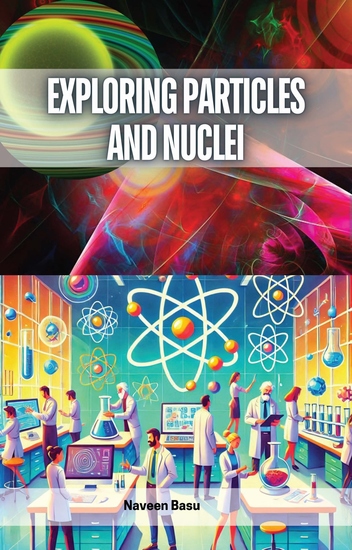
Exploring Particles and Nuclei - cover

Exploring Particles and Nuclei

Naveen Basu

Publisher: Educohack Press

  • 0
  • 0
  • 0

Summary

"Exploring Particles and Nuclei" is a comprehensive guide to the fascinating realm of subatomic physics. We delve into the fundamental building blocks of matter, from the intricate structure of atomic nuclei to the diverse array of particles that populate the universe.
We begin by unraveling the mysteries of the nucleus, exploring proton-neutron interactions, nuclear forces, and the stability of atomic nuclei. The book covers nuclear reactions, including fusion, fission, and radioactive decay, shedding light on the processes that power stars and fuel nuclear technologies.
Moving beyond the nucleus, we discuss quarks, leptons, and the fundamental forces governing their interactions. Readers will explore the Standard Model of particle physics, understanding the electromagnetic, weak, and strong forces, as well as the role of bosons and fermions.
The book also covers advanced topics such as particle accelerators, collisions, and the search for new particles and phenomena. We discuss the role of particle detectors in experimental physics and the implications of particle physics in cosmology and astrophysics.
With clear explanations, insightful discussions, and engaging illustrations, "Exploring Particles and Nuclei" is suitable for students, educators, and anyone curious about the nature of matter and the forces shaping our universe. Whether you're delving into nuclear physics for the first time or seeking a deeper understanding, this book provides a captivating journey into particle and nuclear physics.
Available since: 02/20/2025.
Print length: 393 pages.

Other books that might interest you

  • Ocean Waves on Sandy Shores - Calming Coastal Ambiance for Yoga and Relaxation - cover

    Ocean Waves on Sandy Shores -...

    Greg Cetus

    • 0
    • 0
    • 0
    Enter the serene allure of "Ocean Waves on Sandy Shores." This audio transports you to tranquil coastal bliss, featuring gentle waves lapping against sandy beaches. Recorded in the idyllic Hawaii islands, it offers a calming ambiance perfect for yoga and relaxation. Listen as the rhythmic melody of waves, accented by bubbles and occasional thuds, soothes your soul and invites peaceful introspection.
    Show book
  • The Postgenomic Condition - Ethics Justice & Knowledge after the Genome - cover

    The Postgenomic Condition -...

    Jenny Reardon

    • 0
    • 0
    • 0
    Now that we have sequenced the human genome, what does it mean? In The Postgenomic Condition, Jenny Reardon critically examines the decade after the Human Genome Project, and the fundamental questions about meaning, value and justice this landmark achievement left in its wake. Drawing on more than a decade of research—in molecular biology labs, commercial startups, governmental agencies, and civic spaces—Reardon demonstrates how the extensive efforts to transform genomics from high tech informatics practiced by a few to meaningful knowledge beneficial to all exposed the limits of long-cherished liberal modes of knowing and governing life. Those in the American South challenged the value of being included in genomics when no hospital served their community.  Ethicists and lawyers charged with overseeing Scottish DNA and data questioned how to develop a system of ownership for these resources when their capacity to create things of value—new personalized treatments—remained largely unrealized. Molecular biologists who pioneered genomics asked whether their practices of thinking could survive the deluge of data produced by the growing power of sequencing machines. While the media is filled with grand visions of precision medicine, The Postgenomic Condition shares these actual challenges of the scientists, entrepreneurs, policy makers, bioethicists, lawyers, and patient advocates who sought to leverage liberal democratic practices to render genomic data a new source of meaning and value for interpreting and caring for life. It brings into rich empirical focus the resulting hard on-the-ground questions about how to know and live on a depleted but data-rich, interconnected yet fractured planet, where technoscience garners significant resources, but deeper questions of knowledge and justice urgently demand attention.
    Show book
  • Data Virtualization - cover

    Data Virtualization

    Mark Jackson

    • 0
    • 0
    • 0
    In the age of digital transformation, managing and integrating data effectively is crucial for organizational success. "Mastering Data Virtualization" is your comprehensive guide to understanding, implementing, and optimizing data virtualization, a revolutionary approach that simplifies data access and integration without the need for physical data replication. 
    This book provides a deep dive into the fundamentals of data virtualization, from its core concepts and architecture to its real-world applications and future trends. 
    "Mastering Data Virtualization" equips you with the knowledge and tools needed to harness the power of data virtualization. Transform your data management practices, enhance decision-making, and drive innovation with this essential guide to modern data integration. 
     
    Show book
  • Welcome to AI - A Human Guide to Artificial Intelligence - cover

    Welcome to AI - A Human Guide to...

    David L. Shrier

    • 0
    • 0
    • 0
    A fascinating guide to the rapidly advancing world of artificial intelligence and how this powerful technology will impact our lives, our careers, and our world. 


    Artificial intelligence is driving workforce disruption on a scale not seen since the Industrial Revolution. 


    In schools and universities AI technology has forced a reevaluation of the way students are taught and assessed. Meanwhile, ChatGPT has become a cultural phenomenon, reaching a hundred million users and attracting a reputed $1 trillion investor interest in its parent company, OpenAI. 


    The race to dominate the generative AI market is accelerating at breakneck speed, inspiring breathless headlines and immense public interest. 


    Welcome to AI provides a rare view into a frontier area of computer science that will change everything about how you live and work. Listen to this book and better understand how to succeed in the AI-enabled future.
    Show book
  • The Sacred Chain - How Understanding Evolution Leads to Deeper Faith - cover

    The Sacred Chain - How...

    Jim Stump

    • 0
    • 0
    • 0
    “In this marvelously accessible book, philosopher-Christian Jim Stump provides the reader with new eyes for a journey through time, the origin of the soul, suffering, and morality, and reveals how the latest scientific findings about what it means to be human have led him to a deeper and more authentic faith.”—Francis S. Collins, Director of the Human Genome Project and Founder of BioLogos, author of The Language of God 
    A thought-provoking and eye-opening work by Jim Stump, Vice President at BioLogos and host of the Language of God podcast, offering a compelling argument about how evolution does not have to be at odds with faith, but can actually enrich and deepen it. 
    In this moving and deeply thoughtful book, Jim Stump takes readers with him on his journey to understanding evolution and reconciling it with his faith. The Sacred Chain draws on philosophy, theology, and the latest scientific research to tackle some of the biggest questions facing humanity and people of faith today, such as:How can we hold the Bible as a sacred text and yet reconcile modern science with it?By condensing noteworthy events in the history of our universe into one calendar week, what can we learn about God’s creative process and priorities, and where humans fit in?If humans are created in the image of God, what does evolution have to teach us about our species and our place in creation?What about the soul? How can we understand our transcendent qualities if the human body is the product of evolution?How does evolutionary science help us understand how God might use pain and suffering for important and good purposes?Does it have to be one or the other—science or religion—or is there a third way, one that not only preserves faith in the face of modern science, but leads to a stronger, more relevant, and more authentic faith? 
    Deeply researched and a delight to read, The Sacred Chain provides clarity in our uncertain times, revealing a bigger picture of our world and our place within it. It is a panorama consistent with the scientific findings about who we are and where we come from that can actually bolster our faith as it engages our curiosity about ourselves, our universe, and the nature of existence itself.
    Show book
  • A Primer of Life Histories - Ecology Evolution and Application - cover

    A Primer of Life Histories -...

    Jeffrey A. Hutchings

    • 0
    • 0
    • 0
    Life histories can be defined as the means by which individuals (or more precisely genotypes) vary their age—or stage-specific expenditures of reproductive effort in response to genetic, phenotypic, and environmental correlates of survival and fecundity. Life histories reflect the expression of traits most closely related to individual fitness, such as age and size at maturity, number and size of offspring, and the timing of the expression of those traits throughout an individual's life. Life-history research plays an integral role in species conservation and management. 


    This accessible primer encompasses the basic concepts, theories, and applied elements of life history evolution, including patterns of trait variability, underlying mechanisms of plastic/evolutionary change, and the practical utility of life-history traits as metrics of species/population recovery, sustainable exploitation, and risk of extinction. 


    A Primer of Life Histories is designed for listeners from a broad range of academic backgrounds and experience, including graduate students and researchers of ecology and evolutionary biology. It will also be useful to a more applied audience of academic/government researchers in fields such as wildlife biology, conservation biology, fisheries science, and the environmental sciences.
    Show book