¡Acompáñanos a viajar por el mundo de los libros!
Añadir este libro a la estantería
Grey
Escribe un nuevo comentario Default profile 50px
Grey
Suscríbete para leer el libro completo o lee las primeras páginas gratis.
All characters reduced
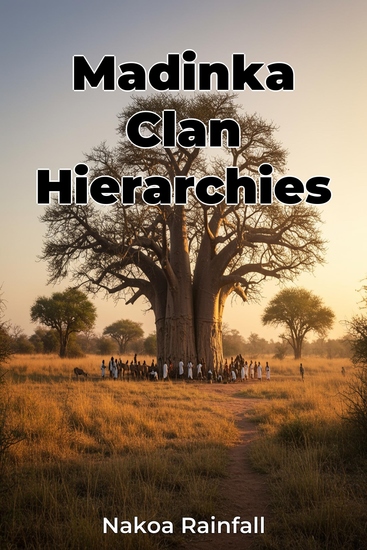
Madinka Clan Hierarchies - cover

Madinka Clan Hierarchies

Nakoa Rainfall

Traductor A AI

Editorial: Publifye

  • 0
  • 0
  • 0

Sinopsis

Madinka Clan Hierarchies explores the intricate social structures of the Madinka people in pre-colonial West Africa, focusing on how clan systems shaped power, wealth, and social standing. The book examines how these hierarchies dictated familial relationships, the distribution of authority, and the allocation of economic responsibilities, providing a framework for social order. One intriguing insight is how lineage and marriage shaped social identities and alliances, influencing everything from leadership protocols to economic strategies. The book argues that these clan hierarchies were dynamic systems, constantly adapting to changing conditions, challenging simplistic notions of tradition. This study uses a combination of documented protocols, oral record devices, and ethnographic data to understand the values and beliefs that shaped these hierarchies. It approaches oral records not as secondary sources, but as key texts. The book progresses from introducing core concepts of clan structure, kinship, and economic responsibility, to exploring variations in specific regions within the Madinka cultural sphere, and finally offering a comparative analysis of clan hierarchies. This approach provides a deeper appreciation of the complexities of social organization in West Africa.
Disponible desde: 03/05/2025.
Longitud de impresión: 58 páginas.

Otros libros que te pueden interesar

  • Retreat from Kabul - The First Anglo-Afghan War 1839-1842 - cover

    Retreat from Kabul - The First...

    George Bruce

    • 0
    • 0
    • 0
    Afghanistan, 1839. 


    The British East India Company dominated the Indian subcontinent, yet they were not secure in their position. 


    Holding unjustified fears that Russia threatened India's north-western border, the Company decided to make a pre-emptive strike and ensure that this menace would be stopped by a strong pro-British Afghanistan. 


    Thousands of British and Indian troops invaded this mountainous land to intervene in a succession dispute between emir Dost Mahommed Khan and former emir Shah Shuja-ool-Mulk. After capturing Kabul they placed the cruel, but pro-British Shah Shuja upon the throne once again, and supported him with an overwhelming military presence. 


    However, the proud and ruthless warriors of Afghanistan were unwilling to submit themselves to British control and within three years they had risen up against their oppressors in one of the bloodiest revolts in history. 


    George Bruce delves into a vast array of published and unpublished nineteenth century sources to uncover this campaign in which very few British survivors made it back through the snow-laden passes to India.
    Ver libro
  • Rangers Scouts and Raiders - Origin Organization and Operations of Selected Special Operations Forces - cover

    Rangers Scouts and Raiders -...

    Michael F. Dilley

    • 0
    • 0
    • 0
    "Well-written and meticulously researched, the book is an excellent example of truth being more interesting than fiction. It is easy to read with photos, charts and maps that help the reader keep pace with the action." — ARMY MagazineThroughout history there has always been a need, in military forces, for special units. In the past, these units have usually been ad hoc formations that were disbanded after their mission was complete. It has only been since the early 1950s that such units have remained active, but even in recent times special purpose, special mission units have been organized and used for a period of time or for a specific mission and then either deactivated or replaced by other units.  This unique approach to the history of American special forces examines their development through a number of operations, ranging from the French and Indian War in the 18th century through to the Vietnam War. From the Son Tay raid to the Force at la Difensa and Rogers’ Rangers, the operations are diverse in both organization and purpose, but all contributed to the overall mission of their theater or larger organization, thus proving the continuing need for special units throughout history and even today.
    Ver libro
  • The Divine Pastimes Of Lord Jagannatha - cover

    The Divine Pastimes Of Lord...

    Sripad Jagnnatha Dasa, Vraj Kunj

    • 0
    • 0
    • 0
    "O Lord Jagannatha, the crest jewel of the Niladri hill! O supreme Brahman in a wooden form! O dark-hued Lord Shyam! Please be merciful upon me." 
    Jagannatha, (Sanskrit: “Lord of the World”) is the form under which Krishna is worshipped at Puri, Orissa, India. The 12th-century temple of Jagannatha in Puri towers above the town. In its sanctuary, wooden images represent Jagannatha, his brother Balabhadra (Balarama), and his sister Subhadra. Although Krishna is absolute and transcendental to material nature, to accept the loving service of His devotees, He appears before us as the temple deity in the form of stone, metal, wood, or paint. Jagannatha is a wooden form of Krishna. Jagannatha is no one else but the ecstatic manifestation of Krishna, who appears in His most merciful form to help us go back to Godhead. Therefore, ISKCON founder Srila Prabhupada introduced the Jagannatha Rathayatra in many cities worldwide to uplift the conditioned souls from the spell of Maya (illusion).  
    Since Lord Jagannatha came to the western world in the mid-1960s millions have embraced the yoga of immersion in his divine pastimes. In this singular rare and unique audiobook, here is everything you need to know about the Bhakti yoga, traditions, and meditational practice of not only Jagannatha but also his brother, Baladev, and his younger sister, Suptra. Written and narrated by a fifty-year devotee of Lord Jagannatha (to whom his guru gave the same name, Sripad Jagannatha Dasa) this is the audiobook for anyone interested in the finer points of yogic philosophy, devotional yoga, and the ancient study of deep self-knowledge. A true treasure from this spiritual plane! Jai Jagannatha!
    Ver libro
  • The Indonesian Famine of 1945-1946 - A Study in Post-War Disruption - cover

    The Indonesian Famine of...

    Sarah Willards

    • 0
    • 0
    • 0
    The conclusion of World War II marked a pivotal turning point in Indonesia’s history. As the Japanese forces surrendered in August 1945, the vacuum left behind in their wake exposed the fragility of colonial and wartime institutions. Indonesia, long under Dutch colonial rule and occupied by Japan since 1942, was suddenly thrust into a state of political and administrative chaos. The power void that followed the Japanese capitulation was quickly filled by nationalist fervor, culminating in the proclamation of Indonesian independence on August 17, 1945. However, the declaration did not result in immediate recognition or control. Instead, the country found itself caught between competing powers and clashing agendas. 
    The collapse of Japanese administrative structures left the newly proclaimed Republic of Indonesia struggling to assert its legitimacy. Republican leaders, including Sukarno and Mohammad Hatta, faced the monumental task of organizing a new government while also managing the fallout of war. Meanwhile, Dutch authorities, with Allied support, sought to re-establish their colonial presence. This led to violent confrontations and widespread instability, as various factions—including local militias, former Japanese-trained troops, and returning colonial forces—vied for control over towns, supply routes, and administrative posts. 
    The disintegration of centralized governance had far-reaching consequences. Essential services, including food distribution and public health, were severely disrupted. The chaos was further compounded by a breakdown in communication lines and transportation infrastructure, much of which had been damaged during the war or repurposed by occupying forces. With no clear authority in many regions, local leaders and grassroots organizations were left to manage crises as best they could, often with limited resources and no coordination.
    Ver libro
  • Reconciling - A Lifelong Struggle to Belong - cover

    Reconciling - A Lifelong...

    Scott Steedman, Larry Grant

    • 0
    • 0
    • 0
    “Larry Grant’s life is a model of what it means to rise above hardship, transcend preconceived notions, and live life in a good way. I’ve had the honour of meeting him, but this book makes me feel as if I know him. And that is a profound gift.” — Shelagh Rogers, Honorary Witness, Truth and Reconciliation Commission; broadcast journalist, CBC Radio
    		 
    A personal and historical story of identity, place, and belonging from a Musqueam-Chinese Elder caught between cultures
    		 
    It’s taken most of Larry Grant’s long life for his extraordinary heritage to be appreciated. He was born in a hop field outside Vancouver in 1936, the son of a Musqueam cultural leader and an immigrant from a village in Guangdong, China. In 1940, when the Indian agent discovered that their mother had married a non-status man, Larry and his two siblings were stripped of their status. With one stroke of the pen, they were disenfranchised—no longer recognized as Indigenous.
    		 
    Reconciling is a series of conversations between Larry and writer Scott Steedman as they visit pivotal geographical places together, including the Musqueam reserve, Chinatown, the site of the Mission residential school, the Vancouver docks and the University of British Columbia. Larry tells the story of his life, including his thoughts on reconciliation and the path forward for First Nations and Canada. His life echoes the barely known story of Vancouver and spans key events of the last two centuries, including Chinese immigration and the Head Tax, the ravages of residential school and now Indigenous revival and the accompanying change in worldview. 
    		 
    When Larry talks about reconciliation, he uses the verb reconciling, an ongoing, unfinished process we’re all going through, Indigenous and settler, immigrant and Canadian-born. “I have been reconciling my whole life, with my inner self,” he explains. “To not belong was forced upon me by the colonial society that surrounded me. But reconciling with myself is part of all that.”
    Ver libro
  • Walking the Appalachian Trail - cover

    Walking the Appalachian Trail

    Larry Luxenberg

    • 0
    • 0
    • 0
    A fascinating portrait of the community of people—and one cat—who’ve traveled the trail end to end, by the founder of the Appalachian Trail Museum.   Countless hikers have walked stretches of the two-thousand-plus-mile Appalachian Trail, but only a small, deeply dedicated group has completed the trek all the way through from Georgia to Maine. This book explores the history of the trail through colorful profiles of those who are a part of this unique community and reveals the customs and culture that have evolved around them over the years.   From the sore muscles to the moments of solitude in nature, from the retired postmaster who parachuted onto the top of Springer Mountain to begin his journey to the woman who set out in tennis shoes because she couldn’t find women’s hiking boots in her size, Walking the Appalachian Trail explores questions of who these end-to-enders are, what drives them, what risks they face, and what rewards to body and soul they gain from this extraordinary walk.   Includes color photographs
    Ver libro