¡Acompáñanos a viajar por el mundo de los libros!
Añadir este libro a la estantería
Grey
Escribe un nuevo comentario Default profile 50px
Grey
Suscríbete para leer el libro completo o lee las primeras páginas gratis.
All characters reduced
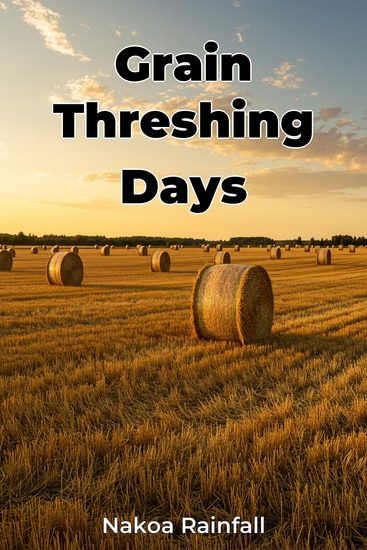
Grain Threshing Days - cover

Grain Threshing Days

Nakoa Rainfall

Traductor A AI

Editorial: Publifye

  • 0
  • 0
  • 0

Sinopsis

Grain Threshing Days explores how grain harvesting techniques profoundly shaped village life, revealing insights into social structures and community bonds. It examines the transition from manual methods, like using sickles, to mechanized harvesters, demonstrating how these shifts influenced labor relations and food security. The book argues that these techniques are not just agricultural practices but cultural ones that reflect and reinforce social, economic, and political dynamics within rural societies.

 
The book analyzes the social organization of harvesting, highlighting the roles of men and women and how cooperation fostered community identity. It also delves into the economic implications of different harvesting methods, detailing their impact on crop yields and wealth distribution. Drawing from agricultural manuals, census data, and oral histories, Grain Threshing Days adopts a narrative non-fiction approach to present a comprehensive account of grain harvesting's role in village life.

 
The book progresses by first introducing harvesting techniques, then exploring the social organization and economic implications, before finally investigating the influence of grain harvesting on social change. This progression provides a nuanced understanding of how agricultural practices have shaped rural communities and the broader social landscape.
Disponible desde: 27/02/2025.
Longitud de impresión: 64 páginas.

Otros libros que te pueden interesar

  • Roman Society and Culture - A Comprehensive Guide - cover

    Roman Society and Culture - A...

    Rogan Fish

    • 0
    • 0
    • 0
    Roman society, one of the most influential civilizations in human history, was built upon a complex and well-structured foundation that evolved over centuries. The origins of Roman civilization can be traced back to the early settlements along the Tiber River, where communities of farmers and shepherds gradually coalesced into the city-state of Rome. As Rome expanded, both geographically and politically, its social structure grew more intricate, reflecting a blend of indigenous customs and influences from conquered territories. 
    At the heart of Roman society was a rigid social hierarchy, essential to maintaining order and stability. This structure was divided primarily into two main classes: the patricians and the plebeians. The patricians were the elite, consisting of noble families who claimed descent from Rome's founding fathers. They held significant political power and owned vast lands. In contrast, the plebeians represented the common people, including farmers, craftsmen, and laborers. Though initially excluded from many aspects of governance, the plebeians gradually secured political rights through persistent social struggles, leading to the establishment of the office of the Tribune, which protected their interests. 
    Apart from these major classes, Roman society also included a growing number of slaves, who were often prisoners of war or born into servitude. Slavery was integral to the Roman economy, with slaves performing various tasks, from domestic duties to skilled labor in workshops. Despite their lack of freedom, some slaves, particularly those with specialized skills, could earn their emancipation, gaining the status of freedmen and integrating into the lower echelons of society.
    Ver libro
  • The Isolated Presidency - cover

    The Isolated Presidency

    Jordan T. Cash

    • 0
    • 0
    • 0
    How powerful is the President of the United States? For many scholars, this is a question that can be answered only by considering factors outside the office itself, such as the president's popularity, personal clout, political talents, or institutional relationships. 


    In The Isolated Presidency, Jordan T. Cash reframes this question to instead ask what authority is available to all presidents. Drawing on the Constitution itself, Cash argues that the presidency possesses an internal logic derived from its structure, duties, and powers which not only grants the president a unique institutional perspective, but also provides the president with considerable agency and discretion in pursuing agendas. 


    To gain a clear view of how the Constitution creates a baseline of authority that is available to all presidents, Cash examines the "isolated presidents"—presidents who were unelected, faced divided government, and were opposed by major factions of their own political parties. Stripped of all external supports, these presidents were left with nothing but their constitutional authority to rely on. Through three case studies of isolated presidents, Cash illustrates how the Constitution creates an empowering logic within the presidency which orients presidential behavior and grants every president significant power and agency.
    Ver libro
  • Populism Vs Liberalism - A Comparative Analysis of Political Ideologies - cover

    Populism Vs Liberalism - A...

    Arlo Holders

    • 0
    • 0
    • 0
    Political ideologies form the foundation of how societies organize governance, economics, and social structures. They are systems of ideas and beliefs that provide a framework for political thought and action, influencing policies, institutions, and the behavior of individuals and groups. Among the diverse range of ideologies, populism and liberalism have emerged as two of the most significant and often opposing forces in modern political discourse. This chapter introduces the concepts of populism and liberalism, highlights their importance, and sets the stage for the comparative analysis that follows. 
    Populism is a political approach that champions the rights and concerns of the common people against an established elite. It is often characterized by a rhetoric that emphasizes “the people” as a unified and virtuous entity, contrasted with a corrupt and self-serving elite. While populism can manifest across the political spectrum, its appeal lies in its simplicity and directness, offering solutions that often resonate with those who feel excluded or marginalized by traditional institutions. Populist movements frequently arise in periods of social upheaval or economic insecurity, presenting themselves as corrective forces against perceived injustices. 
    In contrast, liberalism is a political ideology rooted in the principles of individual rights, equality, and the rule of law. It advocates for democratic governance, free markets, and the protection of civil liberties. Liberalism’s historical development is closely linked with movements such as the Enlightenment and the rise of constitutional democracies. As a flexible and adaptive ideology, liberalism has evolved to address modern issues such as social justice, environmental concerns, and global cooperation while maintaining its foundational emphasis on freedom and equality.
    Ver libro
  • Team Building for Teens: 151 Activities Exercises and Games to Cultivate Teamwork Communication Leadership and Personal Growth in Teenagers - cover

    Team Building for Teens: 151...

    Joss Reed

    • 0
    • 0
    • 0
    Empower Teens to Lead, Succeed, and Build Stronger Teams! 
    For teens dealing with group projects, sports teams, and social circles, learning how to work well with others can be life-changing. But without the right skills, teamwork often leads to frustration, missed goals, or endless group conflicts. 
    This audiobook offers teens 151 exciting, easy-to-follow activities and games that transform any group into a team that supports, trusts, and succeeds together. 
    Perfect for parents, teachers, and coaches looking to help teens:Develop leadership skills that make them stand out and inspire others.Build trust and communication in every group setting.Approach challenges with problem-solving confidence and a clear head.Manage conflicts smoothly and keep projects or practices on track. 
    Each activity is designed to engage and empower teens, whether they’re working on a school project or playing a team sport. With this guide, teens can develop skills that make collaboration natural, rewarding, and even fun. 
    A must-have resource to help teens thrive in groups – click “Add to Cart” and start building the foundation for success today!
    Ver libro
  • The Graeco-Roman Era - cover

    The Graeco-Roman Era

    Pericles, Julius Caesar, ...

    • 0
    • 0
    • 0
    Five speeches from the legendary orators Alexander the Great, Julius Caesar, Cicero, and Pericles.431 BCE: Pericles’ Funeral Oration is a valedictory and eulogy for the great age of Athenian democracy. Reported by Thucydides, it was given at the first annual public funeral for casualties of the Peloponnesian War. That war ended twenty-seven years later with the democratic government of Athens overthrown by an oligarchy known as The Four Hundred. 324BCE: Two speeches by Alexander the Great, reported by the historian Arrian in his Anabasis. Both speeches are a direct address to his army on embarking on a new campaign. The first was given in Opis, Mesopotamia, when rallying his armies to start a new campaign into Persia. The army took heart, and successfully conquered the Persian Empire, adding it to Alexander’s many existing conquests. The second speech is given after the first campaign is over. This time Alexander is ready to move into the Indian subcontinent. After travelling across the known world, the entire army took the offer to quit fighting and go home. This leaves Alexander understandably upset, and produces history’s most finely worded example of saying “After all I’ve done for you! Well, you can all get stuffed then, you bunch of ingrates. I hope you choke.”In 63BCE, the Cataline Conspiracy shook Rome. It was a deep shock to the Roman system, and risked civil war. Included here are speeches by the Consul Cicero and the only extant speech of Julius Caesar.Cicero’s First Speech is a rabble-rousing, impassioned, and slightly unhinged attack upon Cataline and his associates. It speaks to the outrage of the body politic and the masses.Caesar’s speech is a jurisprudential appeal to create no new laws to punish these crimes. Caesar argues that the republic would be ultimately harmed if they were not punished only under existing laws, as people remember the punishment but not the crime.
    Ver libro
  • Things Come Together - Critical Thinking and Dogmatic Indoctrination by an African Layman - cover

    Things Come Together - Critical...

    Mzwandile Mbatha

    • 0
    • 0
    • 0
    In the spirit of Chinua Achebe’s Things Fall Apart, which examined a turbulent time in Africa’s history, Things Come Together grapples with modern challenges and seeks to bring hope for the continent’s future. The book traverses a wide range of perspectives, from the scientific to the artistic, the physical to the sociological, political, economic, and metaphysical. Heeding
     Einstein’s observation that problems cannot be solved with the same 
    mindset that created them, Mzwandile Mbatha offers thoughtful analysis 
    of varied issues, as well as potential solutions leading to prosperity and progress. Things Come Together sends an uplifting message that, through understanding and innovation, Africa can overcome obstacles and thrive and prosper. The book aims to inspire readers to be part of positive change.
    Ver libro