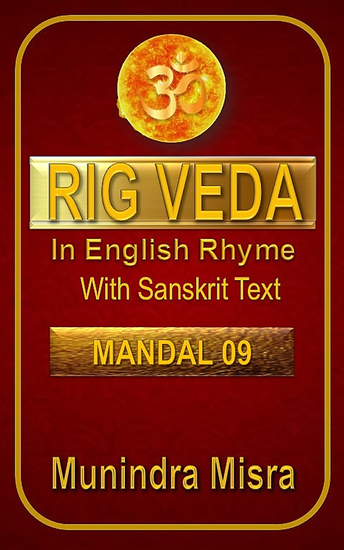
Rig Veda Mandal 9 - In English rhyme
Munindra Misra
Editorial: Munindra Misra
Sinopsis
The Rig Veda - Mandal 09 with 114 Shuktas in English rhyme
Editorial: Munindra Misra
The Rig Veda - Mandal 09 with 114 Shuktas in English rhyme
Athens is chiefly remembered for two reasons: its political system, which would in time form the nucleus of all Western democratic systems of government, and the remarkable number of outstanding individuals which, during the Golden Age of Athens, lived and flourished in the enlightened city-state. The Ancient Athenians formed the backbone of the West’s entire culture, from the arts to philosophy and everything in between. The most unique city-state in Ancient Greece was Sparta, which continues to fascinate contemporaneous society. It is not entirely clear why Sparta placed such a great emphasis on having a militaristic society, but the result was that military fitness was a preoccupation from birth. In the Archaic and Classical periods, Rhodes often stood as a prime exemplar of the highs and lows of its fellow Greek cities, and as the largest island of the Dodecanese, Rhodes’ history is largely in line with that of the rest of those islands. Rhodes would reach the zenith of its power in the Hellenistic period following the death of Alexander the Great in 323 B.C. Modern perceptions of Classical Greece are almost invariably based on Athens and Sparta, but Thebes was also a key player in the history of the region in this pivotal period. Indeed, it was, in fact, Thebes that was the major power for many of the years preceding the emergence of Macedon. The reasons for so little being known about Thebes and its contributions to ancient Greek civilization are complex, but the fact that it was totally destroyed by Alexander the Great is certainly one. Ancient Corinth had actually been founded in the 10th century B.C. and was, for most of its history, the richest port and the largest city in all of Greece. Corinth had a population in excess of 90,000 in 400 B.C., but the Romans leveled this original city in 146 B.C., killing all the male inhabitants and selling the women and children into slavery.Ver libro
Ur was a considerable Sumerian city-state in old Mesopotamia, situated near modern-day "Tell el-Muqayyar" in the Dhi Qar Governorate in southern Iraq. Ur was formerly a seaside city on the Persian Gulf, near the mouth of the Euphrates, but the shoreline has modified, and the city is now well inland, on the south bank of the Euphrates, sixteen kilometers (about 9.9 miles) from Nasiriyah in modern-day Iraq. The city stemmed from the Ubaid period around 3800 BC, and it initially appears in written history as a city-state in the 26th century BC, with Mesannepada as its first noted king. In this guide, you will be able to satisfy your curiosity about this ancient location.Ver libro
Befriending China tells the story of China's current effort to "open up" to a flood of visitors, as part of a campaign of "People-To-People Peacemaking." The story is partially based on three visits to China from late 2023 through late 2024. It describes the impressive achievements China has made in infrastructure, education, health care, and poverty alleviation. It includes an in-depth eye-witness account of visiting Xinjiang, debunking official rumors in the US of abuse of the Uyghur population there. It also highlights exciting tourism opportunities, with closeup looks at the mountainous Guizhou and Shanxi provinces, and the amazing "megacities" of Shanghai, Beijing, Chongqing, Hangzhou and Suzhou. It includes a preface by Carlos Martinez, editor of the Friends of Socialist China website. It also examines China's democratic system, and its successful foreign policy based on common prosperity and a shared future. Finally, it details ongoing US efforts to slander China and prepare for war against it, arguing that China is not our enemy.Ver libro
In the Second World War, Poznan was a key river crossing and railway junction on the Polish-German border. When the alarm was given indicating the Red Army's approach in January 1945, the city's 80-100,000 German civilians were speedily evacuated, leaving a garrison of some 15,000 men, mostly poorly-armed infantry, to face the rigors of a siege conducted by a massively superior and ruthless enemy anxious to acquire this transport center, which was vital for the advance on Berlin. This is the account of Eastern Front veteran Richard Siegert, the gunner and later commander of the defenders' sole Tiger tank. Since the death of the driver in a futile attempt to escape from a PoW camp in Russia just after the end of the war, Siegert is the only survivor of that crew able to pass its record on to posterity. His account details how the crew fought gallantly against impossible odds, even when the Tiger was immobilized and could only act as a stationary antitank gun post or pillbox during the last heroic days' fighting for the citadel.Ver libro
Explore the folklore of the trickster, villain, and rescuer known as Baba Yaga in a new light. “With Becoming Baba Yaga, Kris Spisak presents a robust work of scholarship. Baba Yaga is a wily shapeshifter, nearly impossible to pin down—but Spisak miraculously transforms alongside her, ever keeping up.” —from the foreword by GennaRose Nethercott, bestselling author of Thistlefoot When darkness, fear, and instability inundate our daily lives, folktale figures like Baba Yaga speak to the dichotomy of our existence—the hope and the horror, the magic and the mundane. At once an old hag and an enchantress, a demon and wish granter, a feminist and nothing more than a fairytale, Baba Yaga is an endlessly complex folktale character. Becoming Baba Yaga provides an in-depth look at the Baba Yaga mythos and history through Slavic folklore. Filled with historical and cultural context, analyses, and the stories themselves that add depth to the conversation. A comprehensive resource for anyone hoping to learn more about this ambiguous character and how her multifaceted presence still ripples through the present day, Becoming Baba Yaga is as thoughtful as it is illuminating. Spisak explores Baba Yaga’s connection to nature as an Earth goddess and as an herbalist. She also delves into the Shadow Self and Baba Yaga’s aspect as a trickster and places her in a modern context as not merely a witch of the woods but also as an archetype and force for finding your own path. Becoming Baba Yaga shares how she is both a force for good as much as evil and a feminist before her time.Ver libro
Today, roses are a sign of love and luxury, but for over 30 years, they provided the symbols for two houses at war for control of the English throne. Thousands of people died and many more were injured fighting beneath the white rose of York and the red rose of Lancaster, and the noble families ruling England tore each other apart in a struggle that was as bitter as it was bloody. Though what followed was a period of strong rule under the Tudors monarchs, it ultimately came at a terrible cost, and even then, it was through Elizabeth of York that the Tudor line received its legitimacy. After all, while Henry VII won his throne in battle, Elizabeth of York was the daughter of King Edward IV of England, a Yorkist monarch. Despite their limited social and economic impact, the political and personal dramas of the Wars of the Roses have ensured that they are well remembered and still part of the popular imagination. The most famous depictions of the period came from Shakespeare, whose earliest plays included Richard III and the three parts of Henry VI. Naturally, Shakespeare dramatized the tensions of what he presented as hugely destructive events, and his account, which showed the damage done by corruption and weak rule, and which turned Richard III into a popular villain, aimed to please the Tudor dynasty still in power at the time. Of course, it also played to a popular interest in high drama and the sort of personal and political conflicts that lay at the heart of the war. Indeed, the Wars of the Roses were perfect material for a drama about greed, power and ambition, and many others followed Shakespeare's example. From Henry Payne's painting of a Shakespearean scene in which the two sides of the war are picked to John Everett Millais's mournful portrait of the Princes in the Tower, these pictures often evoke the tension and sorrow of the period, bringing it dramatically to life.Ver libro