Rejoignez-nous pour un voyage dans le monde des livres!
Ajouter ce livre à l'électronique
Grey
Ecrivez un nouveau commentaire Default profile 50px
Grey
Abonnez-vous pour lire le livre complet ou lisez les premières pages gratuitement!
All characters reduced
The Jealousy of le Barbouillé (La Jalousie du Barbouillé) - cover

The Jealousy of le Barbouillé (La Jalousie du Barbouillé)

Molière Molière

Traducteur Charles Heron Wall

Maison d'édition: DigiCat

  • 0
  • 0
  • 0

Synopsis

Molière's "The Jealousy of le Barbouillé" (La Jalousie du Barbouillé) is a masterful satire that explores themes of jealousy and love through the lens of farcical comedy. Written in the mid-17th century, the play employs witty dialogue and exaggerated characters, typical of Molière's literary style, which combines slapstick humor with sharp social commentary. The narrative revolves around the absurd machinations of le Barbouillé, a comically possessive husband, whose unfounded suspicions lead to a series of humorous misadventures, ultimately highlighting the irrational nature of jealousy and the folly of mistrust in relationships. Molière's ability to blend humor with moral insight situates this work within the rich context of French farce and comedy, making it both entertaining and thought-provoking. Molière, born Jean-Baptiste Poquelin, was deeply rooted in the theatrical traditions of his time, frequently drawing from personal experiences and societal observations. His encounters with the complexities of love and human behavior greatly informed his writing. Additionally, as a playwright navigating the intricacies of court life and public sentiment, Molière's sharp critiques of social norms and human folly were often reflections of his own struggles with the expectations placed upon artists and intellectuals in the 17th-century French landscape. This delightful and insightful play comes highly recommended for anyone interested in the intricacies of human emotions and the comedic tendencies that often accompany them. Molière's keen observations and masterful characterization provide readers with both a timeless and entertaining exploration of jealousy, making "The Jealousy of le Barbouillé" an essential addition to the canon of classic literature.
Disponible depuis: 15/09/2022.
Longueur d'impression: 109 pages.

D'autres livres qui pourraient vous intéresser

  • Haunted House The (Unabridged) - cover

    Haunted House The (Unabridged)

    Charles Dickens

    • 0
    • 0
    • 0
    "The Haunted House" is a story series published in 1859 for the weekly periodical All the Year Round. It was "Conducted by Charles Dickens", with Charles Dickens writing the opening and closing stories, framing stories by Dickens himself and five other authors.
    The story appeared in the Extra Christmas Number on 13 December 1859. Dickens began a tradition of Christmas publications with A Christmas Carol in 1843 and his Christmas stories soon became a national institution. The Haunted House was his 1859 offering.
    In Dickens's opening story, The Mortals in the House, the narrator's ("John") health "required a temporary residence in the country." Knowing this, a friend of the narrator had chanced to drive by the house-situated close to a railroad stop mid-way between Northern England and London-and had written to the narrator suggesting he travel down from the North and look the place over. It was a large mid-eighteenth-century manor house on two square acres with a "sadly neglected garden," recently cheaply repaired, and "much too closely and heavily shadowed by trees." The house itself is "stiff ... cold ... [and] formal" and "in as bad taste, as could possibly be desired by the most loyal admirer of the whole quartet of [King] Georges." It was "ill-placed, ill-built, ill-planned, and ill-fitted." It was "damp ... not free from dry rot" and redolent with the "flavour of rats."
    Voir livre
  • The Master of the World - cover

    The Master of the World

    Jules Verne

    • 1
    • 0
    • 0
    A deviously brilliant inventor is out to control the world in this 1904 thriller by the pioneering science fiction author.Reports of strange occurrences in the mountains of South Carolina have reached the desk of government agent John Strock. Though the Blue Ridge Mountains are not volcanic, rumblings and smoke have led some to fear an eruption. Then new reports emerge of unidentified objects racing across air, land, and water at incredible speeds. Behind it all is a mastermind named Robur whose ambition is as boundless as his genius. On his quest to stop Robur, Agent Strock is taken captive and finds himself onboard the Terror: a single vehicle with capacities far beyond anything mankind has seen before. Though global powers offer Robur enormous sums for his invention, he chooses to keep it—and its unrivaled power—for himself.
    Voir livre
  • Theory of the Perpetual Discomfort of Humanity The (Unabridged) - cover

    Theory of the Perpetual...

    H. G. Wells

    • 0
    • 0
    • 0
    Herbert George "H. G." Wells (1866 - 1946) was an English writer.
    He was prolific in many genres, including the novel, history, politics, social commentary, and textbooks and rules for war games. Wells is now best remembered for his science fiction novels and is called a "father of science fiction"
    THE THEORY OF THE PERPETUAL DISCOMFORT OF HUMANITY: He had been sitting with his feet upon the left jamb of my mantel, admiring the tips of his shoes in silence for some time.
    Voir livre
  • Our First Whale (Unabridged) - cover

    Our First Whale (Unabridged)

    Frank Thomas Bullen

    • 0
    • 0
    • 0
    Frank Thomas Bullen (April 5 1857 - March 1 1915), British author and novelist, was born of poor parents in Paddington, London, on 5 April 1857, and was educated for a few years at a dame school and Westbourne school, Paddington. At the age of 9, his aunt, who was his guardian, died. He then left school and took up work as an errand boy. In 1869 he went to sea and travelled to all parts of the world in various capacities including that of second mate of the Harbinger and chief mate of the Day Dawn, under Capt. John R. H. Ward jun in 1879 when she was dismasted and disabled.
    OUR FIRST WHALE: Simultaneous ideas occurring to several people, or thought transference, whatever one likes to call the phenomenon, is too frequent an occurrence in most of our experience to occasion much surprise.
    Voir livre
  • Bertram Cope's Year - cover

    Bertram Cope's Year

    Henry Blake Fuller

    • 0
    • 0
    • 0
    In 1918, when Henry Blake Fuller was 62 years old, he completed Bertram Cope's Year. Though Fuller was well known as an accomplished realist and had published twelve previous novels, this was his first to address sexual ambivalence. Bertram Cope, a young college teaching assistant, is befriended by Medora Phillips, a rich society type who tries to match him with three eligible young women. However, Bertram is emotionally attached only to his friend and housemate, Arthur Lemoyne. The portrayal of various friendships makes it an ironic and witty comedy of manners.
    Voir livre
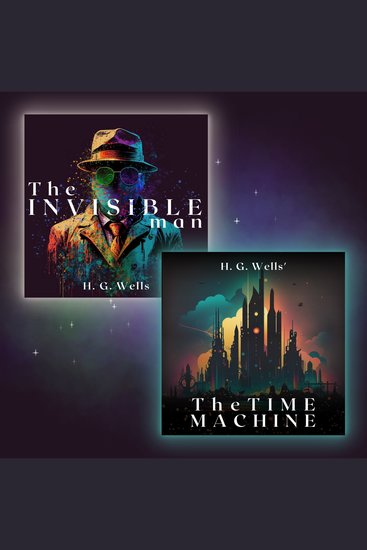
  • The Invisible Man & The Time Machine - cover

    The Invisible Man & The Time...

    H. G. Wells

    • 0
    • 0
    • 0
    This bundle features two classic H. G. Wells stories narrated by Jake Urry. 
    The Invisible Man 
    An unexpected guest at the Coach and Horses in Iping arouses the local's interest with his short temper and his completely covered face. Griffin is seeking solitude and quiet, but is soon forced from the village and finds temporary shelter in the home of an old university friend, Kemp. There, injured and fatigued, he tells his old friend how he discovered the secret to making himself invisible, and tries to join forces with him to use this new power to bring about a reign of terror. 
    The Time Machine 
    A Victorian scientist travels into the far future and discovers the descendants of humanity, the Eloi, living in apparent peace and tranquility. However, after his time machine goes missing, he discovers that humanity has in fact split into two distinct species, and the Morlocks are not quite so benign as the Eloi. The time traveller must arm himself and get his time machine back if he ever wants to return to his own era.
    Voir livre