¡Acompáñanos a viajar por el mundo de los libros!
Añadir este libro a la estantería
Grey
Escribe un nuevo comentario Default profile 50px
Grey
Suscríbete para leer el libro completo o lee las primeras páginas gratis.
All characters reduced
Indigenous Festivals - cover

Indigenous Festivals

Mira Donnelly

Traductor A AI

Editorial: Publifye

  • 0
  • 0
  • 0

Sinopsis

Indigenous festivals worldwide are far more than relics of the past; they’re dynamic expressions of cultural identity and resilience. Indigenous Festivals explores these celebrations as vital links connecting history, present realities, and future aspirations. Festivals like powwows and Inti Raymi are examined not only for their historical context, but also for their modern roles in preserving cultural heritage and asserting Indigenous self-determination. They serve as key vehicles for intergenerational knowledge transfer, ensuring traditions continue to thrive.

 
The book delves into how these festivals have evolved, particularly under the influences of colonialism, modernization, and globalization, revealing how Indigenous communities navigate these pressures while maintaining unique identities. Through historical accounts, ethnographic studies, and contemporary perspectives, the book showcases the political dimensions of these celebrations and challenges stereotypical views by highlighting ongoing resilience.

 
It's structured to first introduce festivals as sites of preservation, then to explore specific cases across regions, and finally to examine their political impact. This approach shows how festivals promote community cohesion, assert Indigenous rights, and contribute to cultural revitalization.
Disponible desde: 06/03/2025.
Longitud de impresión: 65 páginas.

Otros libros que te pueden interesar

  • Who Is a Worthy Mother? - An Intimate History of Adoption - cover

    Who Is a Worthy Mother? - An...

    Rebecca Wellington

    • 0
    • 0
    • 0
    Nearly every person in the United States is affected by adoption. In the wake of the U.S. Supreme Court's overturning of Roe v. Wade, the renewed debate over women's reproductive rights places an even greater emphasis on adoption. Wellington's timely—and deeply researched—account amplifies previously marginalized voices and exposes the social and racial biases embedded in the United States' adoption industry. 


    The history of adoption is rarely told from an adoptee's perspective. Wellington remedies this gap by framing the chronicle of adoption in America using her own life story. As she reckons with the pain and unanswered questions of her own experience, she explores broader issues surrounding adoption in the United States, including changing legal policies, sterilization and compulsory relinquishment programs, forced assimilation of babies of color and Indigenous babies adopted into white families, and other liabilities. 


    According to Wellington, US adoption practices in America are shrouded in secrecy, for they frequently cast shame on unmarried women, women struggling with fertility, and "illegitimate" babies and children. As the United States once again finds itself embroiled in heated disputes over women's bodily autonomy Wellington's book offers a unique and much-needed frame of reference.
    Ver libro
  • Germany vs Great Britain in the Air: The History of the Enemy Air Forces in World War I and World War II - cover

    Germany vs Great Britain in the...

    Editors Charles River

    • 0
    • 0
    • 0
    One of the most important breakthroughs in military technology associated with World War I, and certainly the one that continues to capture the public imagination, was the use of airplanes, which were a virtual novelty a decade before. While the war quickly ground to a halt in its first few months, the skies above the Western Front became increasingly busy. The great powers had already been acquiring aircraft for potential uses, but given that aerial warfare had never been a major component of any conflict, it’s understandable that few on either side had any idea what the planes were capable of doing. Furthermore, at the start of the war, all sides’ aircraft were ill-equipped for combat mostly because the idea that planes might somehow fight was still a novel one. 
    The Royal Air Force (RAF), Britain's legendary air arm, was born in the skies above the First World War. The British had previously used balloons for spotting and reconnaissance for decades, and in the years leading up to the war, planes started seeing military use. They mostly provided reconnaissance, though experiments were made in using them offensively. During the Boer War of 1899-1902, the British Army used the crews of helium-filled balloons to plot and help target artillery fire. But these were small, tentative steps. The first patent to fit a machine gun to a plane, taken out in 1910, had not yet led to active fighting vehicles, and there was no doctrine, no tactics, and no combat between massed air fleets.  
    The Third Reich's Luftwaffe began World War II with significant advantages over other European air forces, playing a critical role in the German war machine's swift, powerful advance. By war's end, however, the Luftwaffe had been decimated by combat losses and crippled by poor decisions at the highest levels of military decision-making, and it proved unable to challenge Allied air superiority despite a last-minute upsurge in German aircraft production.
    Ver libro
  • Criminal Justice in Divided America - Police Punishment and the Future of Our Democracy - cover

    Criminal Justice in Divided...

    David A. Sklansky

    • 0
    • 0
    • 0
    How a broken criminal justice system has fueled the crisis of American democracy, and how we can address both problems together.Criminal Justice in Divided America shows how police, courts, and prisons helped to break American democracy and how better approaches to public safety and criminal accountability can help to repair it. Engaging critically with concerns from both the left and the right, Sklansky lays out a clear and deeply researched agenda for reforming police departments, prosecutors' offices, criminal trials, and punishment. Sklansky seeks pragmatic solutions that take account of political realities: the lofty ideal of empowering "the people" or "the community" can mean little when members of the public or the community disagree. While efforts to "defund" the police have exacerbated political conflicts without addressing the underlying problem of how and when force should be used to protect public safety, reforms aimed at improving police accountability, restraining prosecutorial power, and expanding the role of juries can bring together warring parties who share a concern for justice.Ultimately, Sklansky argues, reform must be rooted in a strong commitment to pluralism―bridging political divides rather than worsening them, strengthening democracy, and securing the broad support that enables durable change.
    Ver libro
  • Our Fathers Fought Franco - cover

    Our Fathers Fought Franco

    Willy Maley

    • 0
    • 0
    • 0
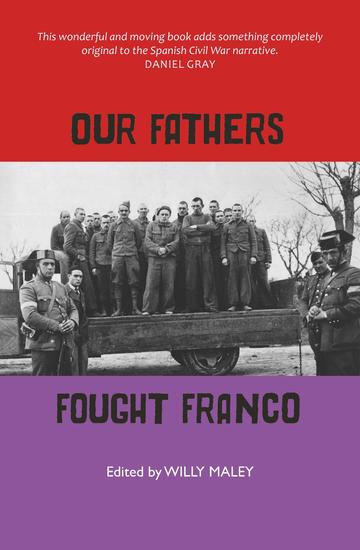
    James Maley, George Watters, Donald Renton and Archibald Williams were members of Machine Gun Company No. 2 of the XV International Brigade. This is the first book to focus on a small group of men from different starting-points, ended up in the same battleground at Jarama, and then in the same prisons after capture by Franco's forces.
    Their remarkable story is told both in their own words and in the recollections of their sons and daughters, through a prison notebook, newspaper reports, stills cut from newsreels, interviews, anecdotes and memories, with a foreword by Daniel Gray.
    Our Fathers Fought Franco is a collective biography that promises to add significantly to the understanding of the motives of those who 'went because their open eyes could see no other way'.
    Ver libro
  • The Murder Squad - cover

    The Murder Squad

    Michael Adams

    • 0
    • 0
    • 0
    SHORTLISTED FOR THE NED KELLEY AWARD FOR BEST TRUE CRIME 
     
    How the New South Wales Police Force's finest solved murders in one of the most tumultuous periods in Australian history.  
     
    As Australia sank into the darkest days of the Great Depression, a succession of bloody mysteries grabbed headlines and gripped the country. The Hammer Horror, The Bungendore Bones, The Park Demon, The Human Glove and The Pyjama Girl – these were just some of the grisly cases that had to be solved by the Sydney detectives of The Murder Squad.  
     
    With the people, press and politicians screaming for justice and vengeance, homicide chief Tom McRae and his colleagues used bold new investigative tools in the massive manhunts for these maniacal killers. Working under intense pressure, hard-nosed and hard-charging cops solved some cases brilliantly – yet others were 'closed' with dodgy convictions while several shadowy figures were to get away with murder.  
     
    Set against the backdrop of our greatest economic crisis, as the federal and state governments headed for a showdown and fascist and communist thugs threatened civil war, The Murder Squad reopens the files on Australia's most chilling forgotten crimes to ask who was guilty, who was innocent, and whether some cops were as dangerous as the monsters they were hunting.
    Ver libro
  • What's Wrong with Stereotyping? - cover

    What's Wrong with Stereotyping?

    Erin Beeghly

    • 0
    • 0
    • 0
    What's Wrong with Stereotyping? offers a refreshing and accessibly written philosophical take on the ethics of stereotyping. Stereotyping is woven into every aspect of human experience: conversation, psychology, algorithmic systems, and culture. It relates to generalization and induction, core aspects of rationality. But when and why it is morally wrong to stereotype? This book tackles this deep and enduring puzzle. 


    Core chapters evaluate important ethical wrongs: the failure to treat persons as individuals, disrespect, harm, prejudice, threats to freedoms, and the failure to treat persons as equals. One finds that there is no "essence" of wrongful stereotyping, a single property or set of properties that all problematic cases share in common. Nor are the wrongs of stereotyping reducible to an elegant number, two or three. Instead, wrongful stereotyping is characterized by clusters of wrong-making properties, including all the ones noted here. Listeners will come away with a radically pluralistic, open-ended theory of wrongful stereotyping that they can use to identify wrongful stereotyping in their own lives and our contemporary world. Filled with thought-provoking examples and models for social change, this book emphasizes the messiness of moral reality and the importance of looking to the past in order to understand the ethical perils of stereotyping.
    Ver libro