Join us on a literary world trip!
Add this book to bookshelf
Grey
Write a new comment Default profile 50px
Grey
Subscribe to read the full book or read the first pages for free!
All characters reduced
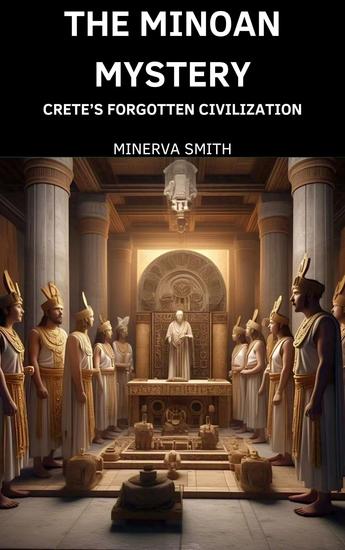
The Minoan Mystery - Crete's Forgotten Civilization - cover

The Minoan Mystery - Crete's Forgotten Civilization

Minerva Smith

Publisher: Heritage Books

  • 0
  • 0
  • 0

Summary

Long before the rise of Athens and the glory of Sparta, an extraordinary civilization flourished on the island of Crete. The Minoans, master seafarers and skilled artisans, built vast palaces, created stunning works of art, and developed a complex society that thrived for centuries. Yet their civilization mysteriously vanished, leaving behind only ruins, myths, and unanswered questions.


The Minoan Mystery uncovers the lost world of this ancient people, exploring their legendary cities, their enigmatic script, and the secrets hidden beneath the ruins of Knossos. Were they the inspiration for the myth of Atlantis? What caused their sudden collapse? Through archaeology, historical analysis, and mythological accounts, this book pieces together the fascinating story of a forgotten civilization that shaped the ancient world.


Step back in time and uncover the truth behind one of history’s greatest mysteries.
Available since: 02/23/2025.
Print length: 70 pages.

Other books that might interest you

  • Finding Your Third Place - Building Happier Communities (and Making Great Friends Along the Way) - cover

    Finding Your Third Place -...

    PhD Richard Kyte

    • 0
    • 0
    • 0
    Do you have a Third Place? Your first place is home, your second place is work, and your third place is where you go to socialize. As more of our lives are spent online and in digital spaces, these often overlooked "Third Places" play a crucial role in keeping our communities vibrant. In a timely and thoughtful examination, Richard Kyte, PhD, explores the places that nurture our souls and make up the bedrock of our communities. Third Places can range from a neighborhood tavern, to a community center, to a local bookstore or coffee shop. They are the critical gathering spaces where friendships are formed, relationships are nurtured, and the tapestry of community is woven. Yet, for an ever-growing list of reasons, many people today find themselves without a third place of their own. At a time when our nation is facing an epidemic of loneliness, when communities are suffering from loss of trust, low levels of engagement, despair, and political polarization, what if the answer to many of our problems lies in a simple idea? What if we just need to pay attention to the places where we find ourselves?
    Show book
  • Strength in Numbers - How Polls Work and Why We Need Them - cover

    Strength in Numbers - How Polls...

    G. Elliott Morris

    • 0
    • 0
    • 0
    Public opinion polling is the ultimate democratic process; it gives every person an equal voice in letting elected leaders know what they need and want. But in the eyes of the public, polls today are tarnished. Recent election forecasts have routinely missed the mark and media coverage of polls has focused solely on predicting winners and losers. 


    In Strength in Numbers, data journalist G. Elliott Morris argues that the larger purpose of political polls is to improve democracy, not just predict elections. Whether used by interest groups, the press, or politicians, polling serves as a pipeline from the governed to the government, giving citizens influence they would otherwise lack. No one who believes in democracy can afford to give up on polls; they should commit, instead, to understanding them better. 


    Morris takes listeners from the first semblance of data-gathering in the ancient world through to the development of modern-day scientific polling. He explains how the internet and "big data" have solved many challenges in polling—and created others. He covers the rise of polling aggregation and methods of election forecasting, reveals how data can be distorted and misrepresented, and demystifies the uncertainty of polling. Acknowledging where polls have gone wrong in the past, Morris charts a path for the industry's future.
    Show book
  • Allied Invasions of France in 1944 The: The History and Legacy of the Campaigns that Began the Liberation of Western Europe from the Nazis - cover

    Allied Invasions of France in...

    Editors Charles River

    • 0
    • 0
    • 0
    By the end of D-Day, the Allies had managed to successfully land 170,000 men, including over 75,000 on the British and Canadian beaches, 57,000 on the American beaches, and over 24,000 airborne troops. Thanks to Allied deception, the German army had failed to react to prevent the Allies from making the most of their landings. Just one division, the Hitlerjugend, would arrive the following day. Despite a fearsome and bloody day, the majority of the Allied forces had held their nerve, and most importantly, achieved their objectives. This ensured Operation Overlord was ultimately successful, and victory in Europe would be achieved within less than a year. 	Churchill was not overstating the achievements of the invasion when he described the plan “the greatest thing we have ever attempted”. The greatest armada the world had ever seen had landed 170,000 soldiers on the heavily defended beaches of Normandy in just 24 hours. More remarkable was the fact that the operation was a success on every major level. Deception, tactical surprise and overwhelming force had contributed to the establishment of an adequate beachhead. Confusion and dissent had stopped the Germans massing for any great counterattack. The Atlantic Wall which Hitler had placed so much faith in had been breached, and the race to Paris was on. The landings in Normandy and the campaign that followed were successful, but that very success brought its own problems.  
    	While D-Day is one of the most famous events of the war, it is widely overlooked that about two months after the landings in Normandy, there was a second Allied landing in France. On August 15, 1944, a combined US-French force landed in southern France on the beaches of the Côte d'Azur as part of Operation Dragoon. In just over four weeks of fighting, the Allied landing led to the liberation of most of southern France and to one of the most audacious and successful Allied operations of World War II. 
    Show book
  • Andy Williams - cover

    Andy Williams

    Wink Martindale

    • 0
    • 1
    • 0
    Andy Williams got his start doing anonymous voice tracks for movies in the 1940s. He got his start singing at teas with his brother, and then made a move to singing on radio in Des Moines, Iowa and Chicago. Finally, Williams found his way to New York where he started to really focus on his singing career.    Television played an instrumental role in Williams’ success. His big breakthrough came as a singer on The Tonight Show starring Steve Allen. In February of 1973, he sat down with Wink Martindale to take a look back at his career. Williams discusses his early life, his work in television and fruitful career.
    Show book
  • Speed Reading: Unlock Your Brain's Potential - Master the Art of Speed Reading and Boost Your Learning Efficiency - cover

    Speed Reading: Unlock Your...

    Emily Hayes

    • 0
    • 0
    • 0
    Unlock your brain's potential with "Speed Reading: Unlock Your Brain's Potential: Master the Art of Speed Reading and Boost Your Learning Efficiency." This comprehensive guide takes you through the science and practice of speed reading, offering techniques to increase your reading speed while enhancing comprehension. Whether you're a student managing a heavy workload, a professional aiming to stay ahead, or a lifelong learner eager for more knowledge, this book equips you with the skills to transform your reading habits. 
    The book helps you identify and overcome everyday poor habits, such as subvocalization and regression, by thoroughly examining the reading process. You'll learn to create an optimal reading environment, set realistic goals, and utilize essential tools and resources. Practical exercises and advanced techniques, such as chunking and meta-guiding, are presented with step-by-step instructions to build your speed reading proficiency. 
    Delve into the versatility of speed reading across diverse contexts—academic, professional, and leisure—enabling you to tackle any reading material efficiently. The book underscores the importance of enhancing overall learning efficiency through cognitive techniques for better retention, integrating speed reading with other learning methods, and continuous improvement strategies. This comprehensive approach ensures you feel adaptable and capable of handling any reading challenge that comes your way.
    Show book
  • Alexander the Great - cover

    Alexander the Great

    Jacob Abbott

    • 0
    • 0
    • 0
    "Alexander the Great  was a king of the ancient Greek kingdom of Macedon. He succeeded his father Philip II to the throne in 336 BC at the age of 20 and spent most of his ruling years conducting a lengthy military campaign throughout Western Asia, Central Asia, parts of South Asia, and Egypt. By the age of 30, he had created one of the largest empires in history, stretching from Greece to northwestern India12.    Here are some key points about Alexander the Great:    Military Conquests: Alexander was undefeated in battle and is widely considered to be one of history's greatest and most successful military commanders. His campaigns included victories at Issus and Gaugamela, where he overthrew Darius III and conquered the entire Achaemenid Empire.    Education    Education: Until the age of 16, Alexander was tutored by the philosopher Aristotle.  Empire Building: He expanded his empire through relentless military campaigns, forging connections between different cultures and leaving a lasting impact on the regions he conquered.    Alexander's Balkan campaign    Legacy: Alexander's legacy extends beyond military conquests. He promoted the fusion of Greek and Persian cultures, leading to the Hellenistic period. His influence on art, architecture, and literature reverberated for centuries.    Death of Alexander the Great    Death: Alexander died in Babylon at the age of 32, leaving behind a legacy that continues to captivate historians and enthusiasts alike."
    Show book