¡Acompáñanos a viajar por el mundo de los libros!
Añadir este libro a la estantería
Grey
Escribe un nuevo comentario Default profile 50px
Grey
Suscríbete para leer el libro completo o lee las primeras páginas gratis.
All characters reduced
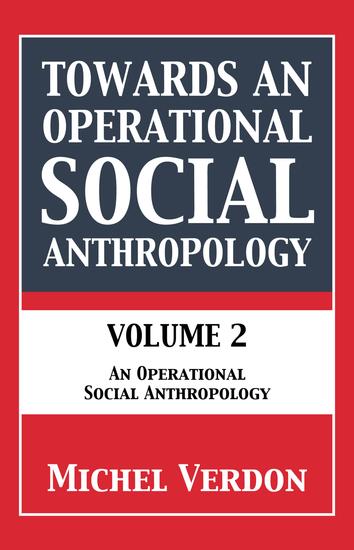
Towards an Operational Social Anthropology - Volume 2: An Operational Social Anthropology - cover

Towards an Operational Social Anthropology - Volume 2: An Operational Social Anthropology

Michel Verdon

Editorial: Grosvenor House Publishing

  • 0
  • 0
  • 0

Sinopsis

In volume 1, Professor Verdon sought to identify what crippled social anthropology's original project, that of understanding sociocultural variability. He found its cause in a universal, Aristotelian cosmology that renders groups ontologically variable to their principles of social organization, by defining them in terms of behaviour regulation. 
In this second volume, he develops a cure to that cosmological malaise: to define groups outside all behaviour regulation, and to define a separate group for every type of activity (unifunctional groups). From these two new cosmological requirements he sets out to define all the main concepts of social anthropology in what he calls an 'operational' language (defined with respect to anthropology's aims, not as entities with intrinsic anthropological attributes): groups, corporations, descent, territoriality, lineages, segmentation, sovereignty and so on.
He then applies this language to 'translate' classical ethnographies operationally. He first chose the most famous ethnographies of so-called segmentary lineage societies, the Nuer (Sudan), Tallensi (Ghana) and Tiv (Nigeria), and then added the Berbers from the Rif (Morocco), the Yao (Malawi) and Australian Aborigines. All those societies were described as having descent groups. Translated operationally, ONLY ONE of them retains descent groups (the Tallensi). This leads him radically to transform the ethnographic landscape of social anthropology. Where all ethnographers saw descent groups almost everywhere, he finds them to be rare occurrences, now replaced with clientelistic social formations.
Overall, setting out to define a set of etic (objective) concepts, he discovers that this language actually yields much better emic approaches to social organization (an approach closer to the actors' subjective experience).
Disponible desde: 06/03/2025.
Longitud de impresión: 221 páginas.

Otros libros que te pueden interesar

  • Fort Henry: The History of the Union’s First Major Victory in the West during the Civil War - cover

    Fort Henry: The History of the...

    Jonathan Gianos-Steinberg

    • 0
    • 0
    • 0
    While the Lincoln Administration and most Northerners were preoccupied with trying to capture Richmond in the summer of 1861, it would be the little-known Ulysses S. Grant who delivered the Union’s first major victories, over a thousand miles away from Washington. Grant’s new commission led to his command of the District of Southeast Missouri, headquartered at Cairo, after he was appointed by “The Pathfinder”, John C. Fremont, a national celebrity who had run for President in 1856. Fremont was one of many political generals that Lincoln was saddled with, and his political prominence ensured he was given a prominent command as commander of the Department of the West early in the war before running so afoul of the Lincoln Administration that he was court-martialed. 
    In January of 1862, Grant persuaded General Henry “Old Brains” Halleck to allow his men to launch a campaign on the Tennessee River. As soon as Halleck acquiesced, Grant moved against Fort Henry, in close coordination with the naval command of Flag Officer Andrew Hull Foote. The combination of infantry and naval bombardment helped force the capitulation of Fort Henry on February 6, 1862, and the surrender of Fort Henry was followed immediately by an attack on Fort Donelson on the Cumberland River, which earned Grant his famous nickname “Unconditional Surrender”. Grant’s forces enveloped the Confederate garrison at Fort Donelson, which included Confederate generals Simon Buckner, John Floyd, and Gideon Pillow. In one of the most bungled operations of the war, the Confederate generals tried and failed to open an escape route by attacking Grant’s forces on February 15. Although the initial assault was successful, General Pillow inexplicably chose to have his men pull back into their trenches, ostensibly so they could take more supplies before their escape. Instead, they simply lost all the ground they had taken, and the garrison was cut off yet again.
    Ver libro
  • Idleness - A Philosophical Essay - cover

    Idleness - A Philosophical Essay

    Brian O'Connor

    • 0
    • 0
    • 0
    The first book to challenge modern philosophy’s case against idleness, revealing why the idle state is one of true freedomFor millennia, idleness and laziness have been regarded as vices. We're all expected to work to survive and get ahead, and devoting energy to anything but labor and self-improvement can seem like a luxury or a moral failure. Far from questioning this conventional wisdom, modern philosophers have worked hard to develop new reasons to denigrate idleness. In Idleness, the first book to challenge modern philosophy's portrayal of inactivity, Brian O'Connor argues that the case against an indifference to work and effort is flawed--and that idle aimlessness may instead allow for the highest form of freedom.Idleness explores how some of the most influential modern philosophers drew a direct connection between making the most of our humanity and avoiding laziness. Idleness was dismissed as contrary to the need people have to become autonomous and make whole, integrated beings of themselves (Kant); to be useful (Kant and Hegel); to accept communal norms (Hegel); to contribute to the social good by working (Marx); and to avoid boredom (Schopenhauer and de Beauvoir). O'Connor throws doubt on all these arguments, presenting a sympathetic vision of the inactive and unserious that draws on more productive ideas about idleness, from ancient Greece through Robert Burton's Anatomy of Melancholy, Schiller and Marcuse's thoughts about the importance of play, and recent critiques of the cult of work. A thought-provoking reconsideration of productivity for the twenty-first century, Idleness shows that, from now on, no theory of what it means to have a free mind can exclude idleness from the conversation.
    Ver libro
  • The End of the Beginning - cover

    The End of the Beginning

    Carrie Voigt Schonhoff

    • 0
    • 0
    • 0
    Carrie Voigt Schonhoff, poet and author of The Liminal Space, has released her second published book of poems, The End of the Beginning. Schonhoff once again captures the spirit of her native Wisconsin while encapsulating the growth of her life’s journey and exciting next chapter. This work will resonate deeply with readers from the Midwest and pull at the heartstrings of those that continue to face challenges but never stop dreaming. Her second book of poems addresses the importance of healing, moving on, and being ready to face a new beginning. Schonhoff’s newest work is a continuation of beliefs that we can heal by connecting and understanding one another on a deeper level through poetry.
    Ver libro
  • Loyalty in Time of Trial - The African American Experience During World War I - cover

    Loyalty in Time of Trial - The...

    Nina Mjagkij

    • 0
    • 0
    • 0
    The little-known history of black soldiers and defense workers in the First World War, and what happened afterward: “Highly recommended.” —Choice   In one of the few book-length treatments of the subject, historian Nina Mjagkij conveys the full range of the African American experience during the “Great War.” Prior to World War I, most African Americans did not challenge the racial status quo. But nearly 370,000 black soldiers served in the military during the war, and some 400,000 black civilians migrated from the rural South to the urban North for defense jobs.    Following the war, emboldened by their military service and their support of the war on the home front, African Americans were determined to fight for equality—but struggled in the face of indifference and hostility in spite of their combat-veteran status. America would soon be forced to confront the impact of segregation and racism—beginning a long, dramatic reckoning that continues over a century later.   “Painstakingly describes the frustration, sometimes anger, and frequent courage demonstrated by southern and northern African Americans in their attempts to include themselves in the national crusade of making the world safe for democracy . . . one of the most comprehensive treatments of the race issue in the early twentieth century that this reader has seen.” —Journal of Southern History
    Ver libro
  • FSOT Simplified - FSOT Success Guide 2024-2025: Ace the Foreign Service Officer Test with Confidence - cover

    FSOT Simplified - FSOT Success...

    Jonas Everhart

    • 0
    • 0
    • 0
    FSOT Simplified: Simplified Guide & Explanations Included 
    Are you eager to advance in your career and strengthen your knowledge by acing the FSOT Exam 2024-2025? 
    Looking for an all-encompassing guide that equips you with everything needed to pass the FSOT Exam 2024-2025? 
    Your search ends here! 
    This guide is your ultimate companion for deepening your understanding, honing your skills, and engaging in practical exercises. With this resource, you're set up for success. 
    Updated for the FSOT 2024-2025 Exam Structure. 
    Key features of this enriched guide: 
    - Profound insights about the FSOT Exam 2024-2025 Certification 
    - Detailed explanation of the Foreign Service Officer Test (FSOT) 
    - Effective strategies for exam preparation and tackling 
    Our guide distinguishes itself through comprehensive coverage, which is essential for your exam success. Concepts are not merely skimmed; they are thoroughly explored with precision. 
    Please note that this guide is not affiliated with any official FSOT entity and is purely an independent resource for your benefit. 
    Designed with a clear structure and easy-to-understand language, our FSOT Exam Guide 2024-2025 ensures smooth transitions between topics. Say goodbye to dense jargon and welcome clear, precise, and technically accurate content. 
    So, why wait? Click the BUY NOW button, secure your guide, and begin your journey to FSOT Exam 2024-2025 success!
    Ver libro
  • Improbable Possibilities - An Entrepreneur's Quest - cover

    Improbable Possibilities - An...

    Linda E. Rawlings

    • 0
    • 0
    • 0
    Observe Possibilities. 
    Entangle Possibilities. 
    Create Possibilities. 
    Throw spaghetti against the wall and see what sticks. 
    Several years ago, I was approached by Carolyn Wyman, author of “The Great American Chocolate Chip Cookie Book” to write a book about Otis Spunkmeyer Cookies.  I am co-founder of Otis Spunkmeyer Cookies with my husband, but no one starts a company alone.  I told her that Otis Spunkmeyer was about many things besides cookies, and I wrote stories to prove it.  Carolyn agreed, indicating my most fascinating stories had nothing to do with cookies.  She suggested I compile my “you can’t make this up” stories of improbable possibilities.  
    My entrepreneurial stories are of Robert C. Brown and Company, investment advisors, and Otis Spunkmeyer Cookies and Burritos.  Triple 888 Manufacturing, the sheet metal company that created the oven to bake Otis Spunkmeyer cookies.  Sentimental Journeys, the DC3 airline that promoted Otis Spunkmeyer.  New Shoes, Old Souls Dance Company, Yoga Garden Dancers, Heterodoxy Magazine, and George Magazine.  Yes, I did meet with John F. Kennedy Jr., to incubate George.  I also took Joe DiMaggio to Las Vegas and Van Morrison sang “Moondance” to me.  Albert Einstein is one of my heroes.  I have daughters.  These narratives are a memorialization of my improbable possibilities.  My spaghetti-walling spirit propagated waves. 
    The most powerful quantum computers can’t negotiate infinite waves of possibilities.  Artificial intelligence generates probable possibilities.  Human intelligence imagines improbable possibilities.  Artificial intelligence exists on codes and algorithms.  Human intelligence is nurtured by thinking with thoughtfulness.  It actualizes imagination, and spaghetti-walls improbable possibilities. 
    This is not a treatise on mindfulness.  It is not an AI bashing, or a self-help book.  Primarily, I am spaghetti-walling this book to entertain you.  I’ve been determined to make waves.
    Ver libro