¡Acompáñanos a viajar por el mundo de los libros!
Añadir este libro a la estantería
Grey
Escribe un nuevo comentario Default profile 50px
Grey
Suscríbete para leer el libro completo o lee las primeras páginas gratis.
All characters reduced
Out of the Ordinary - cover

Out of the Ordinary

Michael/Lobzang Dillon/Jivaka

Editorial: The Lilliput Press

  • 0
  • 0
  • 0

Sinopsis

Now available for the first time in Ireland and the UK – more than half a century after it was written – is the memoir of Michael Dillon/Lobzang Jivaka (1915–62), the Anglo-Irish doctor and Buddhist monastic novice chiefly known to scholars of sex, gender, and sexuality for his pioneering transition from female to male between 1939 and 1949, and for his groundbreaking 1946 book Self: A Study in Ethics and Endocrinology. Here at last is Dillon/Jivaka's extraordinary life story told in his own words.
Out of the Ordinary captures Dillon/Jivaka's various journeys – to Oxford, into medicine, across the world by ship – within the major narratives of his gender and religious journeys. Moving chronologically, Dillon/Jivaka was from Lismullin House, County Meath, but spent his childhood in Folkestone, England, where he was raised by spinster aunts, telling of his days at Oxford immersed in theology, classics, and rowing. He recounts his hormonal transition while working as an auto mechanic and fire watcher in Bristol during World War II and describes his surgical transition under Sir Harold Gillies while Dillon himself attended medical school at Trinity College, Dublin (1945-51). He details his travels as a ship's surgeon in the British Merchant Navy with extensive commentary on his engagement with colonial and postcolonial subjects in Asia, followed by his 'outing' by the British press while he served aboard  The City of Bath.
Out of the Ordinary is not only a unique record of early gender affirmation but also a compelling account of religious conversion in the mid-twentieth century. Dillon/Jivaka chronicles his gradual shift from Anglican Christianity to the esoteric spiritual systems of George Gurdjieff and Peter Ouspensky, to Theravada and finally Mahayana Buddhism. He concludes his memoir with the contested circumstances of his Buddhist monastic ordination in India and Tibet. Ultimately, while Dillon/Jivaka died before becoming a monk, his novice ordination was significant: it made him the first white European man to be ordained in the Tibetan Buddhist tradition.
This first-person narrative, written in the early 1960s and first published more than a generation later in the US by Fordham University Press, is both ahead of its time and distinctly of its time and class, with Dillon's views being sometimes enlightened, sometimes colonial. A Foreword by Susan Stryker from the Fordham University Press edition describes Dillon as 'a seeker after truth, who travelled wherever his queries led him'. An Afterword, 'A Mapless Journey', by London-based literary agent Andrew Hewson – unique to the Lilliput Press edition – traces the typescript memoir's provenance and preservation prior to its eventual publication. An introductory biographical essay by consultant psychologist Aidan Collins gives an overview of the timeline of this remarkable individual's history. Out of the Ordinary is a landmark publication that sets free a singular voice from within the history of the transgender movement.
Disponible desde: 18/11/2021.
Longitud de impresión: 256 páginas.
Otros libros que te pueden interesar

  • Voices of Famous Polar Explorers - cover

    Voices of Famous Polar Explorers

    Frederick Albert Cook, Robert E....

    • 0
    • 0
    • 0
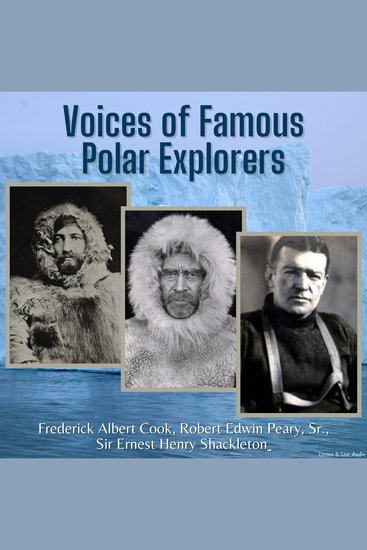
    Frederick Albert Cook (June 10, 1865 - August 5, 1940) was an American explorer and physician noted for his claims of achieving the first summit of Mount McKinley, in September 1906, and having reached the North Pole on April 21, 1908, which would have been a year before Robert Peary. Both claims have been largely discredited. Later, Dr. Cook was a founding member of the Arctic Club and Explorers Club. 
    Robert Edwin Peary, Sr. (May 6, 1856 - February 20, 1920) was an American explorer who claimed to have led the first expedition, on April 6, 1909, to reach the geographic North Pole. 
    Peary's claim was widely accepted for most of the 20th century, rather than the competing claim by Frederick Cook who said he got there a year earlier. More recently, historians generally believe Cook did not reach the pole, and there are grave doubts that Peary did, though he may have been as close as five miles. 
    Sir Ernest Henry Shackleton (February 1874 - January 5, 1922) was an Anglo-Irish polar explorer and one of the principal figures of the period known as the Heroic Age of Antarctic Exploration. 
    In January 1909 - as leader of the Nimrod Expedition - he and three companions made a southern march which established a record-farthest south latitude at 88 degrees 23' S - some 97 geographical from the South Pole - the closest convergence in exploration history up to that time. For this achievement, Shackleton was knighted by King Edward VII on his return home. 
    ©2013 Rick Sheridan (P)2013 Rick Sheridan
    Ver libro
  • Inside the Reagan White House - A Front-Row Seat to Presidential Leadership with Lessons for Today - cover

    Inside the Reagan White House -...

    Frank Lavin

    • 0
    • 0
    • 0
    An inside look at the most successful president of modern times. 


    What makes a good White House memoir? The right mix of personal stories, insight on the president, discussion of policy and historical events, and crazy, colorful anecdotes that capture the reader's attention. 


    Inside the Reagan White House has all this—plus a vivid take on the Reagan assassination attempt, Gorbachev and the Reykjavik summit, Ollie North and the Contras, the 1988 Bush-Dukakis contest—and other critical moments of that era. 


    Original insight on Ronald Reagan, as well as discussions of cabinet members and others, are interspersed with personal anecdotes, off-hand comments, and unique family details that historians and general audiences will love. 


    On the colorful side, the action moves from movie stars to Soviet spies to (literal) knife fights, neo-Nazis, plain old Nazis, intimate affairs, fights on planes, and con men chased by INTERPOL. 


    And at the heart of the story are the thousands of dedicated, patriotic Americans who helped Ronald Reagan as he worked to push back against the Soviet Union, promote democracy, improve trade, lower taxes, and reduce the size and scope of government.
    Ver libro
  • A Nurse’s War - cover

    A Nurse’s War

    Patricia Malcolmson, Robert...

    • 0
    • 0
    • 0
    The remarkable wartime diary of nurse Kathleen Johnstone 
    ‘Warm, chatty and endlessly absorbing, this delightful diary brims with intelligence and humour.’ Wendy Moore, author of Endell Street: The Women Who Ran Britain’s Trailblazing Military Hospital 
    The second world war could not have been won without the bravery and selflessness of women on the Home Front. Women like Kathleen Johnstone. 
    This first-hand story of one extraordinary but unheralded member of Britain’s ‘Greatest Generation’ brings home with extraordinary lucidity and compassion the realities of wartime Lancashire. 
    In 1943, Kathleen, then thirty, was a nurse-in-training at the Blackburn Royal Infirmary. For the next three years she kept a meticulous diary of her day-to-day existence, leaving behind a vivid record of the real-time concerns of a busy, thoughtful woman on the frontline of the war at home. 
    Kathleen’s days were never the same. She writes in clear and lively prose about life in the hospital: of her fellow nurses, her patients, about death and dying, and the progress of the war as wounded soldiers returned from Normandy in the summer of 1944. She muses on being working class, wartime austerity, and her anxiety about examinations. Here too are dances, Americans and a POW boyfriend in Germany. Kathleen’s observations are witty, wry and astute – but above all relatable, even today. 
    Poignant and engrossing, Kathleen Johnstone’s tale of trauma, romance and friendship will leave a lasting impression. 
    Kathleen Johnstone's personal memoirs provide a unique perspective on the social history of 20th century Europe. As a top nurse during the war, her experiences with patients and her insights into the medical challenges of the time make this autobiography a must-read. 
    For fans of Grace Dent (Comfort Eating), and Mary Morris (A Very Private Diary). 
    HarperCollins 2022
    Ver libro
  • Scientists - The Wright Brothers Michael Faraday and George Stephenson - cover

    Scientists - The Wright Brothers...

    Kelly Mass

    • 0
    • 0
    • 0
    This book contains three biographies: 
    The Wright Brothers - Orville and Wilbur Wright were 2 American air travel leaders who are commonly credited with developing, structure, and flying the world's first effective motor-driven plane. On December seventeenth, 1903, four miles (6 kilometers) south of Cat Hawk, North Carolina, they made the first regulated, supported flight of a powered, heavier-than-air airplane with the Wright Leaflet. The brothers were also the first to develop airplane controls, leading the way for fixed-wing powered flight. 
    Michael Faraday - Michael Faraday was born in Newington Butts, Surrey, on September twenty-second, 1791. (which is now part of the London District of Southwark). He originated from a bad home. His dad, James, was a Christian who came from the Glasite sect. At the time of the winter season of 1790, James Faraday moved his marriage partner and 2 kids from Outhgill, Westmorland, where he had been an apprentice to the town blacksmith. In the fall of that year, Michael was born. Michael Faraday, the 3rd of 4 kids, needed to inform himself after getting just a primary school education. 
    George Stephenson - George Stephenson was a British civil and mechanical engineer who lived from June the 9th 1781 to August the 12th 1848. Stephenson, called the "Dad of Railways," was regarded by Victorians as a great example of exertion and a desire to enhance. Samuel Smiles, a self-help supporter, applauded his achievements in particular. The four feet eight +12 inches (1.435 m) basic gauge used by the majority of the world's trains is based upon his chosen rail gauge, at times described as 'Stephenson gauge.'
    Ver libro
  • Story of Vikram and Betal: What is the relationship? - cover

    Story of Vikram and Betal: What...

    Saurabh Kumar

    • 0
    • 0
    • 0
    What happened to Vikram and Betal relationship, King Vikramaditya, after several attempts, captures Betal once again and heads towards the crematorium. Like every time, this time also Betal starts narrating a new story.
    Ver libro
  • Eastern Inferno - The Journals of a German Panzerjäger on the Eastern Front 1941–43 - cover

    Eastern Inferno - The Journals...

    Christine Alexander, Mason Kunze

    • 0
    • 0
    • 0
    This book presents the remarkable personal journals of German soldier Hans Roth. Writing as events transpired, he recorded the mystery and tension as the Germans deployed on the Soviet frontier in June 1941. In these journals, battles are described in "you are there" detail, as Roth wrote privately, as if to keep himself sane, knowing that his honest accounts of the horrors in the East could never pass through Wehrmacht censors. When the Soviet counteroffensive of winter 1942 begins, his unit is stationed alongside the Italian 8th Army, and his observations of its collapse, as opposed to the reaction of the German troops sent to stiffen its front, are of special fascination. 


    Roth's three journals were discovered many years after his disappearance, tucked away in the home of his brother, with whom he was known to have had a deep bond. After his brother's death, his family discovered them and quickly sent them to Rosel, Roth's wife. In time, Rosel handed down the journals to Erika, Roth's only daughter, who had immigrated to America. Hans Roth was doubtlessly working on a fourth journal before he was reported missing in action in July 1944 during the battle known as the Destruction of Army Group Center. Although Roth's ultimate fate remains unknown, what he did leave behind is an incredible firsthand account of the horrific war the Germans waged in Russia.
    Ver libro