Junte-se a nós em uma viagem ao mundo dos livros!
Adicionar este livro à prateleira
Grey
Deixe um novo comentário Default profile 50px
Grey
Assine para ler o livro completo ou leia as primeiras páginas de graça!
All characters reduced
Protected Area Boundaries - cover
LER

Protected Area Boundaries

Michael Davies

Tradutor A AI

Editora: Publifye

  • 0
  • 0
  • 0

Sinopse

Protected Area Boundaries explores the pivotal role of clearly defined and enforced boundaries in environmental protection, particularly for national parks and wildlife reserves. It argues that effective conservation depends not just on environmental law, but on the practical application and acceptance of these boundaries. A key insight is that precise boundaries mitigate environmental degradation by separating conservation areas from exploitation zones. The book examines how clarity in boundary demarcation directly reduces encroachment and illegal resource extraction, thereby safeguarding the integrity of protected areas.

 
The book progresses from foundational legal concepts to practical enforcement challenges and future strategies. It dissects real-world case studies, highlighting the complexities of balancing land use, indigenous rights, and economic pressures. The book uniquely emphasizes the importance of community involvement and transparent governance.

 
Furthermore, it addresses innovative approaches like buffer zones and the use of GIS technology for enhanced monitoring in an era defined by climate change and increasing population. This book offers significant value by providing a comprehensive understanding of the social, legal, and ecological constructs of protected area boundaries. It connects environmental law with geography, sociology, and economics, offering a nuanced perspective for environmental lawyers, policymakers, and conservation professionals.

 
By using comparative legal analysis, the book examines different legal systems and their approaches to boundary enforcement, making it a practical guide for improving boundary management practices and ensuring the sustainability of natural resources.
Disponível desde: 05/04/2025.
Comprimento de impressão: 72 páginas.

Outros livros que poderiam interessá-lo

  • Operation Speedy Express: The History and Legacy of One of the Vietnam War’s Most Controversial Campaigns - cover

    Operation Speedy Express: The...

    Editors Charles River

    • 0
    • 0
    • 0
    Before the Vietnam War, most Americans would have been hard pressed to locate Vietnam on a map. South Vietnamese President Diệm’s regime was extremely unpopular, and war broke out between Communist North Vietnam and South Vietnam around the end of the 1950s. Kennedy’s administration tried to prop up the South Vietnamese with training and assistance, but the South Vietnamese military was feeble. A month before his death, Kennedy signed a presidential directive withdrawing 1,000 American personnel, but shortly after Kennedy’s assassination, new President Lyndon B. Johnson reversed course, instead opting to expand American assistance to South Vietnam. 
    	Operation Speedy Express was a highly controversial military operation carried out by the U.S. Army supported by the Army of South Vietnam (ARVN) as well as regional and popular forces during the Vietnam War. It lasted from December 1968 until May 1969 and took place in the Mekong Delta's Kien Hoa and Vinh Binh provinces. The operation was a part of U.S. Army “pacification” efforts toward the Viet Cong, as American forces sought to interdict Viet Cong supply and communication lines from Cambodia and deny them the use of operational bases. Formally, the operation involved 8,000 U.S. soldiers and resulted in 242 American lives lost compared to 10,899 Viet Cong and People’s Army of Vietnam (PAVN) killed, according to Department of Defense records. Operation Speedy Express was considered successful by U.S. standards, as determined by the primary metric of body counts. However, while the number of Vietnamese dead, including civilians, is unknown, it is assumed to surpass 5,000, and the high number of casualties was attributed to the indiscriminate use of firepower, which included air and artillery strikes in densely populated areas.
    Ver livro
  • The Moral Equivalent of War - cover

    The Moral Equivalent of War

    William James

    • 0
    • 0
    • 0
    The Moral Equivalent of War, the last public utterance of William James, is significant as expressing the opinions of a practical psychologist on a question of growing popular interest. For the past fifteen years the movement for promoting international peace has been enlisting the support of organizations and individuals the world over. That this is a question on which much may be said for the opposition, James, though a pacificist, admits with his usual fair-mindedness, pointing out that militarism is the sole nourisher of certain human virtues that the world cannot let die, and that until the peace party devises some substitute, some moral equivalent, for the disciplinary value of war, their utopian goal is neither desirable nor possible. His own solution is advanced not as a practical measure, but merely as an illustration to show that the world is full of opportunities for the peaceful development and continuation of the martial qualities of human life.This essay was written for general dissemination as a publication of the American Association for International Conciliation, February, 1910. As it not only presents a peace program but defines as well the most familiar arguments of the war party, no militarist article has been included, although it may be mentioned that a suggestive apology for war is to be found among De Quincey's Essays and also in Ruskin's Crown of Wild Olive. Additional documents on conciliation, approaching the question from innumerable points of view, are published by the Association mentioned above.(Summary by Harrison Ross Steeves and Frank Humphrey Ristine, editors.)Edited and with an introduction by Harrison Ross Steeves (1881-1981) and Frank Humphrey Ristine (1884-1958)
    Ver livro
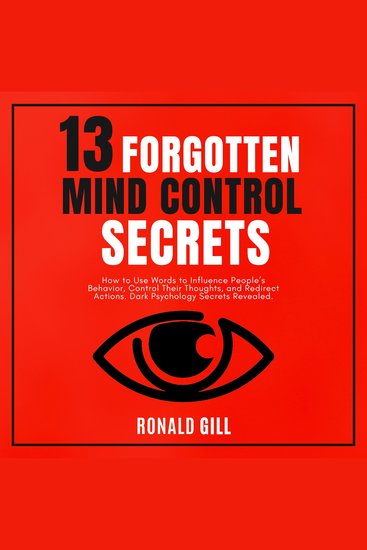
  • 13 Forgotten Mind Control Secrets - How to Use Words to Influence People’s Behavior Target Their Thoughts and Redirect Actions Dark Psychology Secrets Revealed - cover

    13 Forgotten Mind Control...

    Ronald Gill

    • 0
    • 0
    • 0
    From Nervous to Captivating: 
    How to Choose Words That Command Attention and Unveil the Secrets to Unleash Your Influence! 
    Picture this: 
    You stroll into a room full of strangers. Bit nervous, right? But then, you start chatting with someone to break the ice, and boom—within minutes, they're hanging onto your every word. Laughing at your jokes, nodding like crazy, practically begging for more. 
    Spill the beans—what's the secret? No magic, my friend. It's all about the words. 
    In "13 Forgotten Mind Control Secrets," Ronald Gill spills the tea on how words, said just right, can make you the superstar of any conversation. Confidence, charm, persuasion—it's all in there. Forget the ordinary, Ronald's taking you deep into the world of Mind Control. 
    Words are Your Secret Sauce. 
    Words can make or break—Ronald G. shows you how to make 'em. "13 Forgotten Mind Control Secrets" is your ultimate backstage pass to the language party where you control the playlist. Ready to decode minds, be the puppet master, and sprinkle a bit of dark psychology into your talks?  
    Buckle up, Gill's  about to redefine your chat game! 
    Get Your's Today! 
    Ver livro
  • Maria Theresa - cover

    Maria Theresa

    James Franck Bright

    • 0
    • 0
    • 0
    By the time of his death in 1740, the Holy Roman Emperor, Charles VI, had done everything possible to secure the succession to the throne of his daughter, Maria Theresa, but practically nothing to train her how to rule. Nevertheless, Maria Theresa managed by common sense, charm, and expert advice to negotiate a forty-year reign marked by secret diplomacy, shifting alliances, relentless warfare, and ruthless realpolitik. This short biography by the Oxford historian, James Franck Bright, describes her first thirty years on the throne.
    Ver livro
  • Creative Mind - cover

    Creative Mind

    Ernest Shurtleff Holmes

    • 0
    • 0
    • 0
    This little book is an attempt to explain what each soul must discover for himself, that he stands in the midst of an eternal creative power which presses itself around his own thought, and casts back to him glorified all that he thinks. If it awakens within the consciousness of one single individual the realization that the mind of the Universal (which is the only mind that there is) is his own mind that the creative power of this mind is his also; that the manifestation of this mind is his own individuality; that the love and power and peace of this mind is within himself, it will not be written in vain. May it then do much in simplifying and bringing to light some of the deeper mysteries and meanings of life. (Ernest Shurtleff Holmes)
    Ver livro
  • The Autists - Women on the Spectrum - cover

    The Autists - Women on the Spectrum

    Clara Törnvall

    • 0
    • 0
    • 0
    An incisive and deeply candid account that explores autistic women in culture, myth, and society through the prism of the author's own diagnosis. 


    Until the 1980s, autism was regarded as a condition found mostly in boys. Even in our time, autistic girls and women have largely remained undiagnosed. When portrayed in popular culture, women on the spectrum often appear simply as copies of their male counterparts—talented and socially awkward. 


    Yet autistic women exist, and always have. They are varied in their interests and in their experiences. Autism may be relatively new as a term and a diagnosis, but not as a way of being and functioning in the world. It has always been part of the human condition. So who are these women, and what does it mean to see the world through their eyes? 


    In The Autists, Clara Törnvall reclaims the language to describe autism and explores the autistic experience in arts and culture throughout history. From popular culture, films, and photography to literature, opera, and ballet, she dares to ask what it might mean to re-read these works through an autistic lens—what we might discover if we allow perspectives beyond the neurotypical to take center stage.
    Ver livro