Join us on a literary world trip!
Add this book to bookshelf
Grey
Write a new comment Default profile 50px
Grey
Subscribe to read the full book or read the first pages for free!
All characters reduced
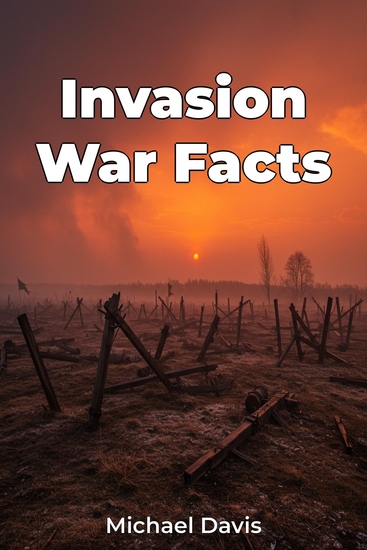
Invasion War Facts - cover

Invasion War Facts

Michael Davies

Translator A AI

Publisher: Publifye

  • 0
  • 0
  • 0

Summary

Invasion War Facts explores the anatomy of invasion warfare, examining history’s most ambitious military operations and their lasting global impact. From ancient times to modern conflicts, the book dissects the strategic and tactical complexities involved in planning and executing large-scale invasions. It examines the necessary resources, intelligence gathering, and technological considerations that underpin successful campaigns. For instance, the book highlights how Operation Barbarossa and the D-Day landings showcase meticulous planning, resource management, and an understanding of the target region’s socio-political environment as crucial elements.

 
The book progresses logically, beginning with the definition of invasion warfare, then dissecting key historical invasions, and concluding with a synthesis of findings that reveal recurring patterns. It analyzes the broader historical impact of these events, focusing on their effects on political structures, cultural landscapes, and the lives of ordinary people. Invasion War Facts draws upon primary sources, military reports, and archival documents, providing a nuanced understanding of events and offering a framework for understanding contemporary conflicts and geopolitical strategies.
Available since: 02/20/2025.
Print length: 69 pages.

Other books that might interest you

  • Kingdom of Israel The: The History of the United Jewish Kingdom and Its Demise - cover

    Kingdom of Israel The: The...

    Editors Charles River

    • 0
    • 0
    • 0
    Before any type of unified political entity named Israel existed, the Jewish groups whose descendants would later form Israel identified themselves by their particular tribe. If asked their nationality or country of origin, they would likely identify themselves as Danites (from the tribe of Dan; Ex. 31:6) or Ephraimites (from the tribe of Ephraim; Judg. 12:5), etc. The main way to differentiate these tribes from other tribes in Canaan was their common worship of the deity YHWH, but in terms of language or other cultural characteristics, it would have been difficult to tell a Canaanite from an Israelite. 
    Eventually, these separate tribes united together as a type of confederation, allies who made a treaty (covenant) to provide military aid for one another when threatened by an enemy state. But it was only under the charismatic leadership of David that the 12 tribes united into a single political entity. Scholars refer to the period encompassing the reign of David and his son Solomon as the United Monarchy. This period, spanning only two generations, was the only time when all of the tribes were politically united, and after a contentious schism that resulted because the northern tribes felt exploited by the Judean kings, the northern tribes seceded from the “United Kingdom” and reverted back to the ancient northern versus southern division of the tribes. The main difference this time was that the southern kingdom now incorporated the tribe of Benjamin, located at the border between these two new nations, within its political borders. The tribe of Simeon (south of Judah) had already ceased to maintain a separate existence (see below). The new northern kingdom adopted the name Israel, while the southern kingdom took their regional name of Judah.
    Show book
  • The Sacred Art of Slowing Down - Find Relief from Rushed Living Soothe Your Soul and Restore Wholeness - cover

    The Sacred Art of Slowing Down -...

    Anna Christine Seiple

    • 0
    • 0
    • 0
    We were created for so much more than rushing through life.It’s easy for everything in our lives to seem fine on the surface. But deep down inside, there’s often another story at play―one of overwhelm, stress and heartache, of finding ourselves stuck in old patterns. Rather than feeling the weight of it all, it’s easier to spend our days on autopilot, ignoring the noise inside.But what if the peace and relief we most long for comes from tuning in with what’s happening inside, instead of tuning it out?Join therapist Anna Christine (A.C.) Seiple on a compassionate, mindful exploration of the depths of our souls. With gentleness, wisdom, and expertise, A.C. invites us to connect with our body and get curious about the spaces within that feel most stuck―and find where we need safety, attunement and care.Rather than a prescriptive “how-to” guide, The Sacred Art of Slowing Down offers unique therapeutic prompts and contemplative reflections to help uscultivate new rhythms to work with what’s happening inside rather than feeling like we’re working against ourselvesholistically explore the cognitive, emotional, spiritual, and somatic strands of ourselves―connecting with and honoring the whole of our created beingbecome more comfortable with being instead of getting caught up in doing through experiential exercisesembrace God’s tender compassion and care―especially for the most wounded parts of usWhen we slow down to connect with the depths of our being, we are able to move through life in freer, more wholehearted―and whole-bodied―ways. May these pages be a sacred space for all parts of us to be seen, held, and nourished.
    Show book
  • Euthydemus - Logic Language and the Absurd – Plato’s Satirical Dialogue on Sophistry and Education - cover

    Euthydemus - Logic Language and...

    Plato, Tim Zengerink

    • 0
    • 0
    • 0
    What if the cleverest arguments were the most meaningless? 
    In Euthydemus, Plato unleashes his sharpest satire on the world of sophistry. When Socrates meets two cunning rhetoricians, Euthydemus and Dionysodorus, a lesson on virtue quickly devolves into a whirlwind of verbal traps, circular logic, and baffling contradictions. Their aim? To appear wise—even if they say nothing at all. 
    This modern audiobook translation delivers Plato’s humor, irony, and insight with clarity and flair. Ideal for listeners curious about logic, language, and the fine line between cleverness and wisdom. 
    What you'll discover inside: 
    •	A comical, cautionary tale about the abuse of language and reasoning 
    •	The most absurd (and enlightening) philosophical dialogue ever written 
    •	Socrates’ cool-headed navigation through nonsense and noise 
    •	A fresh translation that brings Plato’s wit vividly to life 
    If you've ever argued just to win—or lost to someone who did—Euthydemus will both entertain and educate.
    Show book
  • The Orations of Cicero Volume 2 - cover

    The Orations of Cicero Volume 2

    Cicero

    • 0
    • 0
    • 0
    A collection of the most influential speeches by Marcus Tullius Cicero, Rome’s greatest orator and statesman, The Orations of Cicero showcases his rhetorical brilliance, political principles, and defense of the Roman Republic. Spanning legal arguments, public denunciations, and philosophical reflections, these speeches reveal Cicero’s efforts to uphold justice, combat corruption, and resist the rise of autocracy—most notably in his fierce opposition to Mark Antony in the Philippics . Written with eloquence and moral conviction, Cicero’s orations remain foundational texts in the study of rhetoric, law, and classical political thought. They offer invaluable insight into the turbulent final years of the Roman Republic and the mind of a man who believed deeply in the power of words to shape history, preserve liberty, and defend the rule of law.
    Show book
  • Paddleways of Mississippi - Rivers and People of the Magnolia State - cover

    Paddleways of Mississippi -...

    Ernest Herndon, Patrick Parker

    • 0
    • 0
    • 0
    Mississippi rivers and creeks have shaped every aspect of the state's geology, ecology, economy, settlement, and politics. Mississippi's paddleways—its rivers, rills, creeks, and streams—are its arteries, its lifeblood, and the connective tissues that tie its stories and histories together and flood them with a sense of place and impel them along the current of time. The rivers provide structure for the telling of stories. In Paddleways of Mississippi: Rivers and People of the Magnolia State, listeners will discover flowing details of virtually every waterway in the state—the features, wildlife, vegetation, geology, hydrology, and specific challenges to be expected—alongside many wonderful historical and social accounts specific to each system. 


    Interviews and oral histories enliven these waterways with evocative scenery, engaging anecdotes, interesting historical tales, and personal accounts of the people and communities that arose along the waterways of Mississippi. Part natural history, part narrative nonfiction, Paddleways of Mississippi will appeal to outdoor enthusiasts, anglers, naturalists, campers, and historians, and is suitable for novices as well as experts. Told together, the pieces included are a social and ecological history that exposes and deepens the connection coursing between the people and the rivers.
    Show book
  • Sons of the Arghandab - Top Guns in the Devil's Playground - cover

    Sons of the Arghandab - Top Guns...

    Joseph J. Fontenot

    • 0
    • 0
    • 0
    Recounts the harrowing experiences of the 1-320th Field Artillery "Top Guns" Battalion as they navigated the challenges of serving as provisional infantrymen in the hostile Arghandab Valley during 2010-2011. 


    Sons of the Arghandab tells the story of the 1-320th Field Artillery "Top Guns" Battalion, 101st Airborne, in the Arghandab Valley, 2010-2011. 


    The Arghandab River Valley is known for its lush vegetation from its grape furrows and its pomegranate orchards. It's also known as the birthplace of several Taliban leaders such as Mullah Omar and Akhtar Mohammad Mansour, and was a major crossing route for weapons coming from Pakistan into Kandahar. This hostile environment had already claimed the lives of many seasoned infantrymen. But the Top Guns weren't infantrymen, they were artillerymen, deployed without their usual weapons and with minimal last-minute training, redesignated as "provisional infantrymen." Painstakingly researched by one of the Top Guns and told through the perspectives of the men who survived that terrible year, this is the harrowing story of Alpha, HHB, and Bravo Batteries as they undertook the challenges of an artillery unit charged with an infantry mission in the most hostile killing fields in Afghanistan.
    Show book