Junte-se a nós em uma viagem ao mundo dos livros!
Adicionar este livro à prateleira
Grey
Deixe um novo comentário Default profile 50px
Grey
Assine para ler o livro completo ou leia as primeiras páginas de graça!
All characters reduced
Berlin Conference - cover
LER

Berlin Conference

Michael Davies

Tradutor A AI

Editora: Publifye

  • 0
  • 0
  • 0

Sinopse

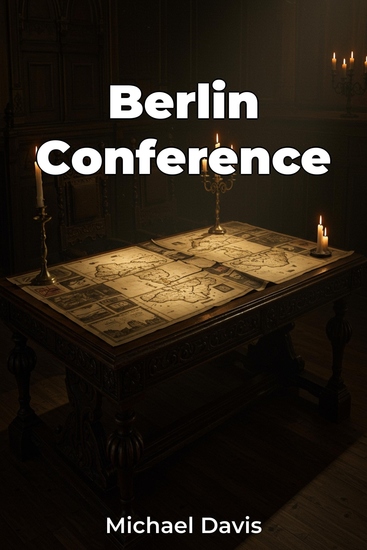
Berlin Conference examines the profound and lasting impact of the 1884-1885 Berlin Conference on Africa. It explores how European powers, driven by 19th-century European imperialism and the Scramble for Africa, arbitrarily divided the continent, disregarding existing ethnic and cultural boundaries. This book argues that these artificial borders, established through political machinations and diplomacy, are a primary source of political instability and economic underdevelopment in many African nations today. The division, fueled by economic ambition, resulted in Africa being carved up with little regard for its inhabitants.

 
The book meticulously unfolds by first introducing the key European players and their motivations. It then analyzes the Conference itself, using records and treaties to reveal the decision-making processes behind the territorial divisions. Finally, it investigates the immediate and long-term impacts, demonstrating how these borders continue to fuel ethnic tensions and impede political development.

 
One key insight is how these imposed borders disrupted traditional trade routes. This study connects to political science, international relations, and postcolonial studies to provide a comprehensive understanding of this pivotal moment in world history.
Disponível desde: 19/03/2025.
Comprimento de impressão: 70 páginas.

Outros livros que poderiam interessá-lo

  • Enki and Sumerian Immortality - Ancient Mythology that has Cultivated Humanity - cover

    Enki and Sumerian Immortality -...

    RYAN MOORHEN

    • 0
    • 0
    • 0
    There is a wide variety of types and genres in these compositions, which are as startling as it is revealing, given the age of the culture involved. In Sumer, nearly a millennium before the Hebrews wrote their Bible, or the Greeks their Iliad and Odyssey, we find a growing body of literature (here and throughout this paper, the term literature is used in the more restricted sense of belles-lettres) that includes such diverse genres as epic tales and myths, hymns and laments - as well as many more "wisdom" compositions, such as maxims, fables, and other didactic compositions. 
    First, we turn to the epic tales of Sumer, the oldest known examples of heroic poetry. Some twelve epic tales that must have been popular in Sumer can now be fully or partially restored. Based on our evidence, they range in length from over four hundred to less than two hundred lines. Consequently, they should be called "epic tales" rather than "epics" since the latter implies a substantial composition.
    Ver livro
  • The Lonely Voice - A Study of the Short Story - cover

    The Lonely Voice - A Study of...

    Frank O'Connor

    • 0
    • 0
    • 0
    Frank O'Connor was one of the twentieth century's greatest short story writers, and one of Ireland's greatest authors. Lilliput Press are now delighted to continue our publishing of O'Connor's writing by bringing his seminal work on the art of the short story back into print.   
    The Lonely Voice is the definitive work of Irish non-fiction on the art of writing short fiction, and has long been held up as one of the greatest works in global literature on the short form. We are delighted to bring The Lonely Voice back into print with a brand new introduction by Kevin Barry, internationally recognised as one of Ireland's greatests short story writers, whose work - like O'Connor's before him - appears frequently in the New Yorker. Barry engages and parrys with O'Connor's writing, bringing about a meeting of great Irish short story writers from the twentieth and twenty-first centuries, and bringing this foundational piece of Irish writing to a new generation.   
    The ideal companion to works such as George Saunders A Swim in a Pond in the Rain or John Yorke's Into the Woods: How Stories Work and Why we Tell Them.   
    Ver livro
  • 3 on 2 off - Rethink the 7-Day Week to Work Less Boost Productivity Increase Creativity and Escape the Hustle - cover

    3 on 2 off - Rethink the 7-Day...

    Linda Morgi

    • 0
    • 0
    • 0
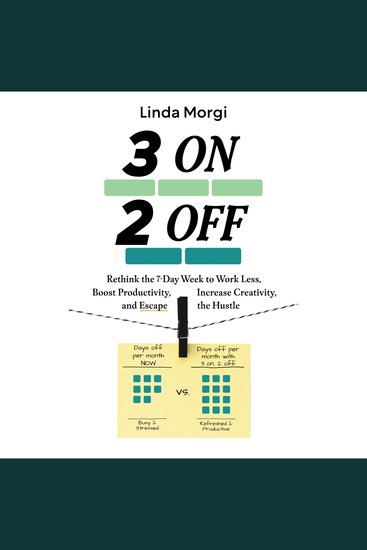
    Are you tired of feeling exhausted after working too many hours, again? Are you over letting your free time slip through your fingers as the most valuable people in your life miss out on the best parts of you? Starting today, that can absolutely change. What if there was a system you could use—one you’ve never heard about before—that would maximize your work productivity while giving you the work-life balance you’ve craved all along? That’s exactly what the 3 On, 2 Off Method does, and it’s going to change your life forever. 
    Now, in 3 On, 2 Off, you’ll learn exactly what is possible when you decide to work better, not harder, to achieve quality results that also improve your personal relationships. Are you ready for a transformation that will make your life better every single day? 
    If you’ve tried different productivity methods and felt more exhausted than ever, it’s time to try something new. Working 100+ hours won’t make your professional goals happen! 
    The 3/2 method will increase your free time, make your work hours more productive, and give you everything you need to live the life you’ve always dreamed of. And the difference is, it’s based on the revolutionary idea that more work time doesn’t equal better productivity. 
    Get ready for a lasting, daily change when it comes to your work-life balance and grab your copy today.
    Ver livro
  • Everything You Know About England is Wrong - cover

    Everything You Know About...

    Matt Brown

    • 0
    • 0
    • 0
    A highly entertaining read for anyone interested in English history and culture, this great myth-busting book takes you on a great ride through history and the national character. Think we're the land of Punch and Judy and Morris Dancing? Think again as both traditions started in southern Europe. Love Winston Churchill's wartime speeches? Well, they were recorded by an actor.
    Packed with details on real English history, the book explodes a range of national myths from bluebirds in Dover (they are not indigenous European birds) to the origin of the Cornish pasty (they might have been invented in London), from our stiff upper lip (an Americanism) to where you can spend a Scottish bank note. English arts, entertainment, food, drink, kings and queens, traditions as well as politics are all covered to give you a fascinating insight into the true England.
    Includes an additional chapter on Scottish, Welsh and Irish myths that we've been peddling in England for decades and need to be laid to rest. 
    Ver livro
  • Egyptian Science and Technology - Innovations of the Ancient World - cover

    Egyptian Science and Technology...

    Omar Khalil

    • 0
    • 0
    • 0
    Ancient Egypt, renowned for its monumental architecture and sophisticated culture, was also a hub of intellectual and scientific advancements. At the heart of Egyptian knowledge was a unique blend of practical experience, religious beliefs, and cultural traditions. Understanding the foundations of their knowledge requires examining the interplay between mythology, early scientific thought, and the ways this knowledge was transmitted through generations. 
    The role of religion and mythology in ancient Egypt cannot be overstated. Egyptian cosmology deeply influenced how people understood the world around them. Deities associated with creation, the afterlife, and natural phenomena shaped the Egyptians' perception of science and technology. For example, the god Thoth was believed to be the deity of wisdom, writing, and mathematics, and his influence permeated educational practices. Priests and scribes, who were often part of temple schools, acted as custodians of this sacred knowledge. Their training combined religious teachings with practical subjects like astronomy, mathematics, and medicine. 
    Early scientific thought in ancient Egypt was pragmatic rather than theoretical. Egyptians were skilled observers, and much of their knowledge arose from practical problem-solving. Whether it was calculating the Nile's flooding patterns or designing complex irrigation systems, their science emerged from the need to manage everyday challenges. For instance, their understanding of geometry developed out of the necessity to remeasure fields after the annual inundation of the Nile. Similarly, medical practices were rooted in practical observations of ailments and their treatments, blending empirical knowledge with spiritual beliefs.
    Ver livro
  • British and French Mandates in the Middle East The: The History of the Allied Powers’ Post-War Occupations via the League of Nations - cover

    British and French Mandates in...

    Editors Charles River

    • 0
    • 0
    • 0
    The United Nations is one of the most famous bodies in the world, and its predecessor, the League of Nations, might be equally notorious. In fact, President Woodrow Wilson’s pet project was controversial from nearly the minute it was conceived. At the end of World War I, Wilson's pleas at the Paris Peace Conference relied on his Fourteen Points, which included the establishment of a League of Nations, but while his points were mostly popular amongst Americans and Europeans alike, leaders at the Peace Conference largely discarded them and favored different approaches. British leaders saw their singular aim as the maintenance of British colonial possessions. France, meanwhile, only wanted to ensure that Germany was weakened and unable to wage war again, and it too had colonial interests abroad that it hoped to maintain. Britain and France thus saw eye-to-eye, with both wanting a weaker Germany and both wanting to maintain their colonies. Wilson, however, wanted both countries to rid themselves of their colonies, and he wanted Germany to maintain its self-determination and right to self-defense. Wilson totally opposed the “war guilt” clause, which blamed the war on Germany. 
    	One of the League’s most lasting legacies was the manner in which it handed over administrative control of land in the Middle East to the victorious Allied Powers, namely France and Britain. The Ottoman Empire quickly collapsed after World War I, and its extensive lands were divvied up between the French and British. The intention of the mandate system was to have the administrators peacefully and gradually usher in independent states, and both European powers eventually attempted to withdraw from the region, but anyone with passing knowledge of the Middle East’s history in the late 20th century knows that the region has seen little peace.
    Ver livro