Junte-se a nós em uma viagem ao mundo dos livros!
Adicionar este livro à prateleira
Grey
Deixe um novo comentário Default profile 50px
Grey
Assine para ler o livro completo ou leia as primeiras páginas de graça!
All characters reduced
Ashanti Legal Codes - cover
LER

Ashanti Legal Codes

Michael Davies

Tradutor A AI

Editora: Publifye

  • 0
  • 0
  • 0

Sinopse

Ashanti Legal Codes explores the sophisticated legal system of the pre-colonial Ashanti kingdom, demonstrating its advanced approach to justice, governance, and conflict resolution. The book highlights how the Ashanti maintained order and social cohesion through customary law, challenging simplistic views of pre-colonial African societies. Intriguingly, the Ashanti used adinkra symbols as visual representations of legal principles, showcasing a unique form of legal documentation. The legal framework also heavily relied on the council of elders in judicial proceedings, emphasizing community involvement in dispute resolution. The book argues that the Ashanti legal system prioritized reconciliation and community harmony.

 
It begins by introducing the fundamentals of Ashanti customary law, then delves into the meaning and application of adinkra symbols. Next, it examines the structure and function of the Ashanti council system. Finally, the book explores various conflict resolution methods, demonstrating how disputes were handled at different levels of society, ultimately emphasizing the relevance of Ashanti legal principles for contemporary legal systems and offering valuable insights into alternative approaches to justice within History World, World History, and Politics.
Disponível desde: 03/05/2025.
Comprimento de impressão: 58 páginas.

Outros livros que poderiam interessá-lo

  • Jews in the Garden - A Holocaust Survivor the Fate of His Family and the Secret History of Poland in World War II - cover

    Jews in the Garden - A Holocaust...

    Judy Rakowsky

    • 0
    • 0
    • 0
    Villages of Poland hide the lost secrets of World War II 


    1944: Heavy footfalls thud on the road on a rainy May night. A band of gunmen scour a hilltop farm, acting on rumors that it harbors a Jewish family. For 18 months, the Rozeneks have been hiding safely, but their luck is about to run out. Only one from the family of six will live to see the sunrise. Sixteen-year-old Hena Rozenek shelters in the woods until morning . . . and then she runs. 


    Forty years later: Holocaust survivor Sam Rakowski Ron has lived in the United States for decades, never thinking he could return to the Polish village he fled as a teenager. But now he's ready to talk about what he heard, what he saw, and what he knows about two separate families of cousins who were his neighbors, and presumably were killed during the war. The story Poland presents to the world is that Poles saved more Jews than citizens of any other nation, that any murders in Poland were committed by Nazis and Nazis alone. But Sam, while defending his countrymen, suspects a painful truth. The stories he shares with his younger cousin, Judy, an investigative journalist, send them off on a decades-long journey unlike any other to find out what happened to the Rozenek family and ultimately reveal the secrets the Polish government is still desperate to keep.
    Ver livro
  • Radical Politics - On the Causes of Contemporary Emancipation - cover

    Radical Politics - On the Causes...

    Peter D. Thomas

    • 0
    • 0
    • 0
    The last twenty years have witnessed a proliferation of radical social and political movements around the world. From the International Women's Strike and Occupy, to #BlackLivesMatter and direct action against the climate emergency, a series of common questions have re-emerged as immediate and practical challenges. How should radical political movements relate to the state? What makes emancipatory politics fundamentally different from both technocratic and populist models of "politics as usual"? Which forms of organization are most likely to deepen and extend the dynamics that led to the emergence of these movements in the first place? 


    To investigate the goal, nature, method, and organizational forms of radical political engagement against the neoliberal consensus, Peter D. Thomas draws on the work of Antonio Gramsci, the Italian Communist Party leader and political theorist best known for his ideas about hegemony. Offering a new reading of Gramsci, Thomas contends that hegemony is a process of differentiation in which political culture is always changing, and always with the goal of moving toward expanded freedom. Over the course of the book, Thomas looks at the way in which various theorists have approached the dilemma of how to engage productively in radical politics and explains why hegemony is a method of doing politics rather than an end goal.
    Ver livro
  • A Rare Recording of Henry Cabot Lodge - cover

    A Rare Recording of Henry Cabot...

    Henry Cabot Lodge

    • 0
    • 0
    • 0
    Henry Cabot Lodge (May 12, 1850 - November 9, 1924) was an American Republican politician, historian, and statesman from Massachusetts. He served in the United States Senate from 1893 to 1924 and is best known for his positions on foreign policy. The following recording documents his successful crusade against Woodrow Wilson's Treaty of Versailles and ensured that the United States never joined the League of Nations and his reservations against that treaty influenced the structure of the modern United Nations.
    Ver livro
  • Hope for the Mission - Getting It Right in the Call to End Homelessness - cover

    Hope for the Mission - Getting...

    Kevin Nye

    • 0
    • 0
    • 0
    To get it right in the mission to end homelessness, we don’t have to choose between faith and factsFor well over a century, Christian ministries have actively offered relief for the poor and unhoused in North America. The dominant model in faith-based homelessness response has long been gospel rescue missions, nonprofit organizations that shelter and feed people experiencing homelessness. While the presence of these ministries in this work is undeniable, they frequently position themselves against best practices to meet their goal of evangelism. This approach often perpetuates homelessness instead of ending it.In this inspiring and clarifying book, homeless services advocate Kevin Nye reports on dozens of faith-based stories and examples that will equip readers to help end homelessness in their communities. Alongside critical evaluation of what Christian groups have tended to get wrong in addressing homelessness, Nye offers stories of faith and hope about what’s going right. Churches and other organizations have been faithfully answering the call to provide services, support, shelter, housing, and so much more in ways that align with broader efforts to successfully end homelessness. These exemplars embody the spirit of Christian social response alongside a commitment to the most effective, evidence-based practices for ending homelessness. Hope for the Mission offers groups of any size paths to consider, values to emulate, and methods to embody as we follow Jesus toward solidarity with the unhoused. As we imagine a world where everyone has a place to call home, we can find hope and insight for the real mission that lies before us: loving our unhoused neighbors in ways that bring them into fullness and flourishing. 
    Ver livro
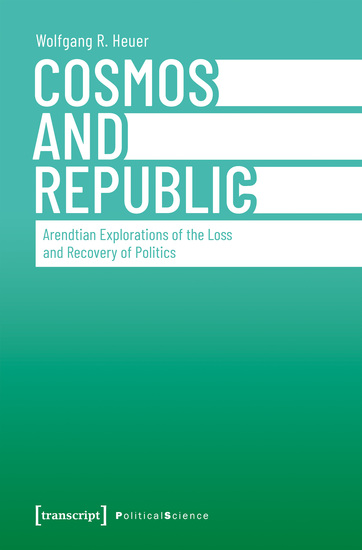
  • Cosmos and Republic - Arendtian Explorations of the Loss and Recovery of Politics - cover

    Cosmos and Republic - Arendtian...

    Wolfgang R. Heuer

    • 0
    • 0
    • 0
    In 20 essays inspired by Hannah Arendt's analysis of crisis-ridden modernity, Wolfgang R. Heuer addresses aspects of depoliticization and the loss of politics, and thus of freedom. The wide-ranging essays are grouped in five sections: When Politics Vanishes, The Call of Responsibility, Images and Emotions, Federations, and From Plurality to Cosmos. They lead to the insight that the crises of our time require a common change of perspective towards ecological and political sustainability, the unity of »Cosmos and Republic«.
    Ver livro
  • Residual Governance - How South Africa Foretells Planetary Futures - cover

    Residual Governance - How South...

    Gabrielle Hecht

    • 0
    • 0
    • 0
    In Residual Governance, Gabrielle Hecht dives into the wastes of gold and uranium mining in South Africa to explore how communities, experts, and artists fight for infrastructural and environmental justice. Hecht outlines how mining in South Africa is a prime example of what she theorizes as residual governance—the governance of waste and discard, governance that is purposefully inefficient, and governance that treats people and places as waste and wastelands. She centers the voices of people who resist residual governance and the harms of toxic mining waste to highlight how mining's centrality to South African history reveals the links between race, capitalism, the state, and the environment. In this way, Hecht shows how the history of mining in South Africa and the resistance to residual governance and environmental degradation is a planetary story: the underlying logic of residual governance lies at the heart of contemporary global racial capitalism and is a major accelerant of the Anthropocene.
    Ver livro