Join us on a literary world trip!
Add this book to bookshelf
Grey
Write a new comment Default profile 50px
Grey
Subscribe to read the full book or read the first pages for free!
All characters reduced
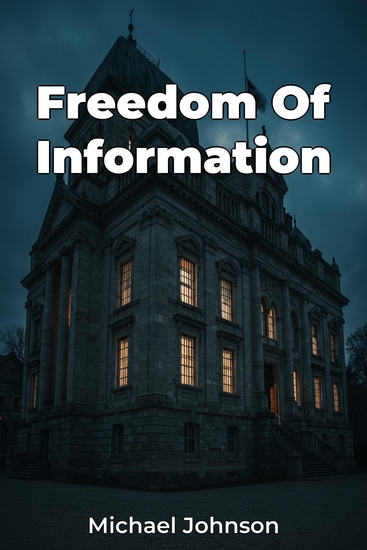
Freedom Of Information - cover

Freedom Of Information

Michael A Johnson

Translator A AI

Publisher: Publifye

  • 0
  • 0
  • 0

Summary

"Freedom Of Information" explores the vital role of public access laws in a democracy, focusing on government transparency and accountability. It highlights how these laws empower informed citizenship by allowing individuals to scrutinize government actions. The book argues that effective Freedom of Information (FOI) laws are fundamental to a healthy democracy, reducing corruption and enabling informed decision-making. For example, without access to information, corruption can increase exponentially. The book examines the history and evolution of FOI laws, tracing their development from the post-World War II era to the present day, with a focus on the US Freedom of Information Act of 1966. It then delves into the practical aspects of requesting government records, navigating bureaucratic hurdles, and understanding exemptions. Case studies illustrate the successes and failures of FOI laws in practice, showing how they've been used to uncover wrongdoing and influence policy. The book adopts a pragmatic and analytical approach, presenting information in plain language suitable for a broad audience. It progresses logically, starting with core concepts, then moving to practical applications and recommendations for strengthening transparency mechanisms. This makes it valuable for students, journalists, policymakers, and engaged citizens interested in understanding their rights to access government information.
Available since: 04/03/2025.
Print length: 76 pages.

Other books that might interest you

  • How to Make Money - An Ancient Guide to Wealth Management (series: Ancient Wisdom for Modern Readers) - cover

    How to Make Money - An Ancient...

    PLINY

    • 0
    • 0
    • 0
    Ancient Romans liked money. But how did they make a living and sometimes even become rich? The Roman economy was dominated by agriculture, but it was surprisingly modern in many ways: the Romans had companies with CEOs, shareholders, and detailed contracts regulated by meticulous laws; systems of banking and taxation; and a wide range of occupations, from merchant and doctor to architect and teacher. The Romans also enjoyed a relatively open society, where some could start from the bottom, work, invest, and grow rich. How to Make Money gathers a wide variety of ancient writings that show how Romans thought about, made, invested, spent, lost, and gave away money. 


    The Roman elite idealized farming and service to the state but treated many other occupations with suspicion or contempt, from money lending to wage labor. But whatever their attitudes, pecunia made the Roman world go round. In the Satyricon, Trimalchio brags about his wealth. Seneca accumulated a fortune—but taught that money can't buy happiness. Eumachia inherited a brick factory from her father, married well, and turned to philanthropy after she was widowed. How to Make Money also takes up some of the most troubling aspects of the Roman economy, slavery and prostitution, which the elite deemed unrespectable but often profited from.
    Show book
  • The Chevron Doctrine - Its Rise and Fall and the Future of the Administrative State - cover

    The Chevron Doctrine - Its Rise...

    Thomas W. Merrill

    • 0
    • 0
    • 0
    The Constitution makes Congress the principal federal lawmaker. Power has inevitably shifted to the executive branch agencies that interpret laws already on the books and to the courts that review the agencies' interpretations. 


    Since the Supreme Court's 1984 decision in Chevron v. Natural Resources Defense Council, this judicial review has been highly deferential: courts must uphold agency interpretations of unclear laws as long as these interpretations are "reasonable." But the Chevron doctrine faces backlash from constitutional scholars and, now, from Supreme Court justices who insist that courts, not administrative agencies, have the authority to say what the law is. Recognizing that Congress cannot help relying on agencies to carry out laws, Merrill rejects the notion of discarding the administrative state. Instead, he focuses on what should be the proper relationship between agencies and courts in interpreting laws, given the strengths and weaknesses of these institutions. Courts are better at enforcing the rule of law and constitutional values; agencies have more policy expertise and receive more public input. 


    The best solution, Merrill suggests, is not of the either-or variety. Neither executive agencies nor courts alone should pick up the slack of our increasingly ineffectual legislature.
    Show book
  • Darker Desires: Engaging Tales for Your Ears - "Unlock Your Darker Desires: Immerse in Captivating Audio Stories for Ultimate Enjoyment!" - cover

    Darker Desires: Engaging Tales...

    Arthur Kellan

    • 0
    • 0
    • 0
    Darker Desires: Engaging Tales for Your Ears 
    Are you looking to immerse yourself in thrilling tales that captivate your spirit? 
    Seeking a comprehensive guide that provides all necessary elements to fully engage with riveting stories? 
    Your search ends here! 
    This audiobook serves as your definitive companion for deepening your enjoyment, applying your imagination, and engaging in immersive narratives. With this, you're set for a gripping experience. 
    Updated for the latest thrilling tales. 
    Key features of this enriched audiobook: 
    - Profound insights into engaging stories 
    - Detailed explanation of the themes and plots 
    - Fruitful strategies for a more immersive listening experience 
    Our audiobook distinguishes itself through comprehensive coverage, essential for your narrative enjoyment. Tales aren’t merely told; they are delved into with precision. 
    Please note that this audiobook is not affiliated with any official storytelling entity and is purely an independent resource for your benefit. 
    Designed with a clear structure and easy-to-understand language, our audiobook ensures smooth transitions between stories. Say goodbye to dense jargon and welcome clear, precise, and enthralling content. 
    So, why wait? Click the BUY NOW button, secure your audiobook, and begin your journey into the captivating world of Darker Desires: Engaging Tales for Your Ears!
    Show book
  • A Rare Recording of President William Howard Taft - cover

    A Rare Recording of President...

    President William Howard Taft

    • 0
    • 0
    • 0
    William Howard Taft (September 15, 1857 - March 8, 1930), born in Cincinnati, Ohio, served as Secretary of War under President Theodore Roosevelt, then was elected on the Republican ticket as the 27th president of the United States from 1909 to 1913, and, later, named the tenth chief justice of the United States from 1921 to 1930. He is the only person to have held both offices. The following recordings are from the campaign trail in 1908, and, later, in 1912.
    Show book
  • Teach Kids to Become Mentally Strong - How to Instill a Strong Mentality in Your Kids and Help Them Overcome Struggles and Achieve Success in a Stigmatized World - cover

    Teach Kids to Become Mentally...

    Anonymous

    • 0
    • 0
    • 0
    Do you want your child to handle life’s challenges with more confidence—and less fear, frustration, or shutdown? 
    Life is hard sometimes. And while you can’t remove every obstacle from your child’s path, you can teach them the mindset and emotional skills to face setbacks, adapt, and keep going. 
    In Teach Kids to Become Mentally Strong, you’ll learn practical, parent-friendly strategies to help your child build resilience, self-belief, and a healthier way of thinking—so they’re better prepared for pressure at school, social stress, and everyday disappointments. 
    In this audiobook, you’ll learn how to: 
     • Build a strong mindset that helps your child bounce back faster after mistakes and failures 
     • Replace negative self-talk with healthier, more confident thinking 
     • Teach emotional strength without forcing your child to “tough it out” alone 
     • Help your child face obstacles with courage, problem-solving, and persistence 
     • Strengthen self-esteem so they don’t crumble under criticism or comparison 
     • Handle peer pressure and social stress with calm, clear boundaries 
     • Create simple daily habits that reinforce confidence, resilience, and mental toughness 
    If you want your child to feel calmer under pressure and more capable in tough moments, this audiobook will help you build those skills—one step at a time.
    Show book
  • Dostoevesky Notes From The Underground - cover

    Dostoevesky Notes From The...

    Fyodor Dostoyevsky

    • 0
    • 0
    • 0
    Notes from Underground is an 1864 novella by Fyodor Dostoyevsky. Notes is considered by many to be the first existentialist novel. It presents itself as an excerpt from the rambling memoirs of a bitter, isolated, unnamed narrator (generally referred to by critics as the Underground Man) who is a retired civil servant living in St. Petersburg. The first part of the story is told in monologue form, or the underground man's diary, and attacks emerging Western philosophy, especially Nikolay Chernyshevsky's What Is to Be Done?. The second part of the book is called "Àpropos of the Wet Snow," and describes certain events that, it seems, are destroying and sometimes renewing the underground man, who acts as a first person, unreliable narrator.Fyodor Mikhailovich Dostoevsky was a Russian novelist, short story writer, essayist, and journalist. His literary works explore human psychology in the troubled political, social, and spiritual atmospheres of 19th-century Russia, and engage with a variety of philosophical and religious themes. His most acclaimed novels include Crime and Punishment (1866), The Idiot (1869), Demons (1872), and The Brothers Karamazov (1880).Many literary critics rate him as one of the greatest novelists in all of world literature, as multiple of his works are considered highly influential masterpieces.
    Show book