Join us on a literary world trip!
Add this book to bookshelf
Grey
Write a new comment Default profile 50px
Grey
Subscribe to read the full book or read the first pages for free!
All characters reduced
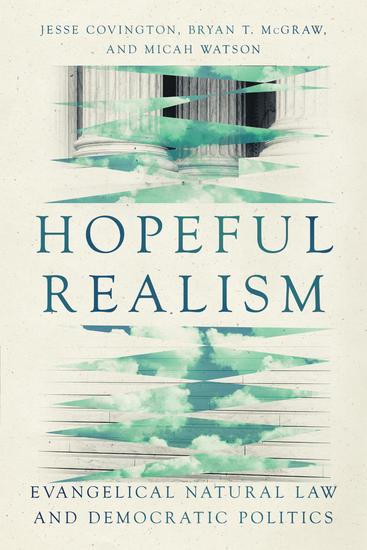
Hopeful Realism - Evangelical Natural Law and Democratic Politics - cover

Hopeful Realism - Evangelical Natural Law and Democratic Politics

Micah Watson, Jesse Covington, Bryan T. McGraw

Publisher: IVP Academic

  • 0
  • 0
  • 0

Summary

A Natural Law Framework for Evangelicals Today
During a time when political conversations are marked by deep polarization and difficult decision-making, what resources do evangelicals have to think critically and theologically about public life?
For political theorists Bryan T. McGraw, Jesse Covington, and Micah Watson, a crucial resource is to be found in natural law, a rich tradition of Christian political thought often neglected by evangelicals. Grounded in the hope and realism of the gospel, their evangelical natural law theory is deep in moral conviction yet oriented toward practical political decision-making. Relevant to all dimensions of political life, they show how an evangelical natural law framework can speak into debates about the economy, family life and marriage, violence and war, and religious freedom.
Hopeful Realism is a generous guide for evangelicals concerned with bringing their theological commitments to bear on their political judgments. A volume that brings together robust theory with practical cases, Covington, McGraw, and Watson show how evangelicals can participate as evangelicals in a pluralistic, often polarized, democracy.
Available since: 01/07/2025.
Print length: 264 pages.

Other books that might interest you

  • Bagavad Gita in Tamil - Chapter 4 - Gnana-Karma-Sanyasa Yoga - cover

    Bagavad Gita in Tamil - Chapter...

    viyasar

    • 0
    • 0
    • 0
    The Bhagavad Gita is a 700-verse Hindu scripture embedded within the epic Mahabharata, depicting a dialogue between Arjuna and Krishna on the battlefield of Kurukshetra. Arjuna, facing his relatives in battle, experiences despair and a crisis of conscience. Krishna, his charioteer and an avatar of Vishnu, provides philosophical and spiritual guidance, addressing themes of duty (dharma), action (karma), devotion (bhakti), and knowledge (jnana). The Gita explores the nature of the self, the divine, and humanity's place in the world, offering paths to liberation and spiritual fulfillment. 
    Show book
  • France and England’s Most Famous Palaces: The History of the Most Famous Royal Residences in Western Europe - cover

    France and England’s Most Famous...

    Editors Charles River

    • 0
    • 0
    • 0
    When people think of the British Royal family, and more specifically where they live, the first image that often pops into mind is that of stately Buckingham Palace, with its changing of the guard and the occasional royal coach leaving or entering. Others may think of the royal country estate of Windsor Castle, a favorite of both Britain’s longest-reigning and second longest-reigning monarchs. And there was a time when both royal residences played second fiddle to a much better known home, the elegant Kensington Palace. Buckingham Palace is not different, for though it was originally built as a home of a private citizen, once a king bought it, its future was sealed.  
    	For the French, and those who study their history, Versailles is a symbol of, as Charles Dickens once put it, “the best of times…the worst of times.” It was here that the Sun King, Louis XIV, built a palace worthy of a great nation during a time when peace was, at best, short-lived. It was at Versailles that Russian Tsar Peter the Great studied the palace’s architecture and gardens so that he could recreate them in his home country. Indeed, the greatest minds and artistic geniuses of the later stages of the Renaissance came to Versailles to build and paint, and it was here that Madame de Pompadour and her successor, Madame du Barry, used their wit and beauty to charm a king into doing their bidding. However, as history constantly demonstrates, nothing good lasts forever, and so it was with Versailles.  
    	France, like all European countries, has had its fair share of palaces over time, but none suffered the rise and fall of fortune like the Tuileries. Built by a widow with a flair for architecture, it grew for more than a decade, along with the royal family that it housed. Then, during the French Revolution, it fell from grace with that family and even became a sight of execution, its famous gardens providing the background for the infamous guillotine. 
    Show book
  • Division of the Roman Empire The: The History of the Conflicts that Split the Western Roman Empire and Eastern Roman Empire in the 4th Century - cover

    Division of the Roman Empire...

    Editors Charles River

    • 0
    • 0
    • 0
    Rome’s Imperial Crisis has been difficult for historians to summarize, which is why, despite being one of the most intriguing periods in Roman history, it is often overlooked by people who have chosen to focus on the more cohesive periods before and after it. Even though he is best remembered for his religious reforms and what his (mostly Christian) admirers described as his spiritual enlightenment, Constantine was also an able and effective ruler in his own right. Rising to power in a period of decline and confusion for the Roman Empire, he gave it a new and unexpected lease on life by repelling the repeated invasions of the Germanic tribes on the Northern and Eastern borders of the Roman domains, even going so far as to re-expand the frontier into parts of Trajan’s old conquest of Dacia (modern Romania), which had been abandoned as strategically untenable.  
    	However, it can be argued that despite his military successes – the most notable of which occurred fighting for supremacy against other Romans – Constantine may well have set the stage for the ultimate collapse of the Roman Empire as it had existed up until that point. It was Constantine who first decided that Rome, exposed and vulnerable near the gathering masses of barbarians moving into Germania and Gaul, was a strategically unsafe base for the empire, and thus he expanded the city of New Rome on the Dardanelles Straits, creating what eventually became Constantinople. By moving the political, administrative, and military capital of the empire from Rome to the East, as well as the imperial court with all its attendant followers, Constantine laid the groundwork for the eventual schism which saw the two parts of the Roman Empire become two entirely separate entities, go their own way, and eventually collapse piecemeal under repeated waves of invasion.
    Show book
  • Varieties of Hope - Stories of Sexuality Shame and Power - cover

    Varieties of Hope - Stories of...

    Jan Campbell

    • 0
    • 0
    • 0
    This book explores how hope operates as an ambivalent force in relation to issues of sex and gender, power, and identity in both our private and public lives. 
     
    The author blends her deep knowledge of psychotherapy and mental health with cultural and philosophical understanding to consider how we have reached our current dilemmas around sex and gender, race, power and identity. Psychoanalysis is put to task in relation to clinical practice, literature, feminism, politics, and the understandings of how our personal lives and selves interact with the wider cultural moment we are living through. She explores these issues with compassion and understanding and offers a vision of how we may be able to navigate through widely varying perspectives to a new way of envisioning hope today, as both a false promise and a real and necessary component in our lives and within the clinical encounter. 
     
    Drawing on clinical psychoanalytic work as well as literature and memoir, this is essential listening for anyone wanting a psychoanalytically informed understanding of where society is on key issues and where we may be able to get to with hope.
    Show book
  • History of Russia - The 1900s and Soviet Russia - cover

    History of Russia - The 1900s...

    Days of History

    • 0
    • 0
    • 0
    Discover the Unfolding Drama of the 20th Century with "History of Russia: The 1900s and Soviet Russia" 
    - The Final book in Our "Russia's Epic Saga: A Journey Through Time" Series. 
    Complete your exploration of Russia's rich history with the enthralling final book in our Russian history series. This riveting book delves into the dramatic events and influential figures that shaped Russia during the 20th century, as the nation underwent a period of unprecedented change. 
    Witness the fall of the Russian Empire and the rise of the Soviet Union, as revolutionary fervor swept the nation. Explore the lives of iconic leaders like Lenin, Stalin, and Khrushchev, whose actions would forever alter the course of history. Experience the triumphs and tragedies of Soviet Russia, from the heights of its global influence to its eventual collapse. 
    This engrossing volume combines engaging storytelling with expert analysis, presenting a balanced and captivating account of Russia's tumultuous 20th-century journey. Accessible and informative, it's perfect for history lovers and newcomers alike. 
    Don't miss your chance to delve into Russia's remarkable past. Order your copy today, and immerse yourself in the incredible stories of a nation that has faced adversity and emerged transformed.
    Show book
  • The Great Dictionary English - Dutch - 60000 Entries - cover

    The Great Dictionary English -...

    Benjamin Maximilian Eisenhauer

    • 0
    • 0
    • 0
    This dictionary contains around 60,000 English terms with their Dutch translations, making it one of the most comprehensive books of its kind. It offers a wide vocabulary from all areas as well as numerous idioms.
    The terms are translated from English to Dutch. If you need translations from Dutch to English, then the companion volume "The Great Dictionary Dutch - English" is recommended.
    Show book