Join us on a literary world trip!
Add this book to bookshelf
Grey
Write a new comment Default profile 50px
Grey
Subscribe to read the full book or read the first pages for free!
All characters reduced
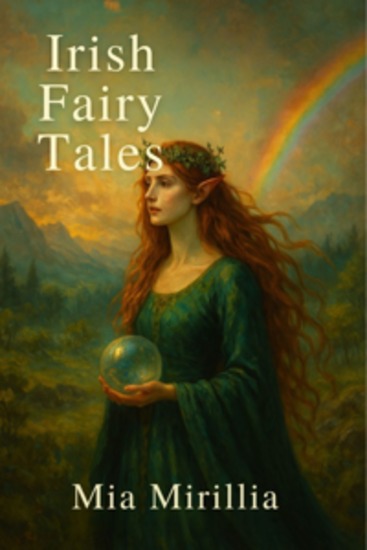
Irish Fairy Tales - Of fairies curses and lost kingdoms - 30 short fairy tales for children and adults - cover

Irish Fairy Tales - Of fairies curses and lost kingdoms - 30 short fairy tales for children and adults

Mia Mirillia

Publisher: Mia Mirillia

  • 0
  • 0
  • 0

Summary

A journey into the mythical heart of IrelandShrouded hills, whispering moors and ancient stone circles - Ireland is a place where the boundaries between our world and the Otherworld have always been permeable. Amidst the mists and ancient songs live beings that seemed forgotten: Fairy Queens, cursed souls, goblins, sirens and shadow spirits. This book is an invitation to a collection of Irish fairy tales that not only revive old legends, but find new voices for an ancient world.Fairy tales full of depth, magic and mysteryEach story is a gateway to another reality. The tales lead to abandoned villages on the moor, to hidden fairy wells, to wandering minstrels, mute shepherds and guardians of ancient powers. The fairy tales are far more than mere entertainment - they are living mirrors of Irish culture, captivatingly told, multi-layered, atmospheric and full of mysterious beauty.For all those who like to lose themselves - and find themselves againThis book is aimed at adult readers who love the magic of old stories, dreamers, night owls and seekers, lovers of mystical literature, Celtic symbolism and impressive storytelling. The fairy tales are poetic and powerful, melancholy and hopeful, dark and luminous at the same time. An ideal work to sink into, linger over - and reread.A treasure trove of fairy tales - not just for Ireland loversWhether you know Ireland or still dream of it: These stories carry the essence of the island. They smell of rain, sound of wind and make you believe for a moment that the Otherworld is just a blink of an eye away.Immerse yourself in the magic of Ireland now - and discover what lies between the lines.
Available since: 05/18/2025.
Print length: 115 pages.

Other books that might interest you

  • Breathmaker: The History and Legacy of the Seminole’s Creator God - cover

    Breathmaker: The History and...

    Editors Charles River

    • 0
    • 0
    • 0
    The Seminole tribe is one of the best known Native American tribes, and one of the most feared among 19th century Americans and Spaniards. In fact, the origin of the term Seminole comes from a Spanish description of them as “wild”, which belies the fact that the Seminole had friendly relations with the British and Spanish during the colonial era.  
    	To appreciate Seminole Native American mythology, their history and origins must be understood. Their forebears, the Muscogee, first migrated into what is now the Southeastern United States from various points in the north and west, which they accomplished by overpowering the indigenous inhabitants. The region was already occupied by several groups, including the Yuchi and Hitchiti, tribes that were likely descendants of the Moundbuilders. These tribes were subdued and then integrated into the Muscogee system. Thus, the traditions, beliefs, rituals, and mythologies of these various groups became the communal belief system of the Muscogee collective.  	 
    	According to the Muscogee, humans emerged “somewhere in the west,” a location described as the “foundation of all things” or the “backbone” of the Earth. Most scholars associate this location with the Rocky Mountains, and they credit the Four Corners area of the United States as being the location for the creation myths of Native American groups like the Pueblo. Though still not commonly understood, Breathmaker became the creator god of the Seminole peoples (the name is also written as Breath Maker and Maker of Breath), and he became the center of a cycle of creation stories. 
    Show book
  • Stress and Anxiety - Understanding Triggers and Mastering Stress Relief Techniques - cover

    Stress and Anxiety -...

    Coral Nunez

    • 0
    • 0
    • 0
    Stress is an inevitable part of life, and everyone experiences it in different ways. It can be triggered by external factors, such as work pressures, relationship challenges, or financial difficulties, or it can stem from internal thoughts and perceptions. Understanding stress and its triggers is the first step toward managing it effectively. In this chapter, we will explore what stress is, how it impacts our well-being, and how we can recognize and understand the triggers that lead to stress. 
    At its core, stress is the body’s natural response to perceived threats or demands. When faced with a stressful situation, the body activates the "fight or flight" response, releasing hormones like adrenaline and cortisol that prepare us to take action. While this response is helpful in short bursts, prolonged stress can have serious consequences on both the mind and body. Chronic stress can lead to health problems such as anxiety, depression, digestive issues, and even heart disease. Recognizing when stress is becoming overwhelming is crucial for maintaining our health. 
    Triggers are the specific events, situations, or thoughts that set off the stress response. Triggers can vary from person to person, depending on their past experiences, personality, and current life circumstances. For one person, an argument with a loved one may be a significant trigger, while for someone else, the pressure of a looming deadline at work may be more stressful. By identifying and understanding our triggers, we can begin to take steps to manage them and prevent unnecessary stress.
    Show book
  • Thrive - The Freedom to Flourish - cover

    Thrive - The Freedom to Flourish

    Lesley Riddoch

    • 0
    • 0
    • 0
    Why won't Scots simmer down?
    Why batter on about independence when folk voted no a decade back?
    
    After all. Scotland is not as populated as Yorkshire, nor as wealthy as London.
    But it's also not as Conservative, nor as suspicious of Europeans, as keen on Brexit or as willing to flog off public assets to the ruling party's pals.
    
    Scotland is a former state with its own laws, education, universities, languages, welfare system, history and hang-ups. A progressive North Atlantic nation steered by a Westminster government that's totally preoccupied with regaining lost imperial status. 
    Put simply – with or without Nicola Sturgeon at the helm – Scotland is another country. A social democracy stuck in a Conservative state.
    And that's why 50% of Scots are determined to find a way out.
    
    In this book, Blossom author Lesley Riddoch sets out an impassioned case for independence, weaving academic evidence with the story, and international comparison with anecdote, to explain why Scotland is ready to step forward as the world's newest state and how the British Isles can work better when Scotland is governed by the folk who call it home. 
    
    Let's cast aside preconceptions. Whichever way you voted in 2014 – if you were able – the world has changed, Europe has changed and the UK has changed – though not in a good way.
    Scots need the freedom to change too.
    Show book
  • Liao Dynasty - Nomadic Conquerors of Northern China - cover

    Liao Dynasty - Nomadic...

    Rolf Hedger

    • 0
    • 0
    • 0
    The story of the Liao people begins in the vast and harsh steppe regions to the north of China, where they first emerged as a formidable force in the region’s history. The Liao were a nomadic group, characterized by their mastery of horseback riding and combat, which set them apart from the sedentary agricultural societies of the surrounding civilizations. Their origins are not fully understood, but it is widely believed that they came from the Mongolian Plateau, migrating southward and eastward into the northern reaches of China during the early centuries of the Common Era. 
    In their early years, the Liao people were organized into various tribes, each with its own leadership and customs. These tribes were constantly in motion, following the migratory patterns of their livestock and engaging in periodic warfare with one another for dominance and resources. Despite the chaotic nature of their existence, the Liao were bound together by a common identity rooted in their nomadic lifestyle and warrior culture. Over time, they developed a strong sense of unity, driven by their shared need to survive in an unforgiving environment. 
    As the tribes of the Liao people grew in number and influence, they began to organize themselves more systematically under the leadership of powerful chieftains. These chieftains rose to prominence not only through their military prowess but also through their ability to forge alliances and broker peace with neighboring peoples. The Liao were skilled diplomats, and many of their early leaders recognized the value of creating relationships with the settled agricultural societies that dominated China’s northern frontier. This strategic diplomacy allowed them to secure critical resources, such as grain and horses, while maintaining their autonomy and military strength.
    Show book
  • Jacques Lacan - The Basics - cover

    Jacques Lacan - The Basics

    Calum Neill

    • 0
    • 0
    • 0
    Jacques Lacan: The Basics provides a clear and succinct introduction to the work of Jacques Lacan, one of the key thinkers of the twentieth century. 


    Lacan's ideas are applied in the study of the humanities, politics, and psychology, as well as contemporary media and the arts, but their complexity makes them impenetrable to many. This book is unique in explaining the key concepts and context, from Lacan's understanding of psychoanalysis to drive and desire, in an accessible way without diluting them beyond meaning. Examples from popular culture are used throughout to emphasize the ideas being discussed and a full glossary and list of resources encourages additional exploration. 


    This engaging and accessible text is essential for all those interested in Lacan and his work, as well as students of psychology, psychoanalysis, literature, politics, cultural studies, film studies, and more.
    Show book
  • Decolonizing Wellness - A QTBIPOC-Centered Guide to Escape the Diet Trap Heal Your Self-Image and Achieve Body Liberation - cover

    Decolonizing Wellness - A...

    Dalia Kinsey

    • 0
    • 0
    • 0
    The lack of BIPOC and LGBTQ representation in the fields of health and nutrition has led to repeated racist and unscientific biases that negatively impact the very people they purport to help. Many representatives of the increasingly popular body-positivity movement actually add to the body-image concerns of queer people of color by emphasizing cisgender, heteronormative, and Eurocentric standards of beauty. Few mainstream body-positivity resources address the intersectional challenges of anti-Blackness, colorism, homophobia, transphobia, and generational trauma that are at the root of our struggles with wellness and self-care. In Decolonizing Wellness, registered dietitian and nutritionist Dalia Kinsey will help listeners improve their health without restriction, eliminate stress around food and eating, and turn food into a source of pleasure instead of shame. A road map to body acceptance and self-care for queer people of color, this book is filled with practical eating practices, journal prompts, affirmations, and mindfulness tools. Ultimately, decolonizing nutrition is essential not only to our personal well-being but to our community’s well-being and to the possibility of greater social transformation. This is a body-positivity and food-freedom book for marginalized folks. It’s a guide to throwing out food rules in exchange for internal cues and adopting a self-love-based approach to eating. It’s about learning to trust our bodies and turning mealtime into a time for celebration and healing.
    Show book