

Junte-se a nós em uma viagem ao mundo dos livros!
Adicionar este livro à prateleira
Grey
Deixe um novo comentário Default profile 50px
Grey
Assine para ler o livro completo ou leia as primeiras páginas de graça!
All characters reduced
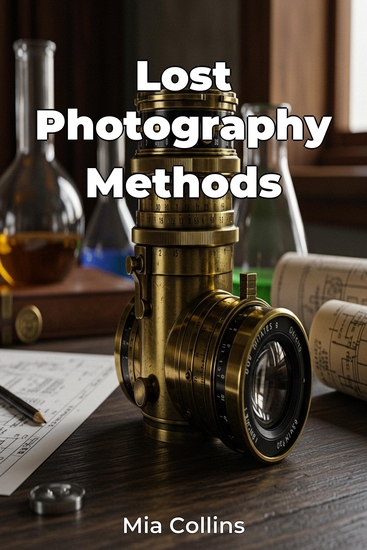
Lost Photography Methods - cover
LER

Lost Photography Methods

Mia Collins

Tradutor A AI

Editora: Publifye

  • 0
  • 0
  • 0

Sinopse

Lost Photography Methods explores the fascinating origins of photography, revealing the ingenuity behind now-obsolete techniques like cyanotypes, daguerreotypes, and calotypes. This journey through photographic history highlights how early photographers merged alchemy, artistry, and science to capture images. Understanding these processes provides a crucial foundation for appreciating the complexities often hidden beneath the apparent simplicity of modern digital photography. For instance, the daguerreotype, known for its sharpness, contrasts with the calotype's more painterly aesthetic, demonstrating early photographers' diverse artistic visions. The book investigates the scientific principles, artistic vision, and cultural impact of these early photographic practices.

 
By examining historical manuals, letters, and early prints, the book connects photography with history, chemistry, and art, revealing the social and economic factors that shaped the evolution of photographic techniques. It begins by introducing core concepts like optics and light sensitivity, then progresses through a historical timeline of significant photographic processes, and concludes by demonstrating the relevance of these techniques to contemporary photography and art.
Disponível desde: 26/02/2025.
Comprimento de impressão: 69 páginas.


Outros livros que poderiam interessá-lo

  • Out of Time and Out of Place: A History of Anomalous Objects and Events that Seemingly Appeared in the Wrong Time - cover

    Out of Time and Out of Place: A...

    Editors Charles River

    • 0
    • 0
    • 0
    “Time travel offends our sense of cause and effect - but maybe the universe doesn't insist on cause and effect.” - Edward M. Lerner, physicist and author  
    	We take time for granted as it passes during every moment of our existence. Other things may change, but time remains constant and predictable. The past, the present, and the future exist within a harmonious, reliable, and never-changing system. Or at least that’s how it seems… 
    	It was Albert Einstein who, in 1905, first theorized that time might not be quite as straightforward as that. In one of the most influential papers on physics ever published[1], he proposed something called “time dilatation.” This suggested that time was neither fixed nor constant and that the passage of time was related to the relative speed of the observer. The closer an object approached the speed of light, the more notable this effect was. For example, if it were possible to build an interstellar craft capable of reaching speeds that approached the speed of light, the passengers on that ship might experience the passage of a single year during a voyage, but when they returned to Earth, they might find that dozens of years had passed on the planet. 
    	That was a truly revolutionary idea back in 1905, and it wasn’t until the 1960s that technology had advanced to the point that it was possible to conduct experiments to check Einstein’s theory by measurement. Those experiments and subsequent tests proved that he was entirely correct. Even in 1908, new theories proposed that time was the fourth dimension of spacetime and that it wasn’t fixed at all but governed by the same laws of relativity that applied to other aspects of physics. 
    	These were exciting developments, and current theories of physics have taken this idea even further, suggesting that both space and time are “emergent.”
    Ver livro
  • The Encyclopedia of Out of Place Artifacts - cover

    The Encyclopedia of Out of Place...

    Martin Ettington

    • 0
    • 0
    • 0
    Out of Place Artifacts is a fascinating subject. There are too many of these unusual objects for them to be fakes. I’ve already written several books on this subject including “Strange Objects Which Should Not Exist”, “More Out of Place Objects”, and “A 300 Million Year Old Civilization Existed on Earth”.In this book I’ve compiled everything I could find out about these unusual finds from my prior three books and additional research. 54 artifacts are covered in detail.I’ve included all of this information except that specifically related to Aliens and UFOs since that information is in my books on those topics.The information here is presented in five parts:Part A: Artifacts Found in Historical TimesPart B: Very Ancient Objects to Millions of Years OldPart C: A Civilization 300 Million Years AgoPart D:  Human Footprints in RockPart E: Artifacts of Undetermined AgesI hope you find all of this information as interesting as I do since it changes our understanding of the history of our planet in incredible ways.
    Ver livro
  • How Can We Stop Fighting - The Right Help At The Right Time - cover

    How Can We Stop Fighting - The...

    Dee Tozer

    • 0
    • 0
    • 0
    It’s normal for couples to fight – isn’t it? When is a fight just a difference of opinion or a mild disagreement and when does it become an argument which leads to a destructive, hurtful fight? Should we stop the fight before it starts? 
    “How Can We Stop Fighting” is all about stopping the nasty accusations and hostility. Couples in thriving affectionate relationships do fight – however they fight in constructive ways which don’t harm their relationship. This book shows you the difference. Fights usually start with a difference of opinion, then escalate to a disagreement which is more animated, then to an argument with greater hostility. An argument typically has three stages of hostile oppositional strength.Hostility at stage one comprises of nasty attacking or defending words with throat tension and a raised voice. In Stage two both partners are yelling at each other, with facial expressions and body language clearly expressing heightened anger and frustration. When Stage two escalates to Stage three one or both partners start screaming nasty accusations at the other, threatening to divorce, using extremely vile language. This book shows you what to do instead..
    Ver livro
  • The Sun Engine - The Story of Life Light and Cosmic Cycles of Creation - cover

    The Sun Engine - The Story of...

    Ylia Callan

    • 0
    • 0
    • 0
    This audiobook is narrated by an AI Voice.   
    The Sun Engine is a sweeping journey through the story of light, life, and cosmic creation. From the fiery death of ancient stars to the birth of our Sun, this audiobook explores how solar energy has shaped every stage of existence—from the formation of planets to the spark of life on Earth. 
    Tracing the Sun’s influence through science, history, and spirituality, the narrative reveals how solar power has fueled ecosystems, inspired myth and religion, ignited industry through fossil fuels, and now returns as a guiding force for modern renewable energy. 
    Beyond its physical presence, The Sun Engine ventures into the profound connection between sunlight and human consciousness, while contemplating the Sun’s ultimate fate and its role in the eternal cycle of stars, black holes, and creation. 
    A story of cosmic wonder and human destiny, The Sun Engine is both a scientific exploration and a poetic meditation on the central star that sustains us all.
    Ver livro
  • The First Atomic Bomb - The Trinity Site in New Mexico - cover

    The First Atomic Bomb - The...

    Janet Farrell Brodie

    • 0
    • 0
    • 0
    On July 16, 1945, just weeks before the atomic bombing of Hiroshima and Nagasaki that brought about the surrender of Japan and the end of WWII, the US unleashed the world's first atomic bomb at the Trinity testing site located in the remote Tularosa Valley in New Mexico. 


    In The First Atomic Bomb Janet Farrell Brodie explores the history of the Trinity test and those whose contributions have rarely been discussed—the men and women who constructed, served, and witnessed the first test—as well as the downwinders who suffered the consequences of radiation. Concentrating on these ordinary people, laborers, ranchers, and Indigenous peoples who lived in the region and participated in the testing, Brodie corrects the lack of coverage in existing scholarship on the essential details and everyday experiences of this globally significant event. This book also covers the environmental preservation of the Trinity test site and compares it with the wide range of atomic sites now preserved independently or as part of the new Manhattan Project National Historical Park. Although the Trinity site became a significant node for testing the new weapons of the postwar US, it is known today as an officially designated National Historic Landmark. Brodie presents a timely, important, and innovative study of an explosion that carries special historical weight in American memory.
    Ver livro
  • Three contributions to the theory of Sex - cover

    Three contributions to the...

    Sigmud Freud

    • 0
    • 0
    • 0
    "Three Contributions to the Theory of Sex" is a seminal work by Sigmund Freud, the father of psychoanalysis. Originally published in 1905 as "Drei Abhandlungen zur Sexualtheorie," this book presents Freud's groundbreaking theories on human sexuality. In it, Freud explores the development of sexual instincts from infancy through adulthood, examining the role of unconscious desires, repression, and the Oedipus complex in shaping sexual behavior. He delves into topics such as infantile sexuality, the nature of sexual aberrations, and the psychological underpinnings of sexual identity. This work laid the foundation for much of Freudian psychoanalytic theory and continues to influence discussions on sexuality and psychology.
    Ver livro
