Junte-se a nós em uma viagem ao mundo dos livros!
Adicionar este livro à prateleira
Grey
Deixe um novo comentário Default profile 50px
Grey
Assine para ler o livro completo ou leia as primeiras páginas de graça!
All characters reduced
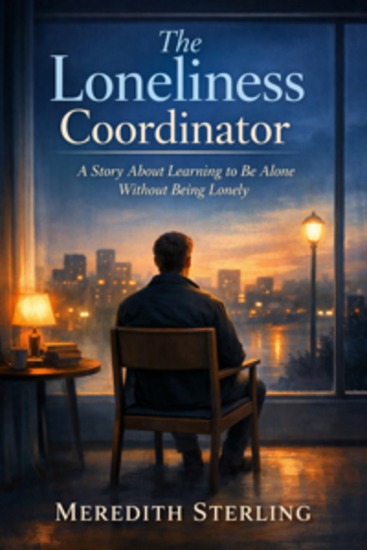
The Loneliness Coordinator - A Story About Learning to Be Alone Without Being Lonely - cover
LER

The Loneliness Coordinator - A Story About Learning to Be Alone Without Being Lonely

Meredith Sterling

Editora: Da'pathfinder Publishing

  • 0
  • 0
  • 0

Sinopse

What if being alone isn't the problem—it's how you've been doing it all wrong?Marcus Vaughn has mastered the art of disappearing. With a job that pays him to teach people how to be alone and an apartment designed for one, he's built the perfect life of solitude. Or so he thinks.Rebecca Channing can't say no. Drowning in social obligations she never wanted, performing happiness at events she dreads, she's surrounded by people but has never felt more isolated.When Marcus becomes Rebecca's "Loneliness Coordinator" at the mysterious Institute for Social Calibration, two broken people with opposite problems begin an unexpected journey. She needs to learn how to be alone. He needs to learn how to connect. Together, they'll discover that the space between isolation and connection isn't empty—it's where real life happens.For readers who loved Eleanor Oliphant Is Completely Fine and A Man Called Ove, comes a witty, heartfelt novel about:→ Learning the difference between loneliness and solitude→ Setting boundaries without guilt→ Finding your rhythm in a world that demands constant connection→ Discovering that sometimes the person teaching you is learning right alongside youThe Loneliness Coordinator is a darkly funny, deeply moving story about two people learning to be themselves—whether that means finally saying no, or finally saying yes.Perfect for fans of character-driven contemporary fiction, stories about self-discovery, and anyone who's ever felt like they're doing connection all wrong.Scroll up and click "Buy Now" to discover why readers are calling this "the book I didn't know I needed" and "a love letter to introverts everywhere."
Disponível desde: 02/01/2026.
Outros livros que poderiam interessá-lo

  • Lacan Sucks and So Do You - A Friendly Guide to Language Desire and Political Helplessness - cover

    Lacan Sucks and So Do You - A...

    Sophia Blackwell

    • 0
    • 0
    • 0
    What if your political identity, your core beliefs, and even your taste in snack food weren’t really yours? What if they were built out of language, hijacked by desire, and quietly manipulated by slogans, myths, and a Symbolic Order you didn’t ask to be born into? 
    Welcome to the world of Jacques Lacan, where nothing means what it seems, and everything is your unconscious acting out. 
    Lacan Sucks is your brutally sarcastic, surprisingly accurate guide to Lacan’s theory of language, power, and why you keep voting against your own interests. From signifiers that never shut up to unconscious desires that vote without you, this book breaks down how politics doesn’t just use language—it is language. 
    Through roast-level commentary, existential side-eye, and actual philosophical insight (yes, really), this book unpacks: 
    How language doesn’t reflect reality—it constructs it 
    Why you’re not an individual, you’re a pre-written script with anxiety 
    How politicians weaponize your desires with slogans and symbols 
    What the hell Lacan meant by “the unconscious is structured like a language” 
    And how to fight back using the one weapon they fear: your own damn voice 
    If you’ve ever felt manipulated by political discourse, confused by your own identity, or just wanted to scream into a pillow while reading Écrits, this is the book for you. 
    No degree in psychoanalysis or philosophy required. Just a sense of humor and a lingering suspicion that reality might be rigged.
    Ver livro
  • Whites - cover

    Whites

    Mark Doten

    • 0
    • 0
    • 0
    The excoriating stories in Mark Doten's brilliant first collection dissect the pathological narratives that shape our culture and country. Narrated by a crosscutting array of White people, Doten's stories spotlight the self-serving logic through which their characters struggle to make sense of, and take control of, the narrative of our time. They run the political spectrum from "well-intentioned" liberals and newly woke CEOs to Trump appointees, QAnon adherents, and believers in replacement theory. There is an anti-vax nursing home employee, an anti-woke billionaire, a nonbinary sneaker podcaster turned January 6 insurrectionist, a nonprofit LA housing president dubbed "WORST KAREN EVER," an elderly Republican in denial of his COVID-19 diagnosis, teenage YouTubers responding to a shooting at their suburban Minnesota school, a demonically possessed cookie manufacturer drafting a BLM statement with his new Black employee, and a gay White supremacist figure who may be a joke on 4chan, but will have his revenge. 


    While their identities and allegiances differ, all of them are united by a ferocious belief in themselves, certain that everything they've done can be justified, if you'll just hear them out. In Whites, Doten has written a relentless book that confirms their standing as one of the great satirists of their generation.
    Ver livro
  • Lemon Tarts in Space! - cover

    Lemon Tarts in Space!

    Cameron Fucile

    • 0
    • 0
    • 0
    Captain Duncan Arugula is being hunted by a sniffing, snarling, snurgling, pointy-toothed monstrosity. He’s locked in the cockpit of his own spaceship, his crew has gone radio silent since the mutiny, and now the monster — whatever it is, let’s just call it a Problem — is closing in. 
    Lemon Tarts in Space! careens through the desperate final days of the space race and crashes into an apocalyptic future, following Captain Arugula on an absurdist cat-and-mouse chase from the deepest tunnels of the moon up to a blistering dogfight across the stars. 
    Ridley Scott’s Alien meets Monty Python in this light science fiction dark comedy that has been proudly declared (by the author) to be “the dumbest science fiction cancer comedy ever written”.
    Ver livro
  • Why Men Are Suspicious of Yoga - Some Funny Stories and Some Not So Funny - cover

    Why Men Are Suspicious of Yoga -...

    Robert "robear" Isenberg

    • 0
    • 0
    • 0
    Discover the captivating and humorous world of Robert "robear" Isenberg in his latest audiobook, "Why Men Are Suspicious of Yoga: Some Funny Stories and Some Not So Funny," narrated by the talented Phillip Nathaniel Freeman and published by Audiobook Publishing Services. 
    Grady Harp raves, "...Jump in for a series of fine escapes from the pickles that life, at present, delivers. This is one fine attitude adjustment resource!” This revised edition features seven additional essays, blending humor and introspection to create a truly unique listening experience.Key Highlights:Against All Odds: Dive into the inspiring tales of two incredibly brave men who faced life's battles and emerged victorious, changing America for the better.The Car Ride: Relive a memorable experience from Robert's childhood at just five years old, a moment etched forever in his memory.Paul’s Special Birthday: Celebrate the life of one of Robert’s older siblings, Paul, an unsung hero of the "Greatest Generation."Learning How to Just Watch: Reflect on Robert's poignant response to one of life’s most challenging moments, inviting listeners to share their reactions.Father’s Day with My Mother-in-Law and Daddy’s Little Girls: Enjoy these heartfelt additions to the Family section, crafted with love and humor.Two Writers Meet, One Speaks: Witness the magical connection between writers, recognizing each other without visible clues. 
    Robert "robear" Isenberg's storytelling prowess shines through in this collection, offering a blend of laugh-out-loud humor and touching narratives. His engaging style, combined with Phillip Nathaniel Freeman's captivating narration, makes this audiobook a must-listen.
    Ver livro
  • The Robot Who Looked Like Me - Stories - cover

    The Robot Who Looked Like Me -...

    Robert Sheckley

    • 0
    • 0
    • 0
    In "The Robot Who Looked Like Me," a busy man and a busy woman find a way to carve out time to romance each other—by having look-alike robots made to do the job—who then run away together. 


    The twelve other stories in this collection are "Slaves of Time," "Voices," "A Supplicant in Space," "Sneak Previews," "Zirn Left Unguarded, the Jenghik Palace in Flames, John Westerly Dead," "Welcome to the Standard Nightmare," "The Never-Ending Western Movie," "What Is Life?", "I See a Man Sitting on a Chair, and the Chair Is Biting His Leg," "Is That What People Do?", "Silversmith Wishes," and "End City." 


    From the very beginning of his career, Robert Sheckley was recognized by fans, reviewers, and fellow authors as a master storyteller and the wittiest satirist working in the science fiction field. Rediscover, or discover for the first time, a master of science fiction who, according to the New York Times, was "a precursor to Douglas Adams."
    Ver livro
  • My Favorite Murder - A true classic of dark humour mixed with murder - cover

    My Favorite Murder - A true...

    Ambrose Bierce

    • 0
    • 0
    • 0
    Ambrose Gwinnett Bierce was born on 24th June 1842 at Horse Cave Creek in Meigs County, Ohio. His parents were poor but they introduced him to literature at an early age, instilling in him a deep appreciation of books, the written word and the elegance of language.  
     
    Growing up in Koscuisko County, Indiana poverty and religion were defining features of his childhood, and he would later describe his parents as “unwashed savages” and fanatically religious, showing him little affection but always quick to punish. He came to resent religion, and his introduction to literature appears to be their only positive effect. 
     
    At age 15 Bierce left home to become a printer’s devil, mixing ink and fetching type at The Northern Indian, a small Ohio paper. Falsely accused of theft he returned to his farm and spent time sending out work in the hopes of being published. 
     
    His Uncle Lucius advised he be sent to the Kentucky Military Institute. A year later he was commissioned as an Officer.  As the Civil War started Bierce enlisted in the 9th Indiana Infantry Regiment.  
     
    In April 1862 Bierce fought at the Battle of Shiloh, an experience which, though terrifying, became the source of several short stories. Two years later he sustained a serious head wound and was off duty for several months. He was discharged in early 1865.  
     
    A later expedition to inspect military outposts across the Great Plains took him all the way to San Francisco. He remained there to become involved with publishing and editing and to marry, Mary Ellen on Christmas Day 1871.  They had a child, Day, the following year.  
     
    In 1872 the family moved to England for 3 years where he wrote for Fun magazine. His son, Leigh, was born, and first book, ‘The Fiend’s Delight’, was published. 
    They returned to San Francisco and to work for a number of papers where he gained admiration for his crime reporting. In 1887 he began a column at the William Randolph Hearst’s San Francisco Examiner.  
     
    Bierce’s marriage fell apart when he discovered compromising letters to his wife from a secret admirer. The following year, 1889 his son Day committed suicide, depressed by romantic rejection. 
     
    In 1891 Bierce wrote and published the collection of 26 short stories which included ‘An Occurrence at Owl Creek Bridge’.  Success and further works including poetry followed.  
     
    Bierce with Hearst’s resources helped uncover a financial plot by a railroad to turn 130 million dollars of loans into a handout. Confronted by the railroad and asked to name his price Bierce answered “my price is $130 million dollars. If, when you are ready to pay, I happen to be out of town, you may hand it over to my friend, the Treasurer of the United States”.  
     
    He now began his first foray as a fabulist, publishing ‘Fantastic Fables’ in 1899.  But tragedy again struck two years later when his second son Leigh died of pneumonia relating to his alcoholism. 
     
    He continued to write short stories and poetry and also published ‘The Devil’s Dictionary’.  
     
    At the age of 71, in 1913 Bierce departed from Washington, D.C., for a tour of the battlefields where he had fought during the civil war. At the city of Chihuahua he wrote his last known communication, a letter to a friend. It’s closing words were “as to me, I leave here tomorrow for an unknown destination,” Ambrose Bierce then vanished without trace.
    Ver livro