¡Acompáñanos a viajar por el mundo de los libros!
Añadir este libro a la estantería
Grey
Escribe un nuevo comentario Default profile 50px
Grey
Suscríbete para leer el libro completo o lee las primeras páginas gratis.
All characters reduced
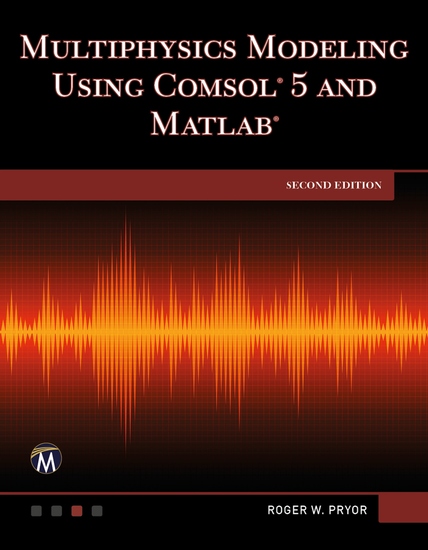
Multiphysics Modeling Using COMSOL 5 and MATLAB - Explore Advanced Techniques for Simulation and Analysis - cover

Multiphysics Modeling Using COMSOL 5 and MATLAB - Explore Advanced Techniques for Simulation and Analysis

Mercury Learning and Information, Roger W. Pryor

Editorial: Packt Publishing

  • 0
  • 0
  • 0

Sinopsis

This updated edition of the book explores COMSOL 5 and MATLAB, essential modeling tools for engineers and scientists. It includes five new models and covers systems from 0D to 3D, introducing numerical analysis techniques in COMSOL 5.6 and MATLAB. Using examples from electromagnetic, electronic, optical, thermal physics, and biomedical models, the book provides fundamental concepts and step-by-step instructions for building each model. Companion files include all models and related animations.The course starts with modeling methodology and material properties, progressing through 0D electrical circuit interface, 1D, 2D, 2D axisymmetric, 2D simple and complex mixed mode, and 3D modeling. Advanced topics like Perfectly Matched Layer models and Bioheat models are also covered. Each chapter builds on the previous one, ensuring a comprehensive understanding of modeling techniques.Understanding these concepts is crucial for developing and analyzing engineering, science, and biomedical systems. This book transitions readers from basic to advanced modeling, combining theoretical knowledge with practical skills. Companion files enhance the learning experience, making this an essential resource for mastering COMSOL 5 and MATLAB.
Disponible desde: 07/08/2024.
Longitud de impresión: 648 páginas.
Otros libros que te pueden interesar

  • The AI Mirror - How to Reclaim Our Humanity in an Age of Machine Thinking - cover

    The AI Mirror - How to Reclaim...

    Shannon Vallor

    • 0
    • 0
    • 0
    For many, technology offers hope for the future—that promise of shared human flourishing and liberation that always seems to elude our species. Artificial intelligence (AI) technologies spark this hope in a particular way. They promise a future in which human limits and frailties are finally overcome—not by us, but by our machines. Yet rather than open new futures, today's powerful AI technologies reproduce the past. Forged from oceans of our data into immensely powerful but flawed mirrors, they reflect the same errors, biases, and failures of wisdom that we strive to escape. Our new digital mirrors point backward. They show only where the data say that we have already been, never where we might venture together for the first time. 


    To meet today's grave challenges to our species and our planet, we will need something new from AI, and from ourselves. 


    Shannon Vallor makes a wide-ranging, prophetic, and philosophical case for what AI could be: a way to reclaim our human potential for moral and intellectual growth, rather than lose ourselves in mirrors of the past. Rejecting prophecies of doom, she encourages us to pursue technology that helps us recover our sense of the possible, and with it the confidence and courage to repair a broken world. Vallor calls us to rethink what AI is and can be, and what we want to be with it.
    Ver libro
  • The Future of Database Management Technologies - Harnessing the Power of Data: Insights and Strategies in Database Management - cover

    The Future of Database...

    Robert Lewis

    • 0
    • 0
    • 0
    Modern database systems are changing quickly, and the book "The Future of Database Management Technologies: Harnessing the Power of Data: Insights and Strategies in Database Management" looks into this and gives a complete guide to the next era of data management. Beginning with traditional relational systems and moving on to the newest ideas like NoSQL, NewSQL, and AI-driven optimization, this book shows how database technologies have changed over time. 
    Although this article talks about big changes like cloud-based database management systems (DBMS), real-time analytics, and decentralized data, it mostly talks about how businesses can use these new technologies to make strategic decisions. The book also looks at how to use big data frameworks, what data lakes and warehouses are for, and some examples of how advanced database solutions work in different types of businesses. 
    Security and privacy are at the top of the conversation because our world is based on data. They deal with both moral issues and new threats. The people who read this will learn about strategies that are ready for the future, like how to make databases that last, solutions based on blockchain technology, and database management systems that run themselves. 
    This book gives readers the information and skills they need to adapt to a database ecosystem that is always changing. It's great for tech fans, business leaders, and people who work with data because it has both in-depth technical information and useful advice. Get ready to use data to its fullest potential and stay ahead of the competition in a digital world that is always changing.
    Ver libro
  • A Year of Flower Wreaths - cover

    A Year of Flower Wreaths

    Malin Björkholm

    • 0
    • 0
    • 0
    Learn how to create beautiful, modern flower wreaths, not just for Advent and Christmas but throughout the year. Decorate your front door, walls and dining tables, and even your head with flower wreaths.
    Organised around the seasons of the year, this book has 40 flower projects for all occasions, from the first longing for spring and budding greenery via summer light and harvest time to Christmas and winter rest. All wreaths have clear step-by-step instructions in text and pictures. There are facts about which materials are suitable and sustainable for the different seasons, including which you can pick yourself from nature or your garden. Written by florist, photographer and writer Malin Björkholm, whose wreaths and flower arrangements have become famous on Instagram due to their simplicity and use of natural materials.
    Projects in this book include an enchanting bright yellow mimosa flower wreath for spring, a traditional midsummer Swedish flower crown, a striking circlet of dried flowers and berries for autumn and a classic door wreath with pine cones for Christmas. More luxurious and more modern than any wreath-making book you'll have seen before, these magical projects will provide endless inspiration for year-round decorating with flowers.
    Ver libro
  • CISSP Simplified: Secrets to Effortlessly Master Security Certification - "Elevate your CISSP exam prep with dynamic audio lessons for unbeatable certification success!" - cover

    CISSP Simplified: Secrets to...

    Cyrus Pendleton

    • 0
    • 0
    • 0
    CISSP Simplified: Secrets to Effortlessly Master Security Certification 
    ⭐⭐ Simplified Guide & Explanations Included ⭐⭐ 
    Are you aiming to advance your career in cybersecurity and reinforce your expertise by successfully obtaining your CISSP certification? 
    Looking for a comprehensive resource that encompasses everything you need to master cybersecurity skills for a successful career journey? 
    Your search ends here! 
    This guide serves as your ultimate companion for enhancing your understanding, applying your skills, and engaging in practical exercises. With this, you’re set for success. 
    Updated for the latest CISSP Exam Structure. 
    Key features of this comprehensive guide include: 
    - In-depth insights into the CISSP Certification   
    - Thorough explanations of cybersecurity concepts   
    - Effective strategies for exam preparation and tackling real-world scenarios   
    Our guide stands out due to its extensive coverage, which is crucial for your exam success. Concepts are explored in detail, leaving no stone unturned. 
    Please note that this resource is an independent guide and is not affiliated with any official CISSP entity. 
    Crafted with a clear layout and accessible language, our guide ensures smooth transitions between topics. Say goodbye to complex jargon and welcome clear, concise, and technically accurate content. 
    So, why wait? Click the BUY NOW button, secure your guide, and embark on your journey to CISSP certification success! 
    Embark on your path to mastering cybersecurity today!
    Ver libro
  • Ultimate Python for Fintech Solutions - Build Modern Financial Applications and Fintech Solutions Using Finance Packages and Blockchain with Python - cover

    Ultimate Python for Fintech...

    Bhagvan Kommadi

    • 0
    • 0
    • 0
    Creating Next Gen Apps in Finance
    
    Book Description
    Dive into the dynamic world where finance meets fintech with Python's versatile capabilities in this 'Ultimate Python for Fintech Solutions'. Whether you're aiming to build secure trading platforms, conduct deep statistical analysis, or pioneer next-generation financial technologies, this book quips you with the knowledge, tools, and practical insights to succeed. 
    This book starts with Python's foundational programming techniques, essential for understanding financial principles and laying the groundwork for robust applications. You will learn to build scalable solutions that handle complex financial data with ease by using Python for analysis, forecasting, and data visualization. 
    Next, it moves to explore advanced topics like AI/ML applications tailored for finance, enabling you to unlock predictive insights and streamline decision-making processes. You will discover how Python integrates cutting-edge technologies such as Big Data and Blockchain, to offer innovative solutions for modern fintech challenges. 
    By the end of this expansive book, you will gain the expertise needed to develop sophisticated financial applications, visualize data effectively across desktop and web platforms, and drive innovation in fintech. 
    
    Table of Contents
    
    1. Getting Started on Python Infrastructure and Building Financial Apps
    2. Learning Financial Concepts Using Python
    3. Data Structures and Algorithms Using Python
    4. Object Oriented Programming Using Python
    5. Building Simulation and Mathematical Analysis Tools Using Python
    6. Stochastic Mathematics and Building Models Using Python
    7. Prediction Algorithms Using Python
    8. Data Science and Statistical Algorithms Using Python
    9. Desktop and Web Charting Using Python
    10. AI/ML Apps Using Python
    11. Big Data/Blockchain-Based Solutions Using Python
    12. Next Generation FinTech Apps Using Python with Financial Singularity   
    Index
    Ver libro
  • Battlefields of The Future: The Evolution of the Technology of War 2025-2125 - cover

    Battlefields of The Future: The...

    Dr. Nick Coman, I. A.I.

    • 0
    • 0
    • 0
    A 36‑lecture audio course on how wars are actually fought in the machine age—from seabed cables and city power grids to low‑Earth orbit, cislunar space, and the neural loop between a human and a weapon. We break the kill chain open: sensing and space‑based cueing; edge compute and target fusion; communications that survive jamming; and the things that do damage—mines, missiles, loitering munitions, directed energy, electromagnetic pulse, and code. 
    We make the stack legible for operators and serious thinkers alike: synthetic aperture radar becomes SAR; high‑altitude long endurance becomes HALE; link budgets and laser crosslinks stop being magic and start being math you can reason about in words. You will see how orbital “stalkers” shadow satellites, why stratospheric platforms matter when air defenses make manned ISR bleed, how decoys and digital camouflage fracture an adversary’s picture, and where the automation boundary really sits when AI runs parts of the kill web with a human on the loop. 
    Engineering reality, not brochure fog, sets the pace. We trace power budgets, attrition math, and reconstitution timelines; map chokepoints in chips, propellants, optics, batteries, and shipyards; and follow sanctions, export controls, and standards as operational constraints, not afterthoughts. 
    The glidepath is explicit. 2025 to 2035: proliferated space, cheap autonomy, hard lessons from electronic warfare. 2035 to 2050: directed‑energy baselines, resilient meshes, smarter decoys. 2050 to 2075 and beyond: cislunar logistics with teeth, human performance management that is governed not ghoulish, brain–computer interfaces that shorten loops without erasing judgment. 
    Rigorous, unsentimental, and built for the intellectually ambitious, this course is an operator’s guide to modern combat systems—how they are built, how they break, and how they win.
    Ver libro