¡Acompáñanos a viajar por el mundo de los libros!
Añadir este libro a la estantería
Grey
Escribe un nuevo comentario Default profile 50px
Grey
Suscríbete para leer el libro completo o lee las primeras páginas gratis.
All characters reduced
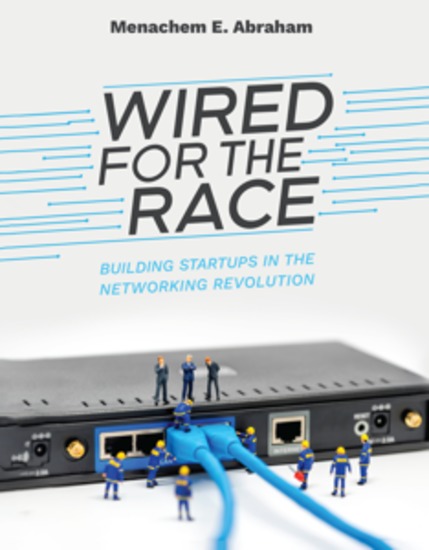
Wired For The Race - Building Startups In The Networking Revolution - cover

Wired For The Race - Building Startups In The Networking Revolution

Menachem E. Abraham

Editorial: Spines

  • 0
  • 0
  • 0

Sinopsis

Step into the thrilling early days of the digital age — a time when "dumb terminals" gave way to personal computers and the modern Internet was just a glimmer on the horizon. In this firsthand account, electrical engineer and entrepreneur Menachem E. Abraham takes you behind the scenes of the networking revolution that transformed the world.Follow the rise of three trailblazing Massachusetts-based startups — Chipcom, Prominet, and Mintera — each founded during pivotal moments in computer networks and Internet history. With gripping insights and honest reflections, Abraham explores the challenges, breakthroughs, and lessons learned while helping to shape the future of this industry.Whether you're an aspiring entrepreneur, a business student hungry for real-world case studies, or a tech enthusiast curious about the origins and evolution of the connected world we live in today, “Wired for the Race”offers a compelling blend of history, entrepreneurship, innovation, and inspiration. A must-read for anyone who’s ever wondered how the world got wired.
Disponible desde: 30/06/2025.
Longitud de impresión: 228 páginas.

Otros libros que te pueden interesar

  • Death Has Very Little Meaning - Ojai 1980 - Dialogue 7 - cover

    Death Has Very Little Meaning -...

    Jiddu Krishnamurti

    • 0
    • 0
    • 0
    Death has very little meaning - 17 April 1980 
    • Is there a totally different way of approaching the whole turmoil of life? 
    • As long as the centre is creating darkness, and thought is operating in that dark 
    ness, there must be disorder, there must be everything as society now is. To 
    move away from that you must have insight. 
    • Insight can only come about when there is a flash which abolishes not only the 
    darkness but the creator of darkness. 
    • Human beings have been acting according to one pattern, responding to 
    hatred by hatred and so on. There are those few, perhaps many, who did not. 
    Why has this division taken place? 
    • The man who is living in darkness can move away at any time to the other. That 
    is the point: at any time. 
    • What happens to a mind that has no conflict?
    Ver libro
  • Seal in the Desert - Moving Past Feeling Stuck - cover

    Seal in the Desert - Moving Past...

    Heather Fritz

    • 0
    • 0
    • 0
    When my late husband and I moved off-grid, we rented property. The previous owners had seals in the middle of the Mojave Desert. The seals clearly did not belong there. 
    You may be unaware that you are stuck, when you do not know better. 
    Our traumas are like building blocks that we use to create walls of a mental prison which effectively becomes the life that we know. 
    Often, the walls are so very clear that even we may not notice them. But our inner voice keeps telling us that we must escape to find where we belong. 
    The problem is that we don't know how to communicate it all to ourselves, let alone to our closest loved ones. 
    This book is about naming, claiming, and taming that feeling of being stuck. Hopefully it will help every seal to get out of the desert and find their ideal ocean. 
    Although this story is a tough one, it sheds a much needed light on emotional and mental abuse. I hope you enjoy this memoir in which healing and growing resilience triumph.
    Ver libro
  • The Nine Lives of Florida's Famous Key Marco Cat - cover

    The Nine Lives of Florida's...

    Austin J. Bell

    • 0
    • 0
    • 0
    Excavated from a waterlogged archaeological site on the shores of subtropical Florida by legendary anthropologist Frank Hamilton Cushing in 1896, the Key Marco Cat has become a modern icon of heritage, history, and local identity. This book takes listeners into the deep past of the artifact and the Native American society in which it was created. 


    Austin Bell explores nine periods in the life of the six-inch-high wooden carving, beginning with how it was sculpted with shell and shark-tooth tools and what it may have represented to the ancient Calusa—perhaps a human-panther god. Preserved in the muck for centuries on Marco Island and discovered in pristine condition due to its oxygen-free environment, the Cat has since traveled more than 12,000 miles and has been viewed by millions of people. In this fascinating account, Bell traces the clues to the Cat's mysterious origins that have emerged in its later lives. 


    Captivating listeners with the miracle and beauty of this rare example of pre-Columbian art, Bell marvels at how an object originally understood to hold cosmological power has indeed transformed the people and places around it. The Nine Lives of Florida's Famous Key Marco Cat is the story of a timeless masterpiece of staggering simplicity that has prevailed over impossibly long odds.
    Ver libro
  • Dynamite Nashville - Unmasking the FBI the KKK and the Bombers beyond their Control - cover

    Dynamite Nashville - Unmasking...

    Betsy T. Phillips

    • 0
    • 0
    • 0
    New evidence in Dynamite Nashville uncovers the origin of an organized group of racist terrorists committing nationwide acts of violence against integration efforts in the late 1950's and early 1960s. Award winning historian Betsy Phillips not only paints a detailed picture of the social dynamic of the times, but details how a violent fringe of racists came to national prominence. In Dynamite Nashville, Phillips unmasks the KKK, reveals a racist terrorist network, names its principle leader, and shines a much needed historical spotlight on unsung civil rights hero Z. Alexander Looby. 


    Just as Nashville was where Civil Rights icons began, Nashville is where one of the country's most prominent organizations of racist terrorists formed. Members of The Confederate Underground would participate in least twenty bombings between 1957 and 1963. In Dynamite Nashville, Phillips revisits three unsolved Nashville bombings. Additionally, her research shows how the differing agendas of local police and the FBI allowed these bombers to escape prosecution until decades later, if at all. Dynamite Nashville is a prequel to the racist violence of the 1960s, the story of how these bombers came together to learn how to terrorize communities, and to escape any meaningful justice. It is also the story of how communities and heroes like Z. Alexander Looby pushed back.
    Ver libro
  • EU-Africa digital partnership - Strategic pathways through the Mattei plan and global gateway - cover

    EU-Africa digital partnership -...

    Marianna Lunardini, Darlington...

    • 0
    • 0
    • 0
    By 2050, Africa's population is projected to reach approximately 2.5 billion people. By the end of the 21st century, the African continent will account for 40.6 per cent of the world's working age population, underscoring an urgent need to create at least 20 million new jobs annually. These demographic transformations present both opportunities and challenges for EU-Africa cooperation under both the Mattei Plan and Global Gateway frameworks. For Africa in particular, the digital sector has the potential to drive innovation, spur economic growth, empower rural communities, foster continental integration and accelerate progress towards achieving Sustainable Development Goals (SDGs) and Agenda 2063. At the same time, Africa's digital transformation is sparking discussion over asymmetric power relations that mirror past historical injustices. With majority of digital infrastructure, platforms and services originating either in China, North America and to a lesser extent Western Europe, questions around technological dependency, lack of transparency, data sovereignty and the risks of perpetuating "digital colonialism" have come to the fore. The EU-Africa digital partnership under Mattei Plan and Global Gateway frameworks can serve as catalysts for strengthening African agency by enhancing digital governance frameworks, investing in targeted capacity-building programmes and mobilising resources to bridge infrastructure and financing gaps.
    This edited volume aims to provide rigorous analysis of the main challenges and opportunities for digital cooperation and partnership between the EU and Africa through two key European policy instruments, the EU Global Gateway and Italy's Mattei Plan. The volume situations EU-Africa digital partnership within a broader digital landscape increasingly being shaped by geopolitical and geo-economic rivalry among global powers enabling informed analysis of the EU-Africa partnership on the global geopolitical chessboard. The analysis focuses on four macro-themes: (i) digital governance frameworks and policy, (ii) technological control and data sovereignty, (iii) digital infrastructure gaps, and (iv) opportunities and challenges for Italy-EU-Africa digital partnership going into the future. Furthermore, the book delves into the current state of global digital landscape from the perspectives of both Africans and Europeans and contains nuanced and targeted recommendations for strengthening the EU-Africa digital partnership.
    Ver libro
  • Our Search for Belonging - How Our Need to Connect Is Tearing Us Apart - cover

    Our Search for Belonging - How...

    Howard J. Ross, JonRobert...

    • 0
    • 0
    • 0
    Why are we so divided today? Paradoxically, Howard Ross, author of Everyday Bias, says it's our compulsion to belong to a group--something hardwired into us-- that ends up making us deeply connected with some, yet deeply divided from others. Ross shows how we can overcome this growing tribalism. 
     
    We are living in a world of almost unparalleled separation. People are no longer disagreeing, but are instead disavowing each other's rights to an opinion. What is driving this polarization, and how can we overcome it? Howard Ross says that ironically it's our profound need to belong. He delves deeply into the powerful psychological, neurological, and biological forces that drive us to want to identify so strongly with a group we're sometimes even willing to sacrifice our individual identity. 
    Drawing on his decades of leadership in the diversity and inclusion field, Ross probes the depth and impact of this growing tribalism, the role social media plays in exacerbating it, the ways it impacts every aspect of the daily lives, and how to combat it.  Readers will gain tools for exploring contentious dialogue in healthier ways and guidelines for breaking down barriers and building bridges across difference, and organizations and institutions will be able to develop approaches that can open dialogue and encourage mutual understanding.
    Ver libro