Junte-se a nós em uma viagem ao mundo dos livros!
Adicionar este livro à prateleira
Grey
Deixe um novo comentário Default profile 50px
Grey
Assine para ler o livro completo ou leia as primeiras páginas de graça!
All characters reduced
My Blue Book of Grammar for Class 8 - cover
LER

My Blue Book of Grammar for Class 8

Meigha Rawat

Editora: Orange Education Pvt Ltd

  • 0
  • 0
  • 0

Sinopse

A Grammar Series That Uses the Functional Approach 

KEY FEATURES 
- Functional approach to grammar teaching, using exemplars to illustrate the usage before defining the structure and rules 
- Vocabulary taught through language-in-use to build the learners’ vocabulary through use rather than memorisation of rules 
- Contemporary topics to inculcate 21-century skills amongst learners 
- Use of literature to help learners understand how grammar is used in text 
- A comprehension section comprising texts from different genres so that learners may relate grammar to different types of works produced in English 
- Phonics in Grades 1 and 2 to teach the very basis of language 
- Uniquely stylised illustrations 
- Activities such as puzzles, crosswords, word grids and games to aid the facilitator in using the concept of ‘flipped classroom’ 
- Periodic tests to help the learners self-assess the acquisition of concepts 
- Digital component to cater to a technology-driven classroom 

DESCRIPTION: 
My Blue Book of Grammar is a course that has been conceptualized and designed keeping in mind the increasingly dynamic role of the English language in today’s world. Especially in our country, where English serves as the lingua franca, a grammar course has to offer not only an exposition of the pedagogy but also the exhibition of the utility of that pedagogy. The aim of a grammar series should be to encourage the development of competency amongst learners, even though their proficiency levels may vary. While the level of exposure to English of all learners may be different, a grammar series should aid in the development of a certain level of confidence amongst the learners, with the end result being that they are able to converse without hesitation in English. 

WHAT WILL YOU LEARN 
- Understand grammar concepts 
- Learn how to use different vocabulary concepts taught through language-in-use 
- Learn 21-century skills 
- Develop deeper understanding of and appreciation for literature 
- Have clearer pronunciation through a better understanding of phonics 

WHO THIS BOOK IS FOR: 
School students of Grades 8 

TABLE OF CONTENTS 
GRAMMAR 
1. Sentences: Complex, Compound, Complex–Compound 
2. Correct and Incorrect Use of Ellipsis 
3. Articles: a, an, the 
4. Determiners 
5. Quantifiers 
6. Subjunctive 
7. Verbs Used in Subjunctive 
8. Parallel Structure 
9. Dangling Modifier 
10. Capitalising Titles 
11. Subject–Verb Agreement with Compound Subjects 
12. Commas, Semicolons, Colons and Dashes 
13. Commas with Interrupters and Appositives 
14. Compound Possessive 
15. Conjunctive Adverbs 
Test Paper 1 
VOCABULARY 
16. Adjectives: good, better, best, bad, worse, worst 
17. Adverbs: well, better, best, badly, worse, worst 
18. Compound Object with I and Me 
19. Removing Redundancy 
20. Prefixes: semi–, mid–, en–, em– 
21. Suffixes: –ence, –ance, –an, –ian 
22. Using Latin and Greek Roots to Find Out the Meaning of Words 
23. Using the Thesaurus 
24. Allusion 
25. Analogy – Revision 
26. Finding the Meaning of the Word from the Context 
27. Formal and Informal Language 
Test Paper 2 
WRITING 
28. Circular 
29. School Circular 
30. Writing a Story as a Play 
31. Story Writing 
32. Argumentative Essay 
33. Article for the School Magazine 
34. Report for the School Newspaper 
Test Paper 3 
COMPREHENSION 
35. Stay Hungry, Stay Foolish 
36. Hallow-Fair 
37. Sqay 
38. Bhikaji Cama 
Orange Global Olympiad – English Sample Paper
Disponível desde: 01/06/2023.
Outros livros que poderiam interessá-lo

  • Philosophers of Change and Substance - The Early Exploration of Matter Change and the Universe (2 in 1) - cover

    Philosophers of Change and...

    Hector Davidson

    • 0
    • 0
    • 0
    This book consists of the following two philosophers: 
    - Anaximander: Anaximander is best known for his revolutionary ideas about the cosmos. He proposed that the universe originated from the apeiron, an indefinite or boundless substance, which he believed was the source of all things. This concept marked a significant departure from the mythological explanations of the cosmos prevalent in his time, suggesting instead a naturalistic origin of the universe. His cosmological model, which included the idea of a cylindrical Earth suspended in space, demonstrated a sophisticated understanding of celestial mechanics for his era. 
    - Thales: In addition to his contributions to philosophy, Thales was also a mathematician and astronomer, and his influence in these fields is considerable. He is credited with being the first to predict a solar eclipse, using his understanding of the stars and celestial movements. His work in geometry is equally important—he is famously known for Thales’ Theorem, which laid the groundwork for the development of geometry. This theorem states that if two points are on a circle, and a line is drawn through them, then the center of that line will always lie on a straight line through the center of the circle. This geometric insight shows his ability to understand and systematize mathematical concepts that were previously unexamined. 
     
    Ver livro
  • North to Boston - Life Histories from the Black Great Migration in New England - cover

    North to Boston - Life Histories...

    Blake Gumprecht

    • 0
    • 0
    • 0
    Between World War II and 1980, tens of thousands of Black people moved to Boston from the South as part of the Great Migration, one of the most consequential mass movements of people in American history. Black migration from the South transformed the city, as it did urban areas across the country. North to Boston is the first book to examine that important subject. 


    Blake Gumprecht traces the history of this migration and explores its impacts in greater depth through the lives of ten individuals, each the subject of one chapter. Those chapters are short biographies based on extensive interviews by the author and are told in an engaging style that reflects the author's background as a journalist. 


    The ten people featured came from six southern states. They fled racism, limited opportunity, and hopelessness, and moved north in pursuit of better jobs, equal treatment, and greater freedom. They settled in neighborhoods such as Roxbury, Dorchester, and Mattapan. They worked as teachers, factory workers, welders, and security guards. Their stories are emblematic of the experiences of Black people everywhere who left the South, and provide a rare glimpse into the lives of ordinary people living in one city's Black community.
    Ver livro
  • Understanding Obsessive Compulsive Disorder (OCD) - cover

    Understanding Obsessive...

    Dale Mclaughlin

    • 0
    • 0
    • 0
    This audiobook is narrated by an AI Voice.   
    Understanding Obsessive Compulsive Disorder (OCD) by Dale McLaughlin is a clear and compassionate guide to overcoming intrusive thoughts, compulsive behaviors, and anxiety that control the mind. 
    Through real-life examples and modern psychology, you’ll learn what OCD really is, how obsessions and compulsions form, and how to use mindfulness and cognitive-behavioral therapy (CBT) techniques to calm the noise. 
    This audiobook offers step-by-step tools to break the overthinking cycle, reduce stress, and rebuild mental clarity. 
    Discover how to: 
    Recognize obsessive thinking patterns 
    Stop compulsive rituals that feed fear 
    Rewire your brain through simple CBT-based exercises 
    Create daily routines for focus, resilience, and emotional healing 
    Whether you’re managing Obsessive Compulsive Disorder, supporting someone with it, or simply looking for calm and balance, this self-help guide gives you the understanding and structure to reclaim control. 
    Perfect for listeners interested in mental health, anxiety relief, mindfulness, psychology, and practical healing strategies for everyday peace of mind.
    Ver livro
  • Talking Cure - An Essay on the Civilizing Power of Conversation - cover

    Talking Cure - An Essay on the...

    Paula Marantz Cohen

    • 0
    • 0
    • 0
    Talking Cure is a timely and enticing excursion into the art of good conversation. Paula Marantz Cohen reveals how conversation connects us in ways that social media never can and explains why simply talking to each other freely and without guile may be the cure to what ails our troubled society. 


    Drawing on her lifelong immersion in literature and culture and her decades of experience as a teacher and critic, Cohen argues that we learn to converse in our families and then carry that knowledge into a broader world where we encounter diverse opinions and sensibilities. She discusses the role of food in encouraging conversation, the challenges of writing dialogue in fiction, the pros and cons of Zoom, the relationship of conversation to vaudeville acts, and the educational value of a good college seminar where students learn to talk about ideas. Cohen looks at some of the famous groups of writers and artists in history whose conversation fed their creativity, and details some of the habits that can result in bad conversation. 


    Blending the immediacy of a beautifully crafted memoir with the conviviality of an intimate gathering with friends, Talking Cure makes a persuasive case for the civilizing value of conversation and is essential listening for anyone interested in the chatter that fuels culture.
    Ver livro
  • Brahma Vishnu Shiva - The Yogic Trinity With The Brama Samhita - cover

    Brahma Vishnu Shiva - The Yogic...

    Sripad Jaganantha Das

    • 0
    • 0
    • 0
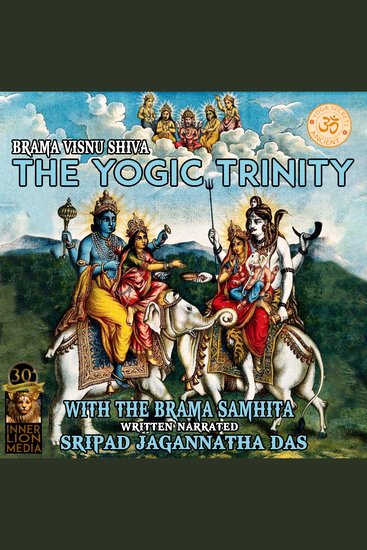
    Brahma is the controller of nature in the mode of passion; he is the engineer who creates the universe. Every universe has its Brahma, who appears as the first created being in it. Although Brahma is usually in the category of the jiva soul, he is designated an avatar (incarnation) of Krishna because he is especially empowered with Krishna’s own creative potency. Using the ingredients furnished by Krishna and following Krishna’s blueprints, Brahma constructs the material universe, and then he begets the offspring, called Prajapatis, whose descendants populate all the planets. 
     
    Vishnu, who controls nature in the mode of goodness and sustains the creation, is directly the Supreme Lord. In the spiritual kingdom of God, where everything is everlasting, the quality of goodness exists without either passion or ignorance. Therefore it is appropriate that Vishnu personally controls this quality even in the material world, where it becomes bracketed by ignorance and passion. 
      
    Shiva, the lord of the mode of ignorance, devastates the universe at the end by his wild, all-annihilating dance. Shiva is a personal expansion of Krishna, not a jiva. Yet, because he comes into intimate contact with the quality of ignorance and with matter (which is innately ignorant), you cannot receive the same spiritual restoration by worshiping him that you do by worshiping Krishna or Vishnu. Shiva is therefore given his own category, shiva-tattva. Learn all about the sacred trinity of yogic lore. 
     
    The Sri Brama-samhita is a collection of prayers by Brahma at the beginning of material creation after the Supreme Person Krishna gave Brahma a divine vision of the spiritual world. Brama, in his amazement, speaks volumes of divinely inspired praise before beginning his work of creation. Sri Chaitanya Mahaprabhu acquired the Fifth Chapter of the Brama-Samhita from the Adi-Keshava temple in South India. 
    Ver livro
  • We Are All Armenian - Voices from the Diaspora - cover

    We Are All Armenian - Voices...

    Aram Mrjoian

    • 0
    • 0
    • 0
    A collection of essays about Armenian identity and belonging in the diaspora. 


    In the century since the Armenian Genocide, Armenian survivors and their descendants have written of a vast range of experiences using storytelling and activism, two important aspects of Armenian culture. Wrestling with questions of home and self, diasporan Armenian writers bear the burden of repeatedly telling their history, as it remains widely erased and obfuscated. Telling this history requires a tangled balance of contextualizing the past and reporting on the present, of respecting a culture even while feeling lost within it. 


    We Are All Armenian brings together established and emerging Armenian authors to reflect on the complications of Armenian ethnic identity today. These personal essays elevate diasporic voices that have been historically silenced inside and outside of their communities, including queer, multiracial, and multiethnic writers. The eighteen contributors to this contemporary anthology explore issues of displacement, assimilation, inheritance, and broader definitions of home. Through engaging creative nonfiction, many of them question what it is to be Armenian enough inside an often unacknowledged community.
    Ver livro