Junte-se a nós em uma viagem ao mundo dos livros!
Adicionar este livro à prateleira
Grey
Deixe um novo comentário Default profile 50px
Grey
Assine para ler o livro completo ou leia as primeiras páginas de graça!
All characters reduced
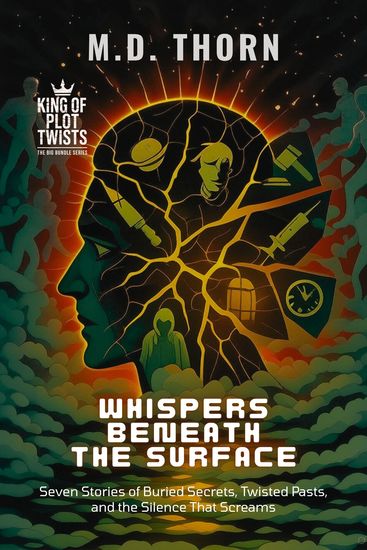
Whispers Beneath the Surface - Seven Stories of Buried Secrets Twisted Pasts and the Silence That Screams - cover
LER

Whispers Beneath the Surface - Seven Stories of Buried Secrets Twisted Pasts and the Silence That Screams

M.D. Thorn

Editora: Twist & Tether Press

  • 0
  • 0
  • 0

Sinopse

Still waters run deep—but what lies beneath might drown you. In a town that never forgets, two sisters return to the lake where something more than memories was buried. Just down the road, a water tower casts a long shadow, and the local ghost story refuses to stay in the past.
 
A forgotten man wakes up in a house that should lead upward—but the only way forward is down. In another world, a nation plays its favorite game under the grip of a regime that turns sport into survival.
 
When a wallet turns up in a snowbank, the evidence it carries could ignite everything—or mean nothing at all. Meanwhile, the silence at the heart of a government is deafening, masking a coup no one sees coming.
 
And in the loneliest part of space, a man returns to Earth—but something about his memory is fractured, and time has left him behind.
 
This bundle unravels identity, memory, power, and truth in stories that teeter on the edge of madness. Beneath each surface, something dangerous waits—half-forgotten, half-remembered, and wholly unstoppable.
 
What if the real danger isn’t what you forgot… but what remembers you?
Disponível desde: 08/08/2025.
Comprimento de impressão: 435 páginas.
Outros livros que poderiam interessá-lo

  • The Short Stories of Leo Tolstoy - Epic collection of stories from the grandmaster of literature - cover

    The Short Stories of Leo Tolstoy...

    Leo Tolstoy

    • 0
    • 0
    • 0
    Leo Tolstoy was born in 1828 in the Russian province of Tula to a wealthy noble family. As a child, he had private tutors but he showed little interest in any formal education. When he went to the University of Kazan in 1843 to study oriental languages and law, he left without completing his courses.  Life now was relaxed and idle but with some writing also taking place.  Gambling debts forced an abrupt change of path and he joined the army to fight in the Crimean War.  He was commended for his bravery and promoted but was appalled at the brutality and loss of life.  He recorded these and other earlier experiences in his diaries which formed the basis of several of his works. 
     
    In 1852 ‘Childhood’ was published to immediate success and was followed by ‘Boyhood’ and ‘Youth’. 
     
    His experience in the army and the horrors he witnessed resulted in ‘The Cossacks’ in 1862 and the trilogy ‘Sevastopol Tales’. After the war he travelled around Europe, visiting London and Paris and meeting such luminaries as Victor Hugo and Charles Darwin.  
     
    It was now that Tolstoy began his masterpiece, ‘War and Peace’. Published in 1869 it was an epic work that changed literature. He quickly followed this with ‘Anna Karenina’.  
     
    These successes made Tolstoy rich and helped him accomplish many of his dreams but also brought problems as he grappled with his faith and the lot of the oppressed poor. These revolutionary views became so popular that the authorities now kept him under surveillance.  
     
    He led a life of asceticism and vegetarianism and put his socialist ideals into practice by establishing numerous schools for the poor and food programmes. He also believed in giving away his wealth, which caused much discord with his wife.  
     
    His writing continued to bring forth classics such as ‘The Death of Ivan Ilyich’ and many brilliant and incisive short stories such as ‘How Much Land Does A Man Need’.  
     
    In 1901 Tolstoy was excommunicated from the Church and controversially deselected for the Nobel Prize for Literature. 
     
    Whilst undertaking a pilgrimage by train in October 1910 with his daughter Aleksandra he caught pneumonia in the nearby town of Astapovo.  Leo Tolstoy died on November 9th, 1910, he was 82. 
    01 - Leo Tolstoy - A Short Story Collection - An Introduction 
    02 - Diary of a Lunatic by Leo Tolstoy 
    03 - A Dialogue Among Clever People by Leo Tolstoy 
    04 - Aloysha The Pot by Leo Tolstoy 
    05 - God Sees The Truth But Waits by Leo Tolstoy 
    06 - How Much Land Does A Man Need by Leo Tolstoy
    Ver livro
  • Guy de Maupassant - Six of the Best - Their legacy in 6 classic stories - cover

    Guy de Maupassant - Six of the...

    Guy de Maupassant

    • 0
    • 0
    • 0
    Six has always been a number we group things around – Six of the best, six of one half a dozen of another, six feet under, six pack, six degrees of separation and a sixth sense are but a few of the ways we use this number. 
     
    Such is its popularity that we thought it is also a very good way of challenging and investigating an author’s work to give width, brevity, humour and depth across six of their very best. 
     
    In this series we gather together authors whose short stories both rivet the attention and inspire the imagination to visit their gems in a series of six, to roam across an author’s legacy in a few short hours and gain a greater understanding of their writing and, of course, to be lavishly entertained by their ideas, their narrative and their way with words. 
     
    These stories can be surprising and sometimes at a tangent to what we expected, but each is fully formed and a marvellous adventure into the world and words of a literary master.
    Ver livro
  • Foreordained - From their pens to your ears genius in every story - cover

    Foreordained - From their pens...

    Anthony Hope

    • 0
    • 0
    • 0
    Sir Anthony Hope Hawkins was born on 9th February 1863 in Clapton, London.  
    He was educated at St John's School, Leatherhead, Marlborough College and Balliol College, Oxford.  Hope trained as a lawyer and barrister and was called to the Bar by the Middle Temple in 1887. Despite what was thought to be a promising legal career he had literary ambitions and wrote in his spare time. 
    His early works appeared in various periodicals of the day but for his first book ‘A Man of Mark’ (1890), with no publisher interested, he published with his own resources.  
    More novels and short stories followed, including the mildly successful ‘Mr Witt's Widow’ in 1892. Hope even found time to run as the Liberal candidate for Wycombe in the election that same year but was unsuccessful. 
    His first major literary success came with ‘The Dolly Dialogues’, a collection of previously published magazine pieces followed very quickly by his instant classic, ‘The Prisoner of Zenda’. He now gave up the vestiges of his legal career to pursue writing full-time. 
    Despite never again reaching the same pinnacle of success he was popular and wrote prolifically across novels, plays and of course, short stories though his writing output rapidly diminished after the war. 
    In 1918 he was knighted for his contribution to propaganda efforts during World War I.  
    His short stories are delicate, mannered and often surprising with their wit, humour and interplay of characters who say one thing and usually mean another.  He was very definitely a writer of escapist rather than serious fare but they are no less enjoyable for that. 
    Anthony Hope died of throat cancer on 8th July 1933 at his country home, Heath Farm at Walton-on-the-Hill in Surrey. He was 70.
    Ver livro
  • Wake Not the Dead - One of the earliest ever vampire stories this tale full of suspense and intrigue has been hugely influential - cover

    Wake Not the Dead - One of the...

    Ernst Raupach

    • 0
    • 0
    • 0
    Ernst Benjamin Salomo Raupach was born on 21st May 1784 at Straupitz in Silesia, a son of the village pastor.  
     
    After attending the gymnasium at Liegnitz, he studied theology at the university of Halle.  This led to a tutorship in St Petersburg in 1804 and occasionally some preaching in the German Lutheran church.  He was also hard at work writing his first dramatic tragedies and in 1817 he gained a professorship in German literature and history. 
     
    In 1822, after anti-German outbreaks in Russia, he left for Italy and thence to Berlin, where he would remain for the rest of his life.  In his career he wrote some 80 plays and other works which greatly influenced life and Culture in the Prussian capital across tragedies, comedies and historical dramas.  
     
    His seminal early prose vampire story ‘Wake Not the Dead’ was originally published in 1823 in Minerva Magazine.  When translated into English it was for many decades wrongly attributed to Johann Ludwig Tieck. 
     
    Ernst Raupach died in Berlin on 18th March 1852.   He was 67.
    Ver livro
  • A Little Unsteadily into Light - New Dementia-Inspired Fiction - cover

    A Little Unsteadily into Light -...

    Jan Carson, Jane Lugea

    • 0
    • 2
    • 0
    New fiction by: 
    
    Suad Aldarra
    Caleb Azumah Nelson
    Jan Carson
    Elaine Feeney
    Oona Frawley
    Sinéad Gleeson
    Anna Jean Hughes
    Caleb Klaces
    Naomi Krüger
    Henrietta McKervey
    Paul McVeigh
    Mary Morrissy
    Nuala O'Connor
    Chris Wright
     
    To live with dementia is to develop extraordinary and various new ways of being – linguistically, cognitively and practically. The storyteller operates similarly, using words and ideas creatively to reveal a slightly different perspective of the world.
    
    
    In this anthology of fourteen new short stories, commissioned by Jan Carson and Jane Lugea, some of the best contemporary writers from Ireland and the UK powerfully and poignantly explore the depths and breadth of the real dementia experience, traversing age, ethnicity, class and gender, sex and consent. Each writer's story is drawn from their own personal experience of dementia and told with outrageous and dark humour, empathy and startling insight. Here are heroes and villains, tricksters and saints, mothers, fathers, lovers, friends, characters whose past has overshadowed their present and characters who are making a huge impact on the world they currently find themselves in. They might have dementia, but dementia is only a small part of who they are. They will challenge, frustrate, inspire and humble you.
    
    
    Above all, these brilliant pieces of short fiction disrupt the perceived notions of what dementia is and, in their diversity, honesty and authenticity begin to normalise an illness that affects so many and break down the stigma endured by those living with it every day.
     
    Find out more about the AHRC-funded research project based at Queen's University Belfast, from which this anthology has emerged: www.blogs.qub.ac.uk/dementiafiction/
     
    Ver livro
  • The Sea Gives Up the Dead - cover

    The Sea Gives Up the Dead

    Molly Olguín

    • 0
    • 0
    • 0
    INDIES INTRODUCE SELECTION ● DEBUT AUTHOR, MOLLY OLGUÍN brings us THE SEA GIVES UP THE DEAD, a collection of stories sprinkled into the soil of fairy tales, left to take root and grow wild there. 


    "A wunderkammer of beauty and sorrow." —Carmen Maria Machado, author of In the Dream House ● "Witty, witchy, darkly brilliant" —Andrea Barrett, author of Natural History and Ship Fever ● "Mix the wildness of fairy tales with horror." —Kim Brock, Joseph-Beth Booksellers ● "Fantastical, queer, wildly inventive stories." —Austin Carter, Pocket Books Shop ● "A mouthwatering ride." —Desirae Wilkerson, Paper Boat Booksellers ● "Absolutely fantastic!" —Randy Schiller, Left Bank Books, St. Louis, Missouri 


    A lovesick nanny slays a dragon. The devil tries to save her mother. A girl drowns and becomes a saint. Three kids plot to blow up their dad, a grieving mother sails the sea to find her son's grave, a scientist brings a voice to life, and a mermaid falls into the power of a witch. Here, historical fiction, horror, and fantasy tangle together in a queer garden of love, grief, and longing.
    Ver livro