Join us on a literary world trip!
Add this book to bookshelf
Grey
Write a new comment Default profile 50px
Grey
Subscribe to read the full book or read the first pages for free!
All characters reduced
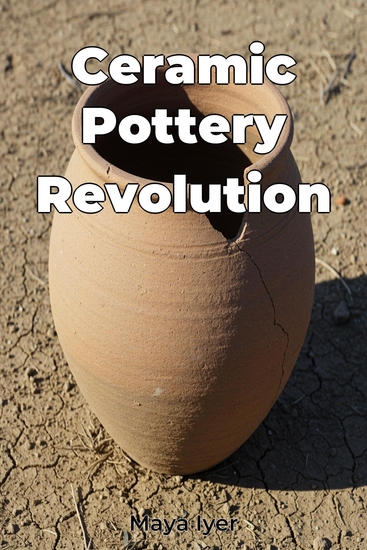
Ceramic Pottery Revolution - cover

Ceramic Pottery Revolution

Maya Iyer

Translator A AI

Publisher: Publifye

  • 0
  • 0
  • 0

Summary

Ceramic Pottery Revolution explores the transformative role of ceramic pottery in shaping ancient civilizations. More than just simple containers, these fired clay vessels revolutionized food storage, enabling settled agriculture and complex societies. The book reveals how pottery influenced cooking techniques, allowing for new methods that enhanced nutritional value. The study examines the evolution of ceramic technology, highlighting its impact on culinary practices, artistic expression, and cultural representation. By integrating archaeological discoveries, anthropological studies, and materials science, the book provides a rich understanding of pottery's multifaceted influence. For example, the aesthetic dimensions of ceramics offer invaluable insights into the beliefs and values of past civilizations through decoration and form. Beginning with the origins of pottery-making across different regions, the book progresses to detail its impact on food preparation, storage, and artistic symbolism. It concludes with an assessment of pottery's enduring legacy and its continued relevance today, making it a valuable resource for anyone interested in art, history, and ancient cultures.
Available since: 02/27/2025.
Print length: 62 pages.

Other books that might interest you

  • Deborah’s Letters To Barak - 28 Conversations - A Young Man's Rites Of Passage To Manhood - cover

    Deborah’s Letters To Barak - 28...

    Munenyashaishe Hove

    • 0
    • 0
    • 0
    Deborah’s Letters to Barak: 28 Conversations – A Young Man's Rites of Passage to Manhood 
    More than a book, Deborah’s Letters to Barak is a call to raise men of integrity, accountability, and purpose. Inspired by the biblical relationship between Deborah, a prophetess, and Barak, a leader called to rise, this book challenges young men to embrace true masculinity, break cycles of dysfunction, and reject toxic patterns—including those that fuel gender-based violence (GBV). 
    Through 28 transformative conversations, this book equips young men, empowers women to make informed choices, and helps communities reshape the narrative on manhood. It tackles leadership, emotional healing, father wounds, accountability, and generational impact, offering wisdom and practical guidance for personal transformation. 
    📖 Key Themes: 
     ✔ Redefining masculinity—balancing strength with responsibility and vulnerability. 
    ✔ Predator vs. Protector—raising men who safeguard, not exploit. 
    ✔ Healing from emotional wounds and fatherlessness—breaking cycles of dysfunction. 
    ✔ Discipleship and accountability—mentorship as a tool for character growth. 
    ✔ Empowering women with knowledge—helping them vet and support men of integrity. 
    ✔ Tackling GBV at the root—raising men who uplift and protect, not harm. 
    This book is for young men, parents, mentors, and women seeking to better understand men of character. It is a conversation starter for families, churches, and communities working to cultivate men who heal rather than harm.
    Show book
  • Popcorn Principles The: Triple Feature Box Set - Supersize Your Storytelling Skills with Three Essential Books - cover

    Popcorn Principles The: Triple...

    John Gaspard

    • 0
    • 0
    • 0
    Unleash your storytelling potential with "The Popcorn Principles: Triple Feature Box Set," a comprehensive guide for novel writers inspired by the magic of movies. This box set includes three indispensable books designed to elevate your fiction writing using principles gleaned from the world of filmmaking. 
    What's Inside: 
    1. The Popcorn Principles: A Novelist's Guide To Learning From Movies 
       - Discover 25 essential storytelling concepts from pre-production to distribution. 
       - Learn how to apply cinematic techniques to your novels, making your stories compelling and emotionally engaging. 
       - Includes practical homework and movie-watching assignments to deepen your understanding. 
    2. More Popcorn Principles: The Sequel! 
       - Dive deeper with additional principles that expand on the foundational techniques. 
       - Explore advanced storytelling methods to refine and enhance your writing craft. 
       - Gain insights from top filmmakers, screenwriters, and industry professionals. 
    3. The Popcorn Principles Strike Back: Interviews With Screenwriters Who Also Write Novels 
       - Hear from acclaimed filmmakers and screenwriters like Nicholas Meyer, Dennis Palumbo, Phoef Sutton, April Smith, Tom Straw and more. 
       - Learn how to adapt film industry secrets to your writing process. 
       - Access exclusive interviews and anecdotes that provide a unique perspective on storytelling.
    Show book
  • A Rare Recording of President John F Kennedy’s "Ich Bin Ein Berliner" Speech - cover

    A Rare Recording of President...

    President John F. Kennedy

    • 0
    • 0
    • 0
    President John F. Kennedy gave his "Ich bin ein Berliner" speech on June 26, 1963, in West Berlin. It is one of the best-known speeches of the Cold War, and among the most famous anti-communist speeches. Twenty-two months earlier, East Germany had erected the Berlin Wall to prevent mass emigration to West Berlin. The speech was aimed as much at the Soviet Union as it was at West Berliners. The speech is considered one of Kennedy's finest, delivered at the height of the Cold War and the New Frontier. It was a great morale boost for West Berliners, who lived in an enclave deep inside East Germany and feared a possible East German occupation. 
     
    President John Fitzgerald Kennedy (May 29, 1917 - November 22, 1963), often referred to by his initials JFK, was an American politician who served as the 35th president of the United States from 1961 until his assassination in 1963. He was the youngest person to assume the presidency by election and the youngest president at the end of his tenure. Kennedy served at the climax of the Cold War, and the majority of his foreign policy concerned relations with the Soviet Union and Cuba. A Democrat, Kennedy represented Massachusetts in both houses of the U.S. Congress prior to his presidency.
    Show book
  • Ink Sketches for Wellness - Poems on My Life with Invisible Disabilities - cover

    Ink Sketches for Wellness -...

    Susan Montgomery

    • 0
    • 0
    • 0
    Noisy eyeballs, fatigue, brain fog, digestive distress... symptoms and conditions that no one can see. 
    Do chronic health conditions have you living in a dark place? 
    The poems within tell a story of anger, struggle, sadness, and hope. 
    Susan paints a picture of her life with chronic medical conditions and invisible disabilities that will take you on a wild journey. Dark humor, creative rhyming, repetition, and rhythm are combined to create expressive verses. 
    Imagine being able to "fix" yourself with twine or silly putty. Picture what your confused brain looks like with bandages and scuff marks. Laughter and silliness have helped Susan get through some of her most difficult times. She explores everything from her rare ear condition to her autoimmune disease. 
    It is her hope that readers will see that humor can be found in the darkest of places, situations, and feelings. She shows that even with challenges and struggles, it is possible to find a path to wellness, whatever that may look like…You may just have to sketch your way there.
    Show book
  • Jewish Ethics - The Basics - cover

    Jewish Ethics - The Basics

    Geoffrey D. Claussen

    • 0
    • 0
    • 0
    Jewish Ethics: The Basics demonstrates how ancient and contemporary ideas have shaped and reshaped Jewish traditions about how to act toward others. Listeners are introduced to foundational questions, controversies, and diverse ethical conclusions developed by Jewish thinkers throughout the ages. Topics addressed include: assumptions about authority; love, compassion, justice, and humility; human rights, war, land, and power; gender and sexuality; personal and social ethics; environmental and animal Ethics; and bioethical issues. 


    Concise and engaging, this is the ideal introduction for anyone interested in religious ethics, secular traditions, Judaism, and the field of Jewish ethics.
    Show book
  • Race to Mars The: The History of the American and Soviet Attempts to Land on the Red Planet - cover

    Race to Mars The: The History of...

    Charles River Editors

    • 0
    • 0
    • 0
    In 1960, when Eisenhower’s administration began planning and funding for the famous Apollo program that would land the first men on the Moon in 1969, the Soviet Union was already thinking further ahead, literally. In one of the worst kept secrets of the Space Race, the Soviet Union launched two probes, Korabl 4 and Korabl 5, toward Mars in October 1960. Meanwhile, throughout the 1960s, NASA would spend tens of billions on missions to the Moon, the most expensive peacetime program in American history to that point, and Apollo was only made possible by the tests conducted through earlier missions, including the historic Ranger Program.  
    	When the Soviet Union attempted to launch probes to Mars in 1960, the goals were considerably less ambitious than saying hello to little green men. Those first two probes were intended merely to fly by Mars and transmit photos of the planet. In addition to getting closer looks at the Red Planet than ever before, the true value of those 1960 missions was the propaganda victory the Soviets hoped to score, obtaining yet another notch in their Space Race belt. Though the Soviets’ missions failed that year, they were still years ahead of the United States.  
    	In November 1971, NASA’s Mariner 9 became the first spacecraft to enter Mars’ orbit, but the Soviets’ Mars 2 and Mars 3 spacecrafts were hot on its heels. Mariner 9 was designed to orbit around Mars, but the Soviets’ spacecrafts had descent modules designed to actually land on the Red Planet’s surface. The descent module aboard Mars 2 crash landed on Mars’ surface on November 27, but less than a week later, Mars 3’s descent module began its historic descent down to the surface. On December 2, 1971, after a few hours of descending, it successfully completed its “soft landing.”
    Show book