

¡Acompáñanos a viajar por el mundo de los libros!
Añadir este libro a la estantería
Grey
Escribe un nuevo comentario Default profile 50px
Grey
Suscríbete para leer el libro completo o lee las primeras páginas gratis.
All characters reduced
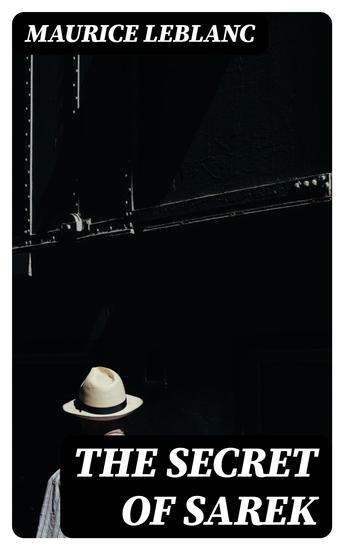
The Secret of Sarek - cover

The Secret of Sarek

Maurice Leblanc

Traductor Alexander Teixeira de Mattos

Editorial: DigiCat

  • 0
  • 0
  • 0

Sinopsis

In "The Secret of Sarek," Maurice Leblanc masterfully blends intricate plotting with a suspenseful narrative that delves into the world of mystery and adventure. This novella features the enigmatic gentleman thief Arsène Lupin as he grapples with a hidden treasure tied to a centuries-old secret. Leblanc's literary style is marked by his wit and sharp characterization, capturing the essence of early 20th-century France while intertwining elements of detective fiction and the fantastique. Through vivid descriptions and clever dialogues, readers are drawn into a labyrinthine plot that keeps them guessing until the very end. Maurice Leblanc, a seminal figure in the mystery genre, created the iconic character of Arsène Lupin inspired by his fascination with the duality of human nature—both criminal and noble. His background as a journalist has equipped him with the skills to weave compelling narratives that reflect both societal norms and the twisting paths of morality. Leblanc's own experiences in Belle Époque France—marked by contrasts between wealth and poverty—profoundly influenced his storytelling, making his works resonate with universal themes. Readers who appreciate richly crafted mysteries and character-driven plots will find "The Secret of Sarek" to be an engaging and thought-provoking read. As they traverse the twists and turns alongside Lupin, they will encounter not only an intricate mystery but also existential themes about identity and morality. This novella is essential for those interested in the evolution of detective fiction and character archetypes in literature.
Disponible desde: 01/08/2022.
Longitud de impresión: 226 páginas.

Otros libros que te pueden interesar

  • Gone Astray - cover

    Gone Astray

    Anton Chekhov

    • 0
    • 0
    • 0
    "Gone Astray" is one of Chekhov's earlier comedic short stories that is a light-hearted romp about two drunken lawyers trying to find their way home at night. Chekhov's masterful use of irony is present here as one of the lawyers, Kozyavkin, accidentally violates the law by breaking into a house he believes to be his own.
    Ver libro
  • master of ballantrae The: A winter's tale - cover

    master of ballantrae The: A...

    Robert Stevenson

    • 0
    • 0
    • 0
    "The Master of Ballantrae: A Winter's Tale" is a novel written by Robert Louis Stevenson. The book was first published in 1889 and is set in the aftermath of the Jacobite rising of 1745 in Scotland. It tells the story of two brothers, James Durie and Henry Durie, who are on opposite sides of the conflict. The novel explores themes of loyalty, betrayal, and the consequences of political and personal choices. The narrative is framed as a mystery, as it follows the fate of the two brothers and their conflicting paths. The Master of Ballantrae, James Durie, is a complex and enigmatic character whose actions and decisions drive the plot forward. The story is rich in historical and atmospheric details, capturing the rugged landscapes of Scotland and the tumultuous period in which it is set.
    Ver libro
  • The Horse Dealer's Daughter - Poignant story exploring death and its effects by the author of Sons And Lovers - cover

    The Horse Dealer's Daughter -...

    D H Lawrence

    • 0
    • 0
    • 0
    David Herbert Lawrence was born on the 11th September 1885 in Eastwood, Nottinghamshire, a coal mining town where the reality of a harsh life was only useful as experiences for future literary works. 
     
    He was educated at Beauvale Board School and became the first local boy to receive a scholarship to attend Nottingham High School. After 3 years he became a junior clerk in Haywood’s surgical appliances factory. He was also attempting a literary career which, in the short term, led to a teacher training position in Eastwood and later a teaching qualification from University College, Nottingham.  
     
    Lawrence’s first efforts were poems, short stories and a draft of ‘The White Peacock’. Moving to London and a teaching position in Croydon his writing attracted the attention of Ford Madox Ford, editor of The English Review, and he commissioned him to write ‘Odour of Chrysanthemums’.  
     
    Wanting to write full-time he now began work on what would become ‘Sons and Lovers.   
     
    In 1912 he met the older and married mother-of-three Frieda Weekley. They eloped to Germany and here Lawrence could see for himself the growing tensions with France.  So keen was his interest that he was arrested and accused of being a British spy.  
     
    In early 1914 Frieda obtained her divorce and they returned to Britain to be married just days before the outbreak of war. Owing to her German parentage, and his own public dislike of militarism and violence, the couple were treated with contempt and suspicion throughout the war years.  
     
    Despite this he continued to write but his reputation in England was so tarnished and, mirrored by his own disdain for the country, he and Frieda left England in November 1919, first for Europe and then America via Ceylon and Australia. 
     
    They bought a ranch in Taos, New Mexico and visited Mexico several times. The third visit in March 1925 caused a near fatal attack of malaria. To convalesce they moved to Florence. Here he continued work on ‘Lady Chatterley’s Lover’ which for many years would cause controversy. A renewed interest in oil painting resulted in an exhibition in 1929 which was raided by the police and several works were confiscated.  
     
    D H Lawrence died of complications arising from a bout of tuberculosis on the 2nd of March 1930 in Vence, France.  He was 44. 
     
    In ‘The Horse Dealers daughter’ a young woman begins a relationship with a young doctor and a friend of her brothers.  What should be straight forward is intimately investigated by Lawrence’s foraging pen.
    Ver libro
  • Troilus and Cressida - cover

    Troilus and Cressida

    William Shakespeare

    • 0
    • 0
    • 0
    Troilus and Cressida is a tragedy by William Shakespeare, believed to have been written in 1602. It was described by Frederick S. Boas as one of Shakespeare's problem plays. The play ends on a very bleak note with the death of the noble Trojan Hector and destruction of the love between Troilus and Cressida. The work has in recent years "stimulated exceptionally lively critical debate".
    Throughout the play, the tone lurches wildly between bawdy comedy and tragic gloom, and readers and theatre-goers have frequently found it difficult to understand how one is meant to respond to the characters. Several characteristic elements of the play (the most notable being its constant questioning of intrinsic values such as hierarchy, honour and love) have often been viewed as distinctly "modern". 
    Among the most significant works William Shakespeare: Hamlet, Othello, King Lear, Macbeth, Orpheus, Romeo and Juliet, Julius Caesar, Troilus and Cressida, The Tempest, Venus and Adonis, Antony and Cleopatra, Measure for Measure, The Winter's Tale and many more.
    Ver libro
  • Metamorphoses - cover

    Metamorphoses

    Publius Ovidius Naso

    • 0
    • 0
    • 0
    Ovid's Metamorphoses is an epic poem written in Latin, composed of fifteen books, which explores the theme of transformation and change. The narrative follows a chronological order, beginning with the world's creation and ending with the reign of Julius Caesar. Ovid retells traditional Greek and Roman myths, focusing on the transformations of gods, heroes, and mortals as they undergo physical, emotional, and psychological changes that reflect the complexities of the human experience. Some of the most famous stories in the Metamorphoses include the tales of Apollo and Daphne, Pyramus and Thisbe, Narcissus and Echo, and the fall of Icarus.
    While modern scholars consider this epic poem to be Ovid's magnum opus, the work was not well received by its contemporaries; the Roman emperor Augustus went so far as to exile Ovid and ban his books from Rome's libraries. Today, this work is considered one of the most influential works in Western culture and has inspired countless authors like Shakespeare, Chaucer, and Dante.
    Ver libro
  • The Most Dangerous Game - cover

    The Most Dangerous Game

    Richard Connell

    • 0
    • 0
    • 0
    "The Most Dangerous Game" by Richard Connell is a gripping adventure thriller that explores the fine line between hunter and hunted. The story follows Sanger Rainsford, a seasoned big-game hunter who, after falling overboard from a yacht, washes up on a mysterious island. There, he encounters General Zaroff, an aristocratic hunter with a sinister passion—hunting humans for sport. As Rainsford becomes the next target in Zaroff’s deadly game, he must rely on his wits, survival skills, and sheer determination to outmaneuver his ruthless pursuer. This timeless tale of suspense, morality, and survival will keep listeners on the edge of their seats until the very last moment. 
    Cover photo by Ntsikelelo Radebe: https://www.pexels.com/photo/a-silhouette-of-a-wine-in-a-glass-and-bottle-11357544/
    Ver libro
