¡Acompáñanos a viajar por el mundo de los libros!
Añadir este libro a la estantería
Grey
Escribe un nuevo comentario Default profile 50px
Grey
Suscríbete para leer el libro completo o lee las primeras páginas gratis.
All characters reduced
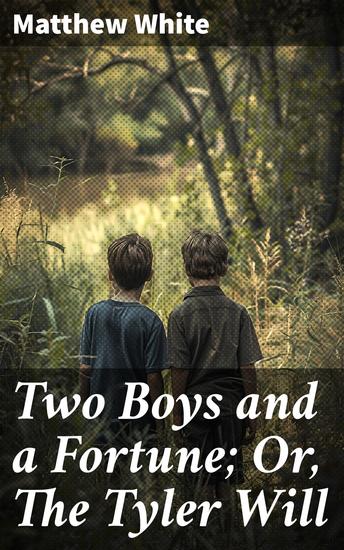
Two Boys and a Fortune; Or The Tyler Will - A Tale of Hidden Wealth and Betrayal - cover

Two Boys and a Fortune; Or The Tyler Will - A Tale of Hidden Wealth and Betrayal

Matthew White

Editorial: Good Press

  • 0
  • 0
  • 0

Sinopsis

In "Two Boys and a Fortune; Or, The Tyler Will," Matthew White crafts a compelling narrative that intertwines themes of ambition, morality, and the intricacies of familial relationships. Set against a backdrop of societal transitions, the novel employs a vivid, accessible literary style replete with sharp dialogue and rich descriptive passages. White's storytelling deftly navigates the complexities of inheritance and the moral dilemmas it evokes, as two boys grapple with an unexpected fortune and its implications on their lives and ethics. The book artfully aligns with the literary traditions of American realism, exploring how wealth can shape character and destiny. Matthew White, a keen observer of human nature and a writer influenced by the socio-economic nuances of his time, imbues this tale with authentic emotional resonance. His experiences and insights into the concept of wealth, particularly its transformative power and potential pitfalls, enrich the narrative. White's background in literature and his understanding of early American societal norms inform his character development and plot structure, allowing for a profound exploration of personal integrity amid temptation. Readers seeking a thought-provoking and engaging tale will find "Two Boys and a Fortune" an enlightening journey. This novel is a rich exploration of youth, greed, and the quest for identity, making it essential reading for those interested in moral complexities and the human condition.
Disponible desde: 12/10/2023.
Longitud de impresión: 131 páginas.
Otros libros que te pueden interesar

  • Wapping Workhouse (Unabridged) - cover

    Wapping Workhouse (Unabridged)

    Charles Dickens

    • 0
    • 0
    • 0
    Charles Dickens was a writer and social critic who created some of the world's best-known fictional characters and is regarded as the greatest novelist of the Victorian era. His works enjoyed unprecedented popularity during his lifetime, and by the twentieth century critics and scholars had recognised him as a literary genius. His novels and short stories enjoy lasting popularity.
    WAPPING WORKHOUSE: My day's no-business beckoning me to the East-end of London, I had turned my face to that point of the metropolitan compass on leaving Covent-garden, and had got past the India House, thinking in my idle manner of Tippoo-Sahib and Charles Lamb, and had got past my little wooden midshipman.
    Ver libro
  • Notes From The Underground - The Classic Tale - cover

    Notes From The Underground - The...

    Fyodor Dostoevsky

    • 0
    • 0
    • 0
    Notes from Underground is an 1864 novella by Fyodor Dostoyevsky. Notes is considered by many to be the first existentialist novel. It presents itself as an excerpt from the rambling memoirs of a bitter, isolated, unnamed narrator (generally referred to by critics as the Underground Man) who is a retired civil servant living in St. Petersburg. The first part of the story is told in monologue form or the underground man's diary, and attacks emerging Western philosophy, especially Nikolay Chernyshevsky's What Is to Be Done?. The second part of the book is called "Àpropos of the Wet Snow," and describes certain events that, it seems, are destroying and sometimes renewing the underground man, who acts as a first person, unreliable narrator. 
     
    Fyodor Mikhailovich Dostoevsky was a Russian novelist, short story writer, essayist, and journalist. His literary works explore human psychology in the troubled political, social, and spiritual atmospheres of 19th-century Russia, and engage with a variety of philosophical and religious themes. His most acclaimed novels include Crime and Punishment (1866), The Idiot (1869), Demons (1872), and The Brothers Karamazov (1880). 
     
    Many literary critics rate him as one of the greatest novelists in all of world literature, as multiple of his works are considered highly influential masterpieces.
    Ver libro
  • The Eye of the Camera - From their pens to your ears genius in every story - cover

    The Eye of the Camera - From...

    Fred M White

    • 0
    • 0
    • 0
    Richard Bernard Heldmann was born on 12th October 1857, in St Johns Wood, North London.  
    By his early 20’s Heldmann began publishing fiction for the myriad magazine publications that had sprung up and were eager for good well-written content.  
    In October 1882, Heldmann was promoted to co-editor of Union Jack, a popular magazine, but his association with the publication ended suddenly in June 1883.  It appears Heldman was prone to issuing forged cheques to finance his lifestyle.  In April 1884 he was sentenced to 18 months hard labour. 
    In order to be well away from the scandal and the damage that this had caused to his reputation Heldmann adopted a pseudonym on his release from jail.  Shortly thereafter the name ‘Richard Marsh’ began to appear in the literary periodicals.  The use of his mother’s maiden name as part of it seems both a release and a lifeline. 
    A stroke of very good fortune arrived with his novel ‘The Beetle’ published in 1897.  This would turn out to be his greatest commercial success and added some much-needed gravitas to his literary reputation.   
    Marsh was a prolific writer and wrote almost 80 volumes of fiction as well as many short stories, across many genres from horror and crime to romance and humour.   His unusual characters, plotting devices and other literary developments have identified his legacy as one of the best British writers of his time.   
    Richard Marsh died from heart disease in Haywards Heath in Sussex on 9th August 1915.  He was 57.
    Ver libro
  • A Cullenden of Virginia - From their pens to your ears genius in every story - cover

    A Cullenden of Virginia - From...

    Thomas Wolf

    • 0
    • 0
    • 0
    Thomas Clayton Wolfe was born at the family home, 92 Woodfin Street, in Asheville, North Carolina on October 3rd, 1900.  
    Aged 15, Wolfe began his studies at the University of North Carolina at Chapel Hill (UNC) where he enrolled in a playwriting course. Wolfe graduated in 1920 and enrolled at the Graduate School for Arts and Sciences at Harvard. Here he studied playwriting under the tutelage of George Pierce Baker. In 1922 he received his master's degree from Harvard.  
    Wolfe now began the transition from studying to commercial playwright. He went to New York in November, 1923 trying to sell his plays to Broadway.  The Theatre Guild came close to producing Welcome to Our City but in the end declined.  Wolfe now believed his style of writing was more suited to fiction.  Grasping the opportunity this afforded him he sailed to England in October 1924 to write and from there on to France, Italy and Switzerland. 
    In 1926 Wolfe began writing a novel, O Lost. This would eventually become Look Homeward, Angel. It was based on his years in Asheville. The original manuscript of O Lost was over 1100 pages. Maxwell Perkins, one of the great book editors of the age, worked at his publishers, Scribner’s and he began to focus the book, cutting and re-shaping it to center it on the character of Eugene.   
    The novel was published in 1929. It was a success.   
    Wolfe now committed the next 4 years to writing a multi-volume epic entitled The October Fair.  At Scribner’s Perkins once more decided to edit it down to a single volume; Of Time and the River.  It was even more successful than his first. It was hailed as the literary event of 1935 and cemented his reputation as one of America’s foremost novelists.  
    In 1938, after submitting his new opus, which ran to an incredible one million words, to his new editor, Edward Aswell, Wolfe left to tour the West, a part of the country he had never before visited. Whilst travelling Wolfe became ill with pneumonia and spent three weeks in a Seattle hospital. Complications arose. The prognosis was serious.  He was diagnosed with miliary tuberculosis of the brain. 
    On September 6th, he was sent to Baltimore's Johns Hopkins Hospital for treatment. The ensuing operation revealed that the disease had overrun the entire right side of his brain.  
    Thomas Clayton Wolfe never regained consciousness and died shortly before his 38th birthday on September 15th, 1938.
    Ver libro
  • Her First Ball - cover

    Her First Ball

    Katherine Mansfield

    • 0
    • 0
    • 0
    "Her First Ball" is a 1921 short story by Katherine Mansfield. It was first published in The Sphere on 28 November 1921, and later reprinted in The Garden Party and Other Stories.
    A young girl called Leila has come to the city to stay with her cousins. They are going to a ball. Leila is very excited: this is her first ball. Once there, she is both excited and terrified. After dancing with several young boys her own age, she dances with a wrinkly balding man who has been coming to balls for a while. This spoils her mood until she dances with a good looking young gentleman where her worries disappear.
    Ver libro
  • Tom Jones - cover

    Tom Jones

    Henry Fielding

    • 0
    • 0
    • 0
    "Tom Jones" is a classic novel by Henry Fielding, published in 1749. Officially titled "The History of Tom Jones, a Foundling," it is a comic novel that follows the life and adventures of the title character, Tom Jones, from his birth to his eventual marriage. The story unfolds in the context of Fielding's satire of 18th-century British society, manners, and morality. It is known for its vibrant characters, intricate plot, and the author's direct engagement with the reader, which was innovative for its time.
    Ver libro